
How we made this guide: picks, prices and specs come from our catalog and the makers' published specs, owner quotes come from customer reviews on our product pages and every guide is checked and edited by Trevor Hall.
Control indoor construction dust in four moves: seal the area, hold negative air, capture dust at the tool and clean the exit path with a HEPA vacuum and a damp wipe. For one room, the Abatement Technologies BULLDOG BD2KMA at $1,345 and the Dapper Supply 10-gallon dust extractor at $459.95 make a starter set under $2,000 at today's prices. To spend less on the air side, the Aerospace America Econo 9143 is $1,015.
Quick answer
Seal it, pull it, catch it, clean it. Browse our negative air machines, air scrubbers, HEPA vacuums and dust extractors. We sell no zip poles, poly sheeting or sticky mats, so buy those from a building supply source.
Why a renovation changes the dust plan
Outdoor site dust is handled with water cannons, sprayers and haul-road control. An indoor renovation or an occupied-building job is a different problem. The dust has nowhere to go but into the rest of the building, through doors, returns and gaps around the barrier. The goal is not a clean room while you work. The goal is to keep dust inside the work area and to remove it before it travels.
That is why the plan has four moves in a fixed order. Containment gives the dust a boundary. Negative pressure makes any leak flow inward. Source capture keeps the load on the air low. Final cleaning stops the dust that settled from walking out on boots and carts. Skip a move and the others work harder for less.
The four moves
1. Seal the work area
Close the room with poly sheeting on zip poles or a hard barrier, with a zip door on the way in and out. Isolate the HVAC zone that serves the work area and seal its supply and return vents. Change the system filters when the job ends. For short tasks in an occupied building, such as opening a ceiling tile or a wall, a portable containment unit encloses just the work zone: it sets up in minutes and can be reused. For healthcare and other infection-control jobs the barrier is set by the risk assessment, covered in our post on what ICRA is.
2. Hold the area under negative pressure
A HEPA negative air machine pulls air out of the work area through its filters and sends it outside through ducting. Air then leaks in through the cracks instead of out. Exhaust the machine outdoors where you can. If you must exhaust back into the building, the HEPA filter is what stands between the dust and the occupied space. Our post on negative pressure rooms covers pressure targets and monitoring, and the post on air scrubbers versus negative air machines explains how the same box is set up two ways.
3. Capture dust at the source
Connect a HEPA vacuum or dust extractor to the tool that makes the dust, or run a backpack vacuum for demolition cleanup. Dust caught at the cut never reaches the air, so the negative air machine and its filters last longer. Do not use compressed air or dry sweeping to clean up (OSHA's housekeeping rule is below). Both throw the finest dust back into the air.
4. Clean the exit path and the final surfaces
Work from the top down. HEPA vacuum ledges, walls, vents and trim, then the floor, then wipe with a damp cloth. On hard floors, HEPA vacuum first and mop second; a wet mop on loose dust turns it to paste in grout lines and textured finishes. On carpet and upholstery, HEPA vacuum slowly in overlapping passes, then extract if fine dust remains (see how to use a carpet cleaning machine). Keep the machine running through cleanup and the final wipe-down, then check the filters. Our post on cleaning a vacuum filter covers the maintenance side. The post-construction cleaning checklist has the room-by-room sequence.
What OSHA says about silica dust
If the dust comes from cutting, grinding or demolishing concrete, brick, block or stone, the OSHA respirable crystalline silica standard for construction (29 CFR 1926.1153) applies. OSHA's page explains that an employer can follow the controls listed in Table 1 or measure exposures and choose its own controls to limit exposure to the permissible exposure limit. It gives water on a saw blade as an example of a control that substantially reduces dust, and it says employers must restrict housekeeping practices that expose workers to silica where feasible alternatives exist. The housekeeping rule bars dry sweeping and dry brushing where they could add to exposure, unless wet sweeping, HEPA-filtered vacuuming or another low-dust method is not feasible. It bars compressed air for cleaning unless a ventilation system captures the dust cloud or no alternative is feasible. For tools such as drills and tuckpointing grinders, Table 1 asks for a dust collector with a filter of 99% or greater efficiency and a filter-cleaning mechanism; check those figures with the maker of any extractor you plan to use.
OSHA's page does not name our vacuums, and we do not say any machine here satisfies Table 1. Read the standard for the exact vacuum and filter requirements on your task, and check with the maker before you rely on a machine for compliance. Silica work needs its own plan; the equipment below is for dust control, not a compliance guarantee.
Lead paint: if paid work disturbs painted surfaces in a home, child care facility or preschool built before 1978, the EPA Renovation, Repair and Painting (RRP) rule applies and the contractor must be EPA certified. Check that rule before you sand or demolish. Our post on lead abatement and lead-safe work covers it. Asbestos is outside this guide.
Construction cleanup equipment by job size
Rough set costs at today's prices, before the poly, tape, zip doors and ducting you buy elsewhere.
| Job | Containment | Negative air | Source capture | Rough set cost |
|---|---|---|---|---|
| One room | Poly and tape | BULLDOG BD2KMA | Dapper 10-gallon extractor | Under $2,000 |
| A suite | Poly or hard barrier walls, plus an ECU4 for above-ceiling or wall access | BULLDOG BD2KMA or Econo 9143 | Dapper extractor and Mosquito backpack | About $6,000 |
| A floor | Barrier walls, with ECU4 units for above-ceiling work and entries | Two or more BD2KMA or Econo 9143 machines | A Dapper extractor per crew, a Mosquito backpack for cleanup | Over $6,500 |
Sizing check, our calculation: air changes per hour = CFM x 60 divided by the room volume in cubic feet. Take a 10 x 14 ft space under a 9 ft ceiling, which holds 1,260 cubic feet. The Econo 9143 on low (rated 1,300 CFM at 1.9 inches of static pressure) gives 1,300 x 60 / 1,260, about 62 changes an hour. Long ducts and loaded filters cut delivered airflow, so treat the rating as a ceiling.
How we picked
These six come from our catalog of air scrubbers, containment and vacuums. We chose three negative air machines in the 1,800 to 2,000 CFM class, a containment unit, a dust extractor and a backpack vacuum, using the maker specs on each product page. MCS did not test these machines. None of the six has owner reviews on our product pages yet, so the notes below rest on the makers' specs.
Comparison of the six
| Machine | Role | Price | Key spec | Weight |
|---|---|---|---|---|
| Abatement Technologies BULLDOG BD2KMA | Negative air | $1,345 | 2,000 CFM high, 1,300 CFM low; 10 A | 117 lb with filters |
| Aerospace America Econo 9143 | Negative air | $1,015 | 1,950 CFM high, 1,300 CFM low at 1.9 in running static pressure; 9.4 A | 106 lb |
| XPOWER AP-2500D | Negative air or air filtration | $2,386 | Rated 1,800 CFM; 8 A; PM2.5 sensor | 95.1 lb |
| HEPACART ECU4 | Containment | $3,695 (modular assembly) | 7 ft to 10 ft 6 in height range | 62 lb working |
| Dapper Supply 10-gallon extractor | Source capture | $459.95 | 151 CFM; automatic filter cleaning | |
| Mosquito HEPA backpack, 10 quart | Cleanup | from $522 | 10.7 A; 129 CFM listed |
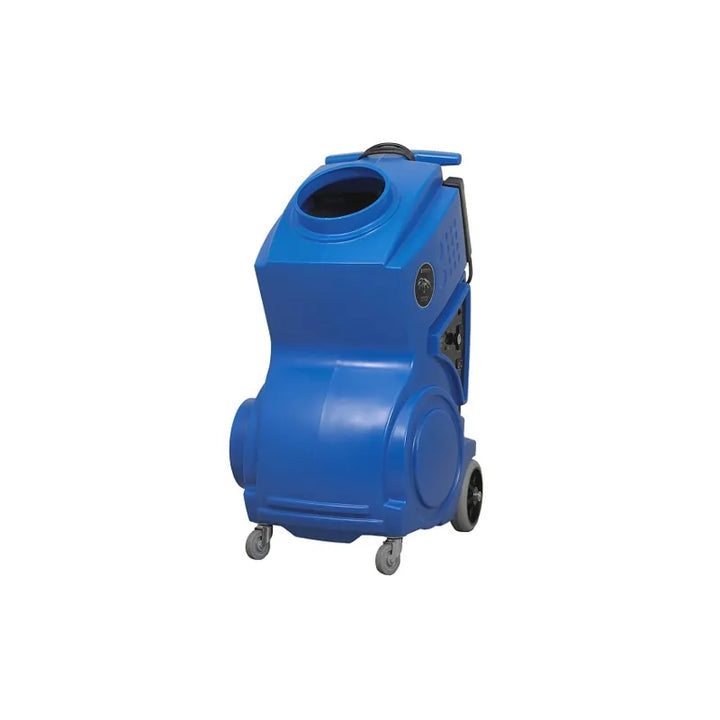
Negative air for most rooms: Abatement Technologies BULLDOG BD2KMA

Negative air for a room or suite
Abatement Technologies BULLDOG Series Deluxe Model Negative Air Machine BD2KMA
$1,345
A rotomolded housing, a pressure gauge and an audible filter alarm.
The BD2KMA carries a maker airflow rating of 2,000 CFM (high) and 1,300 CFM (low), draws 10 A and weighs 117 lb with its filters. The listed spec is a 24 x 24 x 6 inch HEPA filter rated 99.97% at 0.3 microns, behind a polypad and a 2 inch pleated pre-filter. The cabinet is flame-retardant resin, and the machine has an audible filter alarm and four casters, two of them locking.

Pros
- 10 A operating draw on a standard 120 V, 15 A circuit
- Drop-in access door for pre-filter changes
- Optional final-stage 12 inch HEPA filter listed
Cons
- 117 lb needs two people on stairs
- Airflow is a maker rating, not what you get through long ducting
Skip it if the job is a single small room and you only need to filter air, or if you need to move it up several flights alone.
Negative air with the pressure condition stated: Aerospace America Econo 9143

Negative air with a stated static pressure
Aerospace America Aeroclean ECONO 9143 1950 CFM HEPA Air Scrubber
$1,015
Airflow is rated at 1.9 inches of static pressure, in the clean-filter range Aerospace's manual gives.
The Econo 9143 is rated at 1,950 CFM on high and 1,300 CFM on low at 1.9 inches of running static pressure. That condition matters, because airflow drops as ducting and loaded filters add resistance. It draws 9.4 running amps, weighs 106 lb and has a 12 inch exhaust, a differential pressure gauge, a push-button circuit breaker and a two-speed switch. Filters are a 24 inch pre-filter, ring panel and HEPA filter.
Pros
- Rated airflow comes with its test condition
- Lighter than the BD2KMA at 106 lb
- Filter gauge on the panel; Aerospace's manual says clean filters read 1.8 to 2.2 inches of water and not to run the unit past 3.0
- DOP tested at the factory
Cons
- No locking casters listed (2 swivel, 2 rigid)
- No on-board alarm listed in the specs
Skip it if you want the filter alarm and the molded housing of the Abatement machine.
Occupied buildings, variable speed and a particle sensor: XPOWER AP-2500D

Variable speed and a sensor
$2,386
DC motor with a PM2.5 sensor for monitoring while you work.
The AP-2500D is rated at 1,800 CFM, draws 8 A and has variable speed from 500 to 1,700 RPM. It weighs 95.1 lb, has a 25 ft cord, a 12 inch duct size and a stackable housing. A PM2.5 sensor reads fine particles in the air, which is useful to watch while demolition is under way, though it is not a clearance test.

Pros
- Draws 8 A, less than the other two negative air machines here
- Variable speed lets you trim airflow to the job
- Lightest of the three
Cons
- Priced above the others in this guide
- The rated CFM does not state a test condition on our page
- Lowest rated airflow of the three negative air machines here
Skip it if a single small room is the whole job and a lower-priced machine will do.
Portable containment: HEPACART ECU4 modular unit

Containment you can reuse
ECU4 Modular Containment Unit with Collapsible Frame
$3,695
Frame plus reusable envelope with a negative air port and a vacuum port.
The ECU4 is a collapsible aluminum frame with a rip-stop poly envelope, flame-rated to ASTM E 84. It adjusts from 7 ft to 10 ft 6 in, collapses to 12 x 66 x 12 inches and has a working weight of 62 lb. Its deployed footprint is 31.31 x 61 inches, so it encloses a small work zone, not a whole room. HEPACART's brochure lists ceiling containment, wall access and corridor or threshold airlocks among its uses. It has a 12.5 inch negative air duct port, a 3.5 inch utility and HEPA vacuum port, two narrow doors and two cargo doors. HEPACART lists the ECU4 for ICRA levels I to V. The price shown is the full modular assembly of frame and envelope; the frame alone and the envelope alone are priced separately on the product page.

The ECU4 does not include a negative air machine. Pair it with one of the machines above.
Pros
- Collapses to fit through a standard doorway
- Integrated wheels and a ceiling seal
- Ante room assembly option for a controlled entry
Cons
- Priced well above poly sheeting for one room
- Generation 4 parts do not fit older frames

Skip it if the job is a one-off in an odd-shaped space where poly on a frame costs less.
Dust capture at the tool: Dapper Supply 10-gallon dust extractor

Source capture on a budget
Dapper Supply 10-Gallon Wet/Dry Dust Extractor, 151 CFM, Auto HEPA Filter
$459.95
Tool auto-start and an automatic filter cleaning cycle for sanders and saws.
This extractor is rated at 151 CFM with 23 kPa of suction in a 10 gallon tank. Its filter cleans automatically every 20 seconds, and tool auto-start works with tools up to 5.5 A. It has a built-in pneumatic port, overload protection and a dust indicator. The hose is 7.5 ft and the cord 13 ft, and the listing gives a two-year parts and labor warranty.

Pros
- Auto-start turns it on with the tool
- Automatic filter cleaning keeps suction steady
- Low price for a dedicated extractor
Cons
- Short 13 ft cord
- A 10 gallon tank fills fast on drywall sanding
Skip it if you need a rated HEPA vacuum for a specific regulated task; check the maker's documentation for that.
Cleanup and demolition: Mosquito HEPA construction backpack

Backpack for cleanup
Mosquito HEPA Construction Backpack Vacuum 10 Quart
From $522
Three motor options in a 10 quart backpack.
The 10 quart Mosquito comes with a Super, Pulse Power or Construction motor and three lid and hose options. The listed specs are 10.7 A, 1,171 W, 66 dB, 129 CFM and a lift of 115. The listing gives the body a lifetime warranty and covers the motor, pigtail and switch for 7 years. Ask Mosquito which motor suits a tool hookup before you order.
Pros
- Carried on the back, so it goes up ladders and stairs
- Choice of motors by task
- Long motor warranty as listed
Cons
- 10 quart canister fills quickly on heavy dust
- The price varies by motor and hose option
Skip it if the main job is large floor areas, where a wide floor vacuum covers more ground. See our backpack vacuum guide for the wider range.
Setup tips
- Place the negative air machine at the far end of the work area from the entry door, so make-up air comes in at the door and sweeps across the work toward the machine.
- Keep the duct as short and straight as you can. Every bend and extra foot of duct adds resistance and lowers delivered airflow.
- Check that the door flap pulls inward when the machine runs. The gauge on a negative air machine reads its own filter loading, not the room, so confirm containment pressure with a room pressure monitor such as the Abatement Technologies RPM-RT1.
- Change the pre-filter often and the HEPA filter on the maker's schedule. Our HEPA filter explainer covers ratings and seals.
- Bag debris inside the area before you carry it out, and wipe tool wheels and boots at the exit.
- Aerospace America's manual calls for 12-gauge or heavier extension cords of 100 ft or less for 1 HP units, each machine plugged straight into the power source, and a new HEPA filter about every 350 hours.
For a machine comparison across more air scrubbers, see air scrubbers for mold remediation and what an air scrubber is.
Frequently asked questions
How can construction dust be controlled?
Seal the work area, hold it under negative pressure with a HEPA negative air machine exhausted outside, capture dust at the tool with a HEPA vacuum or extractor and finish with HEPA vacuuming and damp wiping. Each step covers a gap in the others.
What does "dust control" mean on a construction site?
It means keeping dust from leaving the work area and from reaching workers and building occupants. Outdoors that often means water or covers. Indoors it means containment, negative air and source capture.
What are the OSHA regulations for dust control?
For silica-containing material, the respirable crystalline silica standard for construction (29 CFR 1926.1153) applies. OSHA's page says employers can use the Table 1 controls or measure exposure and choose their own, and must restrict housekeeping practices that expose workers where feasible alternatives exist. The permissible exposure limit is 50 micrograms of respirable crystalline silica per cubic meter of air, averaged over an 8-hour day.
What is the OSHA limit for dust exposure?
For respirable crystalline silica in construction, OSHA's permissible exposure limit is 50 micrograms per cubic meter of air as an 8-hour time-weighted average, and the action level is 25 (29 CFR 1926.1153). Other dusts have their own limits, so check the material's safety data sheet.
How do you control dust on a construction site indoors?
Use a barrier with a door, a negative air machine with ducting to the outside, a dust extractor on dust-making tools and a HEPA vacuum for cleanup. Keep doors shut and vents sealed.
How do you get rid of construction dust after the job?
Run the negative air machine through cleanup. HEPA vacuum from the top down, replace or clean filters on returns, then wipe surfaces with a damp cloth. HEPA vacuum floors before you mop them.
How long does it take for dust to settle after renovation?
Coarse dust drops in minutes, but the finest dust can stay airborne for hours after the work stops. Keep the air machine running through cleanup, wipe surfaces the next day, then wipe them again.
Can a negative air machine and a containment unit be used together?
Yes. A containment unit such as the ECU4 has a duct port for a negative air machine and a separate port for a HEPA vacuum hose. The ECU4 does not include the machine.
Keep the dust in the work area
Related guides
- What Is ICRA? Infection Control Risk Assessment Classes, Barriers and Containment
- Air Scrubbers for Construction Dust and Drywall Sanding: Sizing and Picks
- Dust Extractor vs Shop Vac: HEPA, Auto-Start and Which to Buy
- Air Scrubber vs Negative Air Machine: Same Box, Different Setup (and When You Need Each)