How we made this guide: picks, prices and specs come from our catalog and the makers' published specs, owner quotes come from customer reviews on our product pages and the guide was drafted with AI help, then checked and edited by Trevor Hall.
A rotary carpet extractor is a powered head with spinning spray jets and vacuum slots that cleans in overlapping circular passes while you guide it, so you steer the agitation instead of pulling a wand. It suits heavily soiled commercial and restaurant carpet, but it does not run alone: the Mytee T-Rex Jr. at $2,253 takes all its solution and vacuum from an extractor behind it, and Mytee's spec sheet says that for best results that should be a 500 PSI or greater extractor or a truckmount.
Quick answer
Choose a rotary head when carpet is heavily soiled and you already own, or are ready to buy, a 500 PSI extractor with strong vacuum. Choose a powered wand such as the EDIC PowerMate 1204ACH at $999 when you want agitation without changing how you work or buying a bigger feeder. Browse the high-pressure carpet extractors that can feed a rotary.

How a rotary extractor works
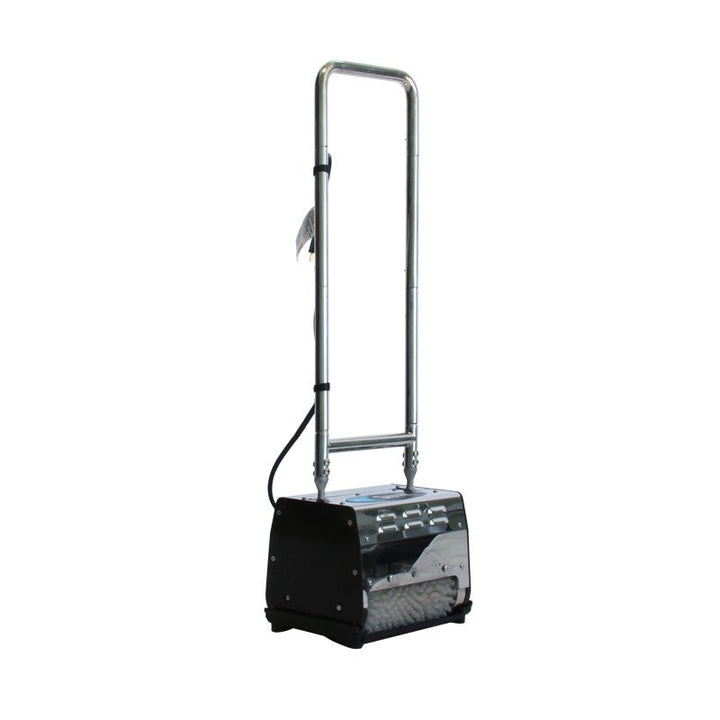
The Mytee T-Rex Jr. has a 12 inch cleaning head with 4 jets and 4 vacuum slots. The head turns at an adjustable 80 to 180 RPM and Mytee lists up to 720 cleaning passes a minute. Solution is sprayed through the jets and pulled straight back out through the slots, all inside the footprint of the head.
You do not push it across the floor the way you drag a wand. Mytee's manual says the machine stays in one spot while spinning as long as the head sits flush with the carpet. Lifting the handle slightly swings the head to the right, lowering it swings the head to the left and the manual recommends an arc or circular pattern for best results.
Two hoses connect to the machine. A vacuum hose attaches through a 2 inch Cuff-Lynx connection to the clear plastic elbow, and a solution line clips onto a quick disconnect fitting at the handle. The rotary head has no pump or tanks of its own. Pump pressure, solution supply and vacuum all come from the extractor behind it, which is why the feeding machine decides how well the head works.
The head itself is a small machine. Mytee lists a 0.5 HP motor, 3.8 A at 115 V on its own cord (a 50 ft twist-lock cord on Mytee's spec sheet) and a weight of 53 lb. Its spec rows say it is made for heavily soiled residential carpets, restaurant carpets and rugs.
Rotary vs wand vs powered wand
A drag wand is a hand tool: you pull it, and the jets and your stroke do the work. A powered wand adds a motor-driven brush to that same pulling motion. A rotary head swaps the pulling motion for a spinning head you steer. This table sets out the differences using the figures on our product pages and the makers' spec sheets.
| Feature | Drag wand | Powered wand (EDIC PowerMate 1204ACH) | Rotary head (Mytee T-Rex Jr.) |
|---|---|---|---|
| Agitation | None beyond the jets and your stroke | Cylindrical Tynex brush at 2,500 RPM | Spinning head at 80 to 180 RPM |
| How you move it | Pull in straight strokes | Pull in straight strokes | Steer in arcs or circles |
| Cleaning passes | One per stroke | One per stroke, with the brush working the pile | Up to 720 a minute (4 jets at up to 180 RPM, Mytee) |
| Cleaning width | 12 inches | 12 inches | |
| Power draw | None | 1 A, 25 ft cord | 3.8 A at 115 V, own cord |
| Weight | 15 lb | 53 lb | |
| Feeding machine | Any extractor | EDIC portables: Galaxy 2000, Galaxy PRO, Galaxy 5, Polaris, Supernova (EDIC's spec sheet) | 500 PSI or more, or a truckmount, for best results (Mytee's spec sheet) |
| Price | $999 | $2,253 |
The practical split is simple. A powered wand keeps the motion you already know and adds a brush. A rotary changes the motion and demands a bigger feeding machine. If your carpet jobs are mostly light traffic lanes, a standard wand on a good extractor is already enough. Even with a rotary, keep a wand on the job: a 12 inch round head will not reach stairs, edges or tight corners. For a deeper look at brush-driven machines, read our guide to CRB carpet cleaning.

Rotary head
Mytee T-REX Jr. Rotary Extractor, 720 cleaning passes/minute, 12″
$2,253
A 12 inch head with 4 jets and 4 vacuum slots for heavily soiled commercial and restaurant carpet.
Which extractors can feed a rotary
Mytee's T-Rex Jr. spec sheet says: "For best results, use with a 500 PSI or greater extractor or a truckmount." The pump is half the picture. The vacuum has to pull the solution back out of the carpet through the hose, so lift and airflow matter as much as pressure. Three of the machines in our range that meet the 500 PSI line are compared below. Others include the heated Mytee 1003DX Speedster at $3,761, the Mytee LTD5-LX Speedster at $4,738 and the 1,000 PSI Mytee ETM-LX-PLUS Escape Plus electric truckmount.
| Feeding machine | Pump | Vacuum | Heat | Cords | Price |
|---|---|---|---|---|---|
| Mytee 1005LX Speedster | 500 PSI, adjustable, 1.5 GPM | Dual LX, up to 250 CFM, 182 in lift | None | Two 50 ft cords, 20 A and 15 A | $3,667 |
| Mytee LTD3 Speedster LTD | 500 PSI, adjustable, 1.5 GPM | Dual 3-stage, 200 CFM, 130 in lift | 1,600 W | Two 50 ft cords, 20 A each | $4,374 |
| Sandia Sniper 80-2500 | 500 PSI, adjustable | Dual 2-stage | Optional, on the 80-2500-H | Two 25 ft 12/3 cords, 20 A outlets (Sandia's manual) | $2,499 to $2,799 |
All three machines above rate their pump at 500 PSI, and we list each one in the high-pressure carpet extractor collection. Plan the power: Mytee's Speedster manual puts each cord of a dual-cord machine on its own 20 A circuit, and the T-Rex Jr. needs its own grounded outlet, so a rotary behind a two-cord feeder takes three outlets.
Also check the fittings before you buy: the rotary takes a 2 inch Cuff-Lynx vacuum hose and a quick disconnect solution line. Mytee's Speedsters have a 2 inch Cuff-Lynx vacuum connection, while Sandia's Sniper manual lists a 1-1/2 inch vacuum hose, so plan on an adapter there.
Mytee 1005LX Speedster
The 1005LX is the unheated route. It rates its pump at an adjustable 500 PSI and 1.5 GPM and pairs it with dual LX vacuum motors, up to 250 CFM and 182 inches of water lift, for a hose run Mytee lists at 150 ft. It weighs 130 lb and draws 20 A on one cord and 15 A on the other, both at 115 V.

Unheated feeder
Mytee 1005LX Speedster Portable Extractor, 10 gal., 500 PSI, LX vacuums
$3,667
Strongest listed vacuum of the three feeders, with 10 gallon tanks.

Skip it if you want hot solution built in: the 1005LX has no heater.
Mytee LTD3 Speedster LTD
The LTD3 adds a 1,600 watt heater to the same 500 PSI class. Its vacuum is dual 3-stage at 200 CFM and 130 inches of lift, and the tanks are about 11 gallons each. It runs on two 50 ft cords at 20 A each and weighs 165 lb. Browse more heated carpet extractors if heat is on your list.

Heated feeder
Mytee LTD3 Speedster Heated Carpet Extractor, 500 PSI, 11 gal
$4,374
500 PSI with a 1,600 W heater, garden-hose auto-fill and a 3.3 GPM pump-out.
Skip it if weight or price matters most: it is the heaviest and the most expensive of the three. For heat at a lower price, the Mytee 1003DX Speedster pairs a 500 PSI pump with the same 1,600 W heater rating at $3,761.
Sandia Sniper 80-2500
The Sniper pairs a 500 PSI adjustable pump with 12 gallon tanks and dual 2-stage vacuum motors. It comes in two versions: the 80-2500 without heat and the 80-2500-H with heat. Sandia's owner's manual lists two 25 ft 12/3 power cords on 20 A grounded outlets. It ships at 137 lb without heat or 141 lb with heat. Our product page does not list a vacuum lift figure or airflow rating for it.

12 gallon feeder
Sandia Sniper 12-Gallon Carpet Extractor - 500 PSI Adjustable Pump with Optional Heat - 80-2500
From $2,499 · 5.0 from 2 reviews
500 PSI with 12 gallon tanks, sold with or without heat at different prices.
Heat is what the 80-2500-H adds. One owner of the heated model, who also finds it a little heavy to lift often, writes:
“Heats up very fast, was very impressed with the quality of cleaning.”
Sandia Sniper 12-Gallon Carpet Extractor owner · 5 out of 5 stars
Skip it if you need a published vacuum figure to size a long hose run. Choose a Speedster instead, where lift and CFM are listed.
Add vacuum for long hose runs
A long vacuum hose loses pull. The Mytee 7303LX Air Hog is a vacuum booster that adds dual LX vacuum motors, up to 250 CFM and 182 inches of water lift, in a 53 lb body with a 7 gallon recovery tank. Mytee lists a 150 ft hose run for the LX vacuums, and the Air Hog takes 15 A per cord on two 50 ft cords.

Vacuum booster
Mytee 7303LX Air Hog Vacuum Booster, 7 gal., LX vacuums
$1,955
Adds LX vacuum motors for long hose runs behind a rotary.

Skip it if your extractor already pulls strongly at the hose length you run. The booster has no solution pump, so it does not replace a feeding extractor.
Watch the rotary at work
The middle option: a powered wand
If a rotary is more machine than you need, the EDIC PowerMate 1204ACH keeps the pulling motion and adds a cylindrical brush with Tynex bristles at 2,500 RPM across a 12 inch path. It draws 1 A on a 25 ft cord, weighs 15 lb and carries a 5 year parts and labor warranty. EDIC's spec sheet says most EDIC portables can be fitted with an optional AC plug for it, so it does not need its own outlet. All 5 owner reviews on our product page give it 5 stars.

Powered wand
EDIC PowerMate Powered Carpet Wand 1204ACH
$999 · 5.0 from 5 reviews
Brush agitation on a wand you already know how to use.

“Digs deep and stands the pile up nicely. Takes a little longer to clean than a drag wand but works better on soiled carpet.”
EDIC PowerMate Powered Carpet Wand 1204ACH owner · 5 out of 5 stars
“it’s been an excellent carpet cleaning tool. Cleaning carpets with it compared to a standard drag wand is like night and day. I feel less fatigued and can work faster without sacrificing quality.”
EDIC PowerMate Powered Carpet Wand 1204ACH owner · 5 out of 5 stars
Note the trade-off the first reviewer names: a brush can take longer than a plain drag wand. The second owner replaced the brush belt and handle after three years, so budget for those wear parts. Skip it if speed on lightly soiled carpet is your priority.
When a rotary pays for itself
The math is a payback period, and it only works with your own numbers. Our calculation: payback in months = machine cost / (hours saved per job x the value of an hour x jobs per month).
Worked example: our calculation
Mytee's spec sheet says the head deposits chemical, agitates and extracts at the same time, so the saving to measure is the separate agitation pass. Say that saves half an hour on each heavily soiled job, an hour of your time is worth $40 and you run 20 such jobs a month. That is 0.5 x $40 x 20 = $400 a month. Against the head at today's price, payback lands in under 6 months. These are example inputs, not measured savings, so swap in your own.
Remember the feeder. If you already own a 500 PSI extractor, the head is the only purchase. If you do not, the pair costs far more:
| Rig | What it includes | Total at today's prices | Payback at $400 a month (our calculation) |
|---|---|---|---|
| T-Rex Jr. with Sandia Sniper, no heat | Rotary head and a 500 PSI Sandia box extractor | Under $5,000 | About 12 months |
| T-Rex Jr. with Mytee 1005LX | Rotary head and an unheated Speedster | About $6,000 | About 15 months |
| T-Rex Jr. with Mytee LTD3 | Rotary head and a heated Speedster LTD | Under $7,000 | About 17 months |
If most of your carpet work is light, a wand on one extractor is the lower-cost way to run. Our guide to starting a carpet cleaning business covers equipment costs and pricing math, and the carpet cleaning price per room post shows what pros charge. For the pressure and heat basics behind the feeding machine, see our extractor PSI and heat guide.
Care and setup
Mytee's maintenance schedule has you inspect cords and hoses for breaks or tears every day and keep the felt vacuum seal lubricated. After cleaning, remove built-up fibers from the head, wipe it down and store it in the included head cover. Set the speed knob to the lowest setting before you switch on. Mytee's troubleshooting table ties a slow head or a hot motor to a dry felt seal, and the schedule says to clear debris from the motor shaft and head hub to protect the gearbox oil seal. These steps come from Mytee's T-Rex manual.
If you are new to extraction, learn the basic passes first. Our walkthrough on how to use a carpet cleaning machine covers the steps, and the Mytee carpet extractors collection and the wider portable carpet extractors collection show the machines that can sit behind a rotary or a wand.
Frequently asked questions
What does a commercial carpet extractor cost?
In our range, portable and box carpet extractors run from about $1,500 to about $5,500, self-contained machines from about $2,100 to about $7,300, and an electric truckmount is about $7,200. A rotary head such as the T-Rex Jr. is an add-on at $2,253 that still needs a feeding extractor.
How do you extract carpet?
Pre-treat, then spray solution and pull the vacuum in overlapping passes, then rinse and dry. Our guide on how to use a carpet cleaning machine walks through each step and the settings.
What is the difference between a carpet cleaner and a shampooer?
An extractor sprays solution and vacuums it back out, while a shampooer works foam or detergent into the pile. Our post on carpet shampoo vs steam cleaning explains what each machine really does.
What is Rotovac carpet cleaning?
Rotovac is a brand of rotary extraction tool, so the phrase usually means cleaning with a powered rotary head fed by a truckmount or a high-pressure portable. The Mytee T-Rex Jr. works on the same idea.
Do I need a truckmount to run a rotary extractor?
No. Mytee's T-Rex Jr. spec sheet says that for best results it should run with a 500 PSI or greater extractor or a truckmount. A 500 PSI portable such as the Mytee 1005LX or LTD3 meets that line, but the 220 PSI Speedsters, such as the 1000DX-200, do not. An Air Hog booster can add vacuum for a long hose.
Feed a rotary with the right extractor
Related guides
- CRB Carpet Cleaning: How Counter-Rotating Brush Machines Work and When to Use One
- How to Use a Carpet Cleaning Machine: The Pro Extraction Steps, Passes and Settings
- Carpet Shampoo vs Steam Cleaning: What an Extractor, Shampooer and Steamer Really Do
- How to Start a Carpet Cleaning Business: Equipment, Startup Costs and Pricing Math