How we made this guide: picks, prices and specs come from our catalog and the makers' published specs, owner quotes come from customer reviews on our product pages and the guide was drafted with AI help, then checked and edited by Trevor Hall.
A refrigerant (compressor) dehumidifier pulls room air across a coil that is colder than the air's dew point, so water vapor turns to liquid on the coil and drains away, and the dried air then passes over a warm coil and goes back into the room.
A desiccant dehumidifier works differently: a rotating wheel soaks water out of the air, and a separate heated air stream dries the wheel out again, which is why desiccant units keep working in cold spaces where a coil would frost. An LGR (low grain refrigerant) unit is a refrigerant machine built to keep pulling water as the air gets drier. The four machines in this guide run from $799.11 for the AlorAir Storm LGR Extreme to $4,867 for the Ebac DD400. Across our range, dehumidifiers run from under $500 for a 35-pint crawl space unit to over $40,000 for the largest industrial desiccant model, and desiccant units start above $3,500. Browse every dehumidifier we carry.
Quick answer
Warm, damp air goes in, drier air comes out and the water ends up in a bucket, a drain hose or a pump line, or, on a desiccant unit, leaves as warm, wet air through a duct. Refrigerant units condense the water. Desiccant units absorb it. Which one fits depends mostly on how cold the space gets and how much water you need out per day.
What a dehumidifier actually does
A dehumidifier lowers the amount of water vapor in the air of a room. It does not heat the room for comfort, it does not clean the air and it does not dry a wet wall by itself. It takes vapor out of the air, and drier air then pulls moisture out of damp surfaces over time. That second step is why drying a flooded room takes days, not minutes, and why the air has to keep moving past the wet material. For the drying side of that job see our guides on how to dry wet carpet after a leak and drying hardwood floors after water damage.
Three terms come up in every dehumidifier explanation, so it helps to have them in plain words before the machine itself.
Relative humidity
Relative humidity is how full the air is compared with what it can hold at its current temperature. Warm air can hold more water vapor than cold air. That is why the same room can read 50 percent on a warm afternoon and a much higher number on a cold night even though no water was added.
Dew point
Dew point is the temperature at which air is completely full of water vapor. Cool air below that temperature and the vapor turns to liquid. The cold glass of water that beads up in summer is dew point at work: the glass surface is colder than the dew point of the room air. A refrigerant dehumidifier does the same thing on purpose with a coil.
Grains per pound
Grains per pound is a way to count the actual water in the air instead of how full the air is. It is the weight of water vapor, in grains, in one pound of dry air (7,000 grains make a pound). Restoration crews use it because it does not change when the room warms or cools, so it shows whether a machine is really taking water out. Relative humidity only tells you the air is full or not full. The grain count tells you how much water is in it. The "low grain" in LGR refers to this number.
How a refrigerant dehumidifier works, step by step
Most dehumidifiers you will meet, from a small crawl space unit to a big job-site machine, use a refrigeration cycle like the one in a window air conditioner. The difference is that the whole machine sits in the room and the heat it removes is put back into the same air. Here is the path of the air, in order.
- A fan pulls room air in through a filter. The filter keeps dust off the coils. A clogged filter cuts airflow and lets dust coat the coil, which is why maintenance is the first thing to check when a unit slows down. Our guide to dehumidifier maintenance covers the filter, coils, pump and drain line.
- The air passes over the cold coil (the evaporator). Refrigerant inside the coil is cold, so the coil surface sits below the air's dew point. Water vapor condenses into droplets on the coil, the same way it does on a cold glass.
- The droplets run down the coil into a pan, then to the bucket, the drain outlet or the pump.
- The now cooler, drier air passes over the warm coil (the condenser). Here the refrigerant gives up the heat it picked up at the cold coil plus the heat of the compressor's work, and the air leaves the machine warmer and drier than it came in.
- The air returns to the room. This is why a dehumidifier makes a room feel slightly warmer, not cooler, even though one coil is cold.
The refrigerant does the work in a loop. The compressor squeezes the refrigerant gas, which makes it hot. In the warm coil the hot gas gives its heat to the air and condenses into a liquid. The liquid then passes through a narrow tube or valve (the expansion device), its pressure drops and it turns very cold. In the cold coil it boils back into a gas as it takes heat from the air, which is what holds the coil below the dew point, and the gas returns to the compressor. The XPOWER Viking BD-65 is a plain example of this design. Its spec rows list R32 refrigerant and a stainless steel housing, and XPOWER's manual says the unit sets its fan speed from the room's temperature and humidity.


Refrigerant example
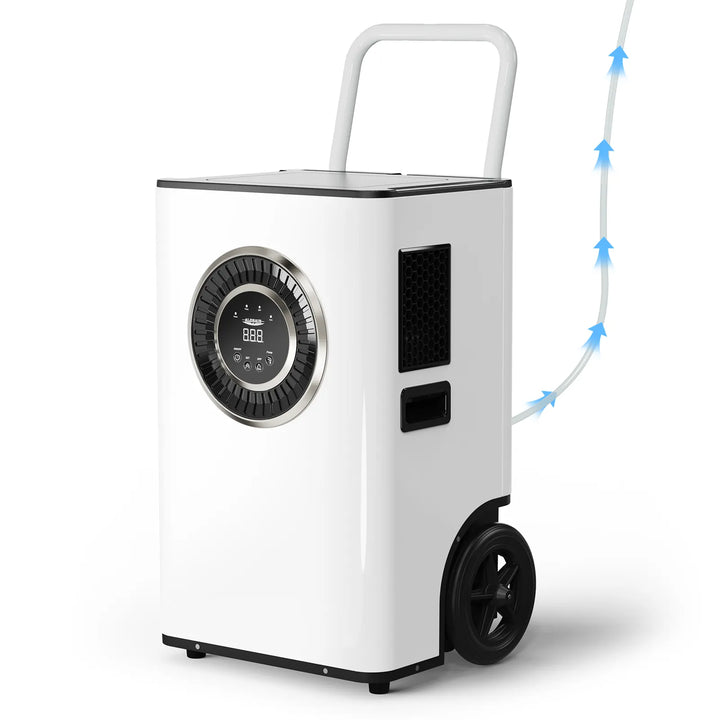
XPOWER VIKING Commercial Grade Dehumidifier for Crawlspace, Basement, Attic, Garage BD-65
$879
A conventional refrigerant unit with gravity drain or a built-in pump with drain hose, sized for a crawl space, basement, attic or garage.
Whole-house dehumidifiers use the same refrigerant cycle but connect to ducts so one machine serves the whole home. In our range they run from under $1,500 to under $4,000.
Why the coil can ice up
When the air is cool, the cold coil can drop below freezing and collect frost instead of dripping water. A frosted coil blocks airflow and stops pulling water, so cooler-room machines need a defrost method. The BD-65 lists automatic defrost. The Abatement Technologies AT250RS lists sensor-controlled thermodynamic defrost. XPOWER's BD-65 manual notes that frost on the cold coil lowers dehumidification and that drying pauses while the unit defrosts, which is why a refrigerant unit that suits a warm basement can disappoint in an unheated garage.
What "pints per day" really means
Pints per day is the volume of water a machine removes in 24 hours, and the number only means something with its test condition. The two conditions you will see on commercial listings are AHAM and saturation. The AlorAir Storm LGR Extreme listing gives two figures: 85 pints at the AHAM test point of 80°F and 60% relative humidity, and 180 pints when the test room is 90°F and 90% relative humidity (saturation). Saturation is a hotter, wetter test, so the number is always bigger. The two figures describe the same machine in two different rooms.
Never compare an AHAM figure with a saturation figure from another listing. A machine rated 120 pints at saturation is not stronger than one rated 85 at AHAM. It may be weaker. Compare AHAM with AHAM and saturation with saturation. Some listings give a pint figure with no condition at all. Our DD400 listing shows 71.5 pints that way, but Ebac's manual rates it at 27°C (about 81°F) and 60% RH, close to the AHAM point but not the AHAM test, so check the manual before you compare.
XPOWER's manual shows how big the drop can be: the BD-65 is rated at 60 pints a day in 80°F air at 60% RH, and 36.8 pints in 65°F air at the same humidity. Home portable dehumidifiers are now rated at 65°F rather than 80°F under the federal test, so a home unit's pint number and a commercial AHAM number come from different tests.
A rough feel for the rate (our calculation): a machine rated 60 pints a day at AHAM removes up to 60 / 24 = 2.5 pints an hour under those test conditions, about 7.5 gallons over a day (8 pints make a gallon). Real output in your space will be lower when the air is cooler or drier than the test.
What makes an LGR dehumidifier different
A standard refrigerant machine removes water well when the air is warm and very damp, then slows as the air dries out. XPOWER's manual, for example, lists the conventional BD-65 for rooms at 36% RH or higher. An LGR dehumidifier is a refrigerant unit designed to keep pulling water at lower humidity, so it can dry the air further down. Restoration crews reach for LGR units on water damage jobs for this reason, where the air must be taken from soaked to dry. LGR designs typically add a step that cools the incoming air before it reaches the cold coil, though the exact layout differs by maker. For a short older note on the topic, see What Is an LGR Dehumidifier and When Do You Need One?, and shop our LGR dehumidifiers.
Two LGR examples in our range show the spread. The AlorAir Storm LGR Extreme carries the same two ratings (85 AHAM, 180 saturation) and draws 5.62 A at 115 V and weighs 64.3 lb. Its spec rows list an operating range of 33.8°F to 104°F and a built-in condensate pump. The Abatement Technologies AQUATRAP AT250RS is the larger machine, rated 147 pints a day at AHAM and 266 at saturation, 11.2 amps at 120 V, 100 lb and an operating range of 34°F to 100°F.


LGR example, compact
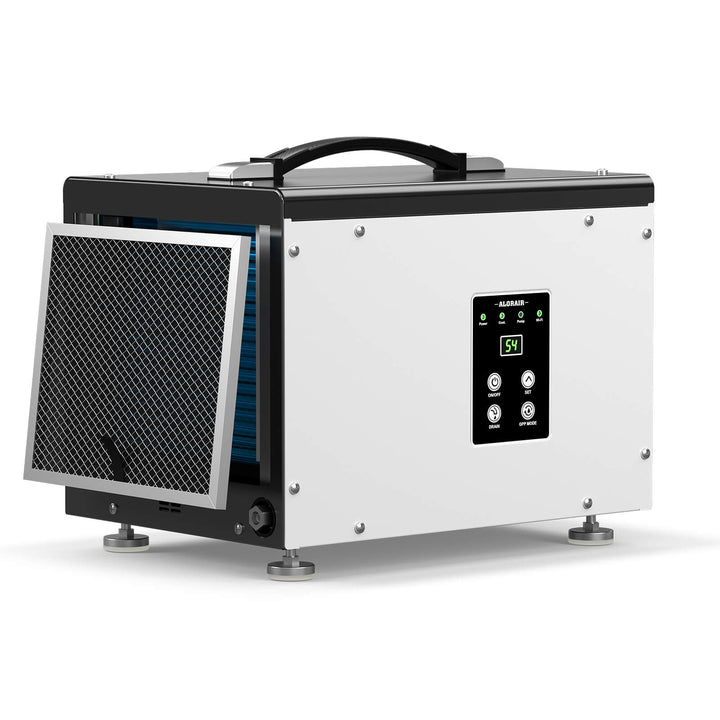
AlorAir Storm LGR Extreme 85-Pint Commercial Dehumidifier with Pump
From $799.11
LGR design with a MERV-8 filter and a built-in pump; available in standard and WiFi versions.

LGR example, large
Abatement Technologies AQUATRAP Series LGR Dehumidifier AT250RS
$2,400
A 100 lb LGR for structural drying, with a 400+ CFM airflow listing and stackable cabinet.
How a desiccant dehumidifier works
A desiccant dehumidifier removes water without a cold coil. The core is a wheel (a rotor) made of a material that soaks up water vapor. The wheel turns slowly through two air streams:
- Room air is drawn through one part of the wheel. The desiccant absorbs water vapor from that air, and drier air goes back to the room.
- As the wheel turns, the wet part moves into a second, separate air stream that is heated. The heat drives the water out of the desiccant as vapor.
- That warm, wet air leaves through its own outlet and is ducted outside the space being dried (Ebac's DD400 manual says it must be), and the dried part of the wheel turns back into the room air to start again.
Because no coil gets cold, nothing frosts. The Ebac DD400 lists a lowest operating temperature of -4°F, far below the 33.8°F and 34°F low ends of the two LGR units above. Its spec rows also show it is ductable, with manual controls and a 1,200 sq ft suggested room size, and Ebac's manual lists 197 CFM of dry (process) airflow and 119 CFM of wet (reactivation) airflow. It draws up to 8 A at 220 to 240 V and weighs 59.5 lb, so plan for a 240 V outlet, unlike the 115 to 120 V refrigerant units here, and for a duct to carry its wet air outside. The trade-off is power: in a warm room a desiccant unit uses more power for the water it removes than a compressor unit (the DD400 is rated up to 1,800 W, the BD-65 at 520 W). Its advantage shows in the cold. Ebac's manual lists 67 dB(A), against under 58 dBA listed for the Storm LGR Extreme. The BD-65 and AT250RS listings give no noise figure.

Desiccant example
Ebac DD400 Commercial Desiccant Dehumidifier 10500SS-US
$4,867 · 5.0 from 1 review
A desiccant unit listed down to -4°F whose wet air is ducted outside.
For the full head-to-head between the two technologies, our older note Desiccant vs Refrigerant Dehumidifier goes through it. To see what we carry, browse desiccant dehumidifiers and refrigerant dehumidifiers.
The three types side by side
| Type | How it removes water | Where it wins | Rated water removal | Operating range (our example) | Water path (our example) | Our example |
|---|---|---|---|---|---|---|
| Refrigerant | Condenses water on a cold coil, then rewarms the air | Warm, damp spaces such as basements and crawl spaces | 60 pints/day at AHAM (80°F, 60% RH) | 33°F to 105°F at 36% RH or higher (BD-65, XPOWER's manual) | Gravity drain or built-in pump with drain hose | XPOWER Viking BD-65, $879 |
| LGR | Refrigerant unit built to keep pulling water as the air dries | Water damage drying and low-humidity targets | 85 pints/day at AHAM (Storm LGR Extreme); 147 at AHAM (AT250RS) | 33.8°F to 104°F (Storm LGR Extreme); 34°F to 100°F (AT250RS) | Built-in pump (Storm LGR Extreme) | AlorAir Storm LGR Extreme, $799.11 |
| Desiccant | Absorbs water on a rotating wheel, then heats the wheel to release it | Cold or unheated spaces | 71.5 pints/day at 27°C (81°F), 60% RH (Ebac's manual) | Lowest operating temperature -4°F (DD400) | Warm, wet air ducted outside; no bucket or pump (DD400) | Ebac DD400, $4,867 |
The BD-65 and both LGR units are rated at the AHAM point, so those figures compare directly. The DD400's figure is Ebac's own test point, close to AHAM but not the same test.
Where the water goes
Pulling water out of the air is half the job. The other half is getting it out of the machine. There are three common water paths on a refrigerant machine, and a fourth on a desiccant unit.
Bucket
The water drips into a tank that you empty by hand. Fine for a small room, a poor fit for a space you do not visit daily, because a full bucket switches the machine off.
Gravity drain
A hose runs from the drain outlet to a floor drain, a sump or the outdoors, and gravity carries the water. The outlet must be higher than the end of the hose, so the hose has to run downhill without kinks. The BD-65 lists gravity drain as an option.

Condensate pump
A built-in pump pushes the water uphill or a long way through a hose. The Storm LGR Extreme has one, and its listing says the end of the drain hose should sit no higher than 15 ft. The BD-65 lists a built-in pump with drain hose beside its gravity option.
Wet-air duct (desiccant)
A desiccant unit such as the DD400 has no bucket or pump at all. The water leaves as vapor in the warm, wet air stream, which Ebac's manual says must be ducted outside. The manual adds that the duct should slope down away from the unit so water that condenses in it cannot run back in.
Which type for which space
Basement
Most basements run cool and damp, and a refrigerant or LGR machine with a pump or a floor drain is the usual match. Pick by size: the coverage figure on the listing (1,300 sq ft for the BD-65, up to 2,300 sq ft for the Storm LGR Extreme) is the maker's number for the space it suits. Set the humidistat to land in the EPA's suggested 30 to 50 percent range. If the basement had a leak or flood, read basement mold remediation for the humidity to hold afterward, because a dehumidifier only lowers humidity; it never takes out existing mold.
Crawl space
Crawl spaces are cramped and often cooler, so look for low operating temperature, defrost and a drain that suits your layout. See crawl space mold remediation for what a clean-up involves. The BD-65 is listed by the maker for crawl spaces, attics, basements and garages.
Water damage job
Here the goal is to take the air from soaked to dry, and an LGR machine suits the work. AlorAir's own video presents the Storm LGR Extreme as a commercial water damage restoration dehumidifier. The AT250RS is described for structural drying. Pair a dehumidifier with air movers so the water leaving the wall or floor has air to move it, as covered in our guide to drying wet carpet after a leak or flood.
Cold warehouse or unheated building
When the space sits near or below freezing, a coil is the wrong tool and a desiccant unit is the usual answer. The DD400 lists warehouse, restaurant, kennel, stable and marine use, and a lowest operating temperature of -4°F.
How to tell if you need one
Buy a hygrometer, a small meter that reads relative humidity. Place it in the room for a few days and read it at different times of day. The EPA's mold guide advises indoor humidity under 60 percent, with 30 to 50 percent as the ideal. A reading that stays above 60 percent for several days is the sign that the room needs a dehumidifier. A musty smell, damp-feeling stored goods and condensation on windows and pipes are signs worth checking with the meter, not instead of it.
Getting more from the one you have
- Close doors and windows while it runs. Open doors and windows let in new damp air faster than the machine can remove it.
- Keep the intake and outlet clear of walls, boxes and furniture.
- Set the humidity target on the control. The Storm LGR Extreme lists a humidity setpoint range of 25% to 80% in 5% steps, plus a continuous mode.
- Check the drain path first when the unit stops: a full bucket, a kinked hose or a blocked pump line are the first things to check.
- Clean the filter and the coils on a schedule, using our maintenance guide.
Frequently asked questions
How well do dehumidifiers actually work?
They work as rated when the room matches the test conditions behind the pints-per-day number. A unit rated 85 pints at the AHAM test point removes less water in a cooler or drier room, and XPOWER's manual shows the BD-65 falling from 60 pints at 80°F to 36.8 pints at 65°F. Compare ratings only when the condition is the same, and size the machine to the space.
Do dehumidifiers work against mold?
A dehumidifier lowers humidity, and mold needs moisture to grow, but the machine does not take out mold that is already there. Mold is handled by remediation. Keeping the air drier afterward is the job of the dehumidifier, as explained in our basement mold remediation guide.
How many hours a day do you run a dehumidifier?
It runs until the humidity reaches the target you set, then cycles off and on to hold it. Aim for the 30 to 50 percent band the EPA suggests. A machine with a humidistat does this itself. In a very damp space it may run most of the day at first, then less once the space is dry.
How long does it take a dehumidifier to dry a room?
There is no single number. It depends on the machine's rating, the starting moisture, the temperature and how much water the walls and floors still hold. After a flood the job usually takes days, with air movers helping.
What are the downsides of using a dehumidifier?
It uses electricity, makes fan noise (67 dB(A) on the DD400, under 58 dBA on the Storm LGR Extreme), gives off heat into the room and needs its filter and drain kept clean. In a warm room a desiccant unit uses more power than a compressor unit. Cold air also limits a standard refrigerant machine.
Does a dehumidifier make a room colder?
No. The air leaves warmer than it entered, because the compressor's heat goes into the dried air. The room can feel cooler because damp air feels clammy, but the temperature does not drop.
What are the benefits of a dehumidifier?
It lowers relative humidity, which cuts condensation on cold surfaces, musty smells and damp damage to stored goods, and it helps a wet building dry after a leak. It does not filter the air, and mold that is already there stays until it is remediated.
Would a dehumidifier help with COPD?
We cannot give medical advice, so ask your doctor. A dehumidifier only lowers relative humidity. The EPA's mold guide suggests keeping indoor humidity between 30 and 50 percent, and a hygrometer shows where your room sits.
Pick the right type for the space