How we made this guide: picks, prices and specs come from our catalog and the makers' published specs, owner quotes come from customer reviews on our product pages and the guide was drafted with AI help, then checked and edited by Trevor Hall.
A negative pressure room exhausts more air than is supplied, so it sits at slightly lower pressure than the space around it and air flows in under the door instead of out. CDC sets the target for an airborne infection isolation room at 2.5 Pa (0.01 inch of water gauge) below the corridor, with at least 12 air changes per hour in new or renovated rooms and at least 6 in existing ones.
Quick answer
Negative pressure is a small difference, not a strong suction. Hospitals build it into their ventilation for isolation rooms. Contractors create a temporary version around construction, renovation or remediation work with a HEPA negative air machine that pulls room air through a filter and exhausts it outside the work area, plus a pressure monitor to show the difference holds. A typical setup pairs a machine such as the HEPA-AIRE H2KMA ($1,290) with a fixed RPM-RT1 monitor ($1,210), or the portable PPM3-S when the monitor moves between jobs. This page is general information about equipment and airflow, not medical advice. A portable setup does not by itself make a code-compliant isolation room.
What negative pressure means
Air moves from higher pressure to lower pressure. In a negative pressure room the pressure inside is a little lower than in the neighboring corridor or room, so any opening, such as the gap under a door, lets air in rather than out. Whatever is floating in the room air is carried toward the exhaust and the filter instead of drifting into the next space.
The CDC figure is 2.5 Pa, which is 0.01 inch of water column. You cannot feel that. You see it as a door that pulls very slightly inward, a smoke tube trail that bends toward the gap, or a number on a monitor.
How a room is made negative
Pressure goes negative when the air leaving the room is greater than the air entering it through the supply. The shortfall is made up by air leaking in through the door gap, the ceiling and any other opening. That inflow is the negative pressure doing its job.
There are two routes to the same result:
- A permanent isolation room has its own ventilation design, with exhaust set higher than supply and the room sealed enough that the balance holds. The building engineers set and test it.
- A temporary room is made on site. You seal the work area, put a HEPA negative air machine inside it and move the filtered air out of the area, through a duct to a window or an exterior opening or into a part of the building that is not the clean side.
Every real room leaks, and a leaky one needs more airflow and still drifts when someone opens a door. That is why sealing the space comes before choosing a machine.
Pressure targets: what the CDC says and how to read the units
CDC's guidelines for environmental infection control in health-care facilities recommend that an airborne infection isolation room keep continuous negative pressure of 2.5 Pa (0.01 inch of water gauge) relative to the corridor. They set the air-change rate at 12 or more per hour for new construction and renovation, and 6 or more per hour for existing rooms. The same guideline says to monitor the pressure periodically, preferably daily, with audible manometers or smoke tubes at the door in existing rooms or with a permanently installed visual monitor, and to document the results.
ASHRAE 170 and the FGI guidelines set their own requirements for new hospital rooms, so ask the facility which applies.
Monitors and specifications use both inches of water column and pascals, at about 249 Pa per inch. The table converts the figures on this page.
| Inches of water column | Pascals (our calculation) | Where it appears on this page |
|---|---|---|
| 0.01 inWC | about 2.5 Pa | CDC target for an airborne infection isolation room |
| 0.04 inWC | about 10 Pa | Range the RPM-RT1's alarm set points can be placed in, plus or minus |
| 0.10 inWC | about 25 Pa | Measuring range of the RPM-RT1 and the PPM3-S, plus or minus |
Read that last row carefully. A monitor that displays plus or minus 25 Pa has a wide window, and the CDC target sits near the small end of it. Abatement lists the RPM-RT1's accuracy as plus or minus 3 percent of full scale and lets you place its alarm set point in steps of 0.001 inWC. Against a 2.5 Pa target that tolerance matters, so give the alarm set point some margin instead of setting it exactly on the target.
Negative pressure vs positive pressure
| Negative pressure room | Positive pressure room | |
|---|---|---|
| Pressure compared with the corridor | Lower | Higher |
| CDC target for hospital rooms | 2.5 Pa (0.01 inch water gauge) below the corridor | 2.5 Pa (0.01 inch water gauge) or more above the corridor |
| Air at the door gap | Flows into the room | Flows out of the room |
| What it protects | The space outside the room | The people or process inside the room |
| Hospital use | Airborne infection isolation rooms | Protective environment rooms for patients at high risk |
| Construction and remediation use | Containment around dust or debris work | Clean rooms, some temporary clean zones |
| How it is made | Exhaust greater than supply | Supply greater than exhaust |
Hospital isolation rooms vs temporary containment
The hospital version is part of the building: dedicated exhaust, tested seals, often an anteroom and a monitor at the door. The pressure is verified and recorded, because a room that was negative on commissioning day may not be after a door has been propped open.
The contractor version is portable and built around a task. CDC's guideline for health-care facilities tells them to "create and maintain negative air pressure in work zones adjacent to patient-care areas", to monitor the negative airflow inside barriers and to repair gaps in barrier joints. The usual pieces are:
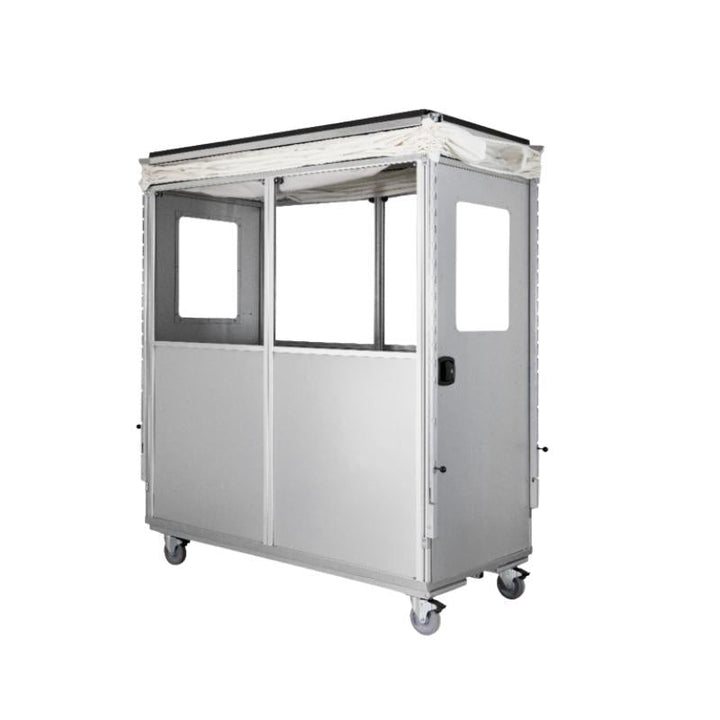
- A sealed or sheeted work area, which can be plastic sheeting, a collapsible enclosure or a mobile containment cart.
- A HEPA negative air machine that exhausts room air out of the work area.
- A way of entering and leaving without breaking the seal, such as a zipper door or an anteroom.
- A differential pressure monitor with an alarm, so a loss of pressure is seen by a person instead of discovered afterward.
Our Abatement Technologies collection carries the negative air machines, monitors and carts. The mobile containment collection holds the carts and enclosures.
How to create temporary negative pressure, step by step
These steps describe the general sequence. Your site plan, the facility's rules and the machine's manual come first.
- Define the work area and the clean side next to it. Ask the facility or the project owner whether an infection control risk assessment (ICRA) applies, since it decides what containment the job needs.
- Seal the work area. Sheeting, tape, a zipper door or a collapsible enclosure close the large gaps. Deal with ceiling tiles, vents and pipe penetrations too, because small openings add up.
- Set the machine inside the work area, usually toward the far end from the entrance so replacement air sweeps across the work on its way to the machine.
- Send the filtered air out of the work area. A machine that returns its filtered air to the same sealed room cleans that air, but it does not change the pressure balance, because the air never left. The exhaust has to go to an exterior opening, away from air intakes, open windows and occupied areas. If your plan allows another place, use that.
- Place the pressure monitor so it reads the difference between the work area and the clean side. Follow the monitor's instructions for where the sensing point goes.
- Start the machine and let the room settle. Look for the reading on the monitor, and check at the door gap with a smoke tube or a light tissue. Air should move into the work area.
- If a fuel-burning furnace or water heater shares the air space, check that it still drafts up its flue with the machine running, and turn the machine to low or add make-up air if it does not.
- Set the alarm point, log the readings at the intervals your plan requires and keep the door closed. Keep the machine running until the barrier comes down.
How much airflow: air changes per hour
An air change is the machine moving a volume of air equal to the room's volume. CDC's guideline describes portable industrial-grade HEPA units in the 300 to 800 CFM range and says to choose ones that give the equivalent of 12 or more air changes per hour. The formula is air changes per hour (ACH) equals CFM times 60 divided by room volume in cubic feet. Rearranged, the airflow you need is ACH times volume divided by 60. All the numbers in this section are our calculation.
| Room (length x width x height) | Volume | CFM for 6 ACH | CFM for 12 ACH |
|---|---|---|---|
| 12 x 10 x 8 ft | 960 cu ft | 96 | 192 |
| 20 x 15 x 9 ft | 2,700 cu ft | 270 | 540 |
| 30 x 20 x 10 ft | 6,000 cu ft | 600 | 1,200 |
Abatement lists the HEPA-AIRE H2KMA at 2,000 CFM with the motor on its high speed and 1,300 CFM on its low speed. In the 20 x 15 x 9 ft room, 2,000 CFM works out to about 44 air changes per hour on high and about 29 on low. In the 30 x 20 x 10 ft room it works out to 20 on high and about 13 on low.
Treat those figures as ceilings, since real airflow falls as filters load and duct runs add resistance. They also say nothing about pressure: air changes tell you how often the room air is filtered, while negative pressure comes from where the air goes. That is why an air scrubber that recirculates differs from a negative air machine that exhausts, a point our air scrubber vs negative air machine guide takes further.
Monitoring: how to know the room is actually negative
A person standing in the doorway does not notice a drop of 2.5 Pa. A monitor does.
- A smoke tube or a thin strip of tissue at the door gap gives a quick visual check that air is moving in. It tells you the direction, not the number.
- A portable manometer gives a number at the moment you read it. It suits spot checks and commissioning.
- A fixed monitor with an alarm and a log reads continuously and keeps a record. That record is what you hand over if someone later asks whether the containment held.
Doors, elevators and exterior openings shift building pressure, so a 2.5 Pa difference can drift between checks. CDC's guideline for construction near patient areas calls for monitoring the negative airflow inside barriers and reviewing the pressure differential records, which is the case for an alarm and a log instead of a once-a-day look. Our guide to room pressure monitors goes further into the choice.
| RPM-RT1 | PPM3-S | |
|---|---|---|
| Price | $1,210 | $1,400 |
| Range | -0.10 to +0.10 inWC (-25 to +25 Pa) | -25 to +25 Pa (-0.1 to +0.1 inch) |
| Alarms | Set point anywhere from -0.04 to +0.04 inWC in 0.001 inWC steps; color-coded display and 85 dB audible alarm | Visual and audio alarms |
| Display | 3.5 inch color TFT, 320 x 240 | Color touch screen |
| Data | 12,000 logged events, USB port for a flash drive | USB port, logs in CSV format |
| Network | BACnet and N2 | USB CSV export |
| Power | 9 to 24 V AC or DC | Up to 12 hours on battery |
| Form | Fixed unit, 5.98 x 4.02 x 1.11 inches, 0.5 lb | Portable, in a protective case with a clear view window |
| Units | inWC or Pa | Pa and inches |

Single-room monitor
Abatement Technologies Single Room Pressure Monitor RPM-RT1
$1,210
Our top seller in air scrubbers and containment, a 0.5 lb monitor that shows inWC or Pa, sounds an alarm and logs 12,000 events.
The RPM-RT1 is the fixed option: set it up on one room and leave it. You choose the alarm set point anywhere between -0.04 and +0.04 inWC (about 10 Pa either way), in steps of 0.001 inWC, and the monitor alarms when the room crosses it. The event log is the record, and it can also report to a building automation system over BACnet or N2. Abatement's own video shows an RPM-RT1 on an AIRE GUARDIAN AG8000 cart, a larger cart than the AG5000 covered below.

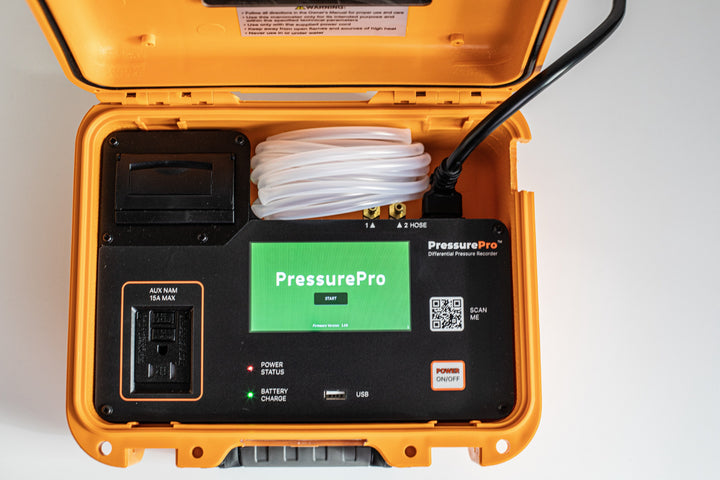
Portable monitor
Abatement Technologies Portable Differential Pressure Monitor PPM3-S
$1,400
Our second-best seller in this category, a battery-powered touch-screen monitor that exports CSV logs and moves between jobs.
The PPM3-S is the one to carry between sites, for a contractor who runs several jobs and wants one monitor on whichever room is active. Choose the RPM-RT1 when the monitor stays put and the PPM3-S when it travels.
Machines that create and hold the pressure

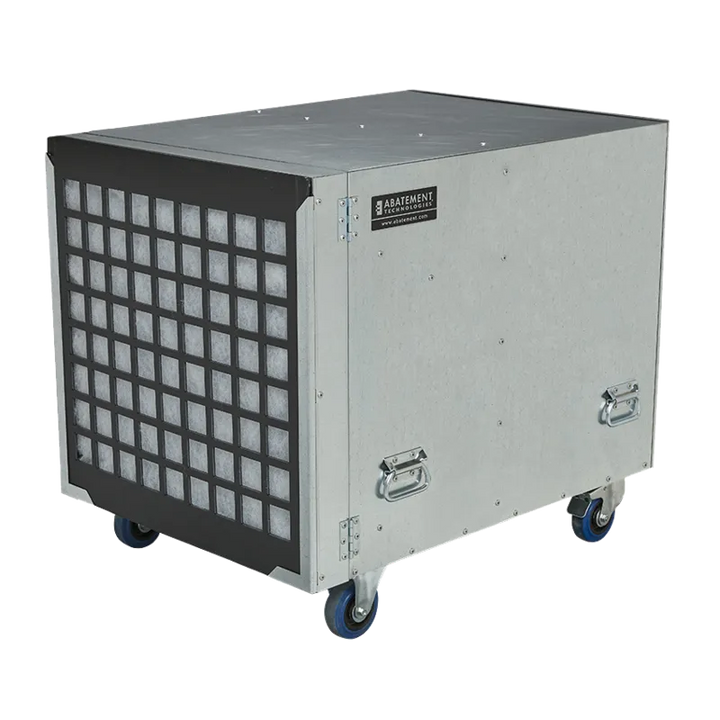
Negative air machine
Abatement Technologies HEPA-AIRE Series Deluxe Model Negative Air Machine H2KMA
$1,290
Two speeds at 2,000 and 1,300 CFM, HEPA rated 99.97% at 0.3 micron, 120 V on a 15 A supply.
The H2KMA is the machine in the airflow examples above. Its main HEPA filter is 6 inches deep and rated 99.97% at 0.3 micron. It has a 1 HP two-speed motor rated at 2,000 CFM on high and 1,300 on low, runs on a 120 V, 15 A supply, rolls on four locking casters and weighs 124 lb with filters. The spec list also includes a 5 inch differential pressure gauge and an audio filter-change alarm. Those tell you when to change filters. They are not a room-to-corridor monitor, so a pressure monitor still goes on the job.

Skip it if a closet-sized space makes 124 lb and a 35.75 x 26 x 30.25 inch cabinet too much machine. A smaller unit from the HEPA air scrubbers range may fit, though one that does not exhaust out of the area will not create negative pressure. Our explainer on what a HEPA filter is covers the ratings, and the negative air machine setup guide covers placement.

Mobile containment cart
Abatement Technologies AIRE GUARDIAN Series Mobile Containment Dust Cart AG5000
$6,780
A collapsible enclosure on casters that reaches a 10 ft ceiling, for ceiling and wall cavity work.
The AG5000 is the enclosure half of the job. Collapsed, it measures 32 x 66.5 x 20 inches. Fully extended, it reaches 124 inches in height and the maximum accessible ceiling height is 10 ft. It weighs 230 lb. An enclosure is not a source of negative pressure. You pair it with a negative air machine, which pulls air out of the enclosure so the fabric walls hold the difference.

Skip it if the work is a whole room or corridor rather than a ceiling or wall opening. Sheeted barriers cover larger areas, and the mobile containment range includes other enclosure sizes.

Containment kit
Abatement Technologies ICRA Compliance Full Package ICMOBVC
$6,600
A pre-configured kit of an air scrubber, HEPA wet/dry vacuum, containment cart, caddy and filters.
The ICMOBVC is the all-in-one route. Its name includes the word compliance, but we do not read that as a certification, and the facility decides whether any setup meets its requirements. The kit contents are listed: a PRED750 portable air scrubber, a V8000WD HEPA-certified wet/dry vacuum, an AG3000MCCK mobile containment cart, an AG-CADDY external cart, a case of F621 prefilters and a case of H502 secondary filters. No pressure monitor appears in that list, so add one if the job needs a reading and an alarm.
Skip it if you already own a machine or a cart, since the kit pays off only when you need all of it. For the compliance side, our ICRA containment guide goes into the process.
What makes a room lose negative pressure
| Symptom | Likely cause | What to check |
|---|---|---|
| Reading drops to zero when someone enters | The door is open or does not close fully | Use a zipper door or an anteroom, and keep the door closed between passes |
| Reading slowly falls over hours | Filters are loading and airflow is dropping | Inspect the pre-filters and the HEPA filter, and change them as the maker's manual says |
| Never reaches a negative reading | Exhaust returns to the same space, or too many leaks | Check where the air leaves the area, then re-seal gaps and penetrations |
| Reading swings up and down | Building pressure changes from other doors, elevators or fans | Look at the monitor's sensing point and nearby air movement |
| Alarm sounds without a visible cause | Alarm set point too close to the normal reading, or a sensing tube that is kinked, loose or ending near moving air | Give the set point some margin from the target, then check the sensing tubes and where the reference tube ends on the clean side |
The practical answer to most pressure problems is the same: seal harder, exhaust out of the area and watch a monitor instead of guessing.
Frequently asked questions
Why are patients put in negative pressure rooms?
For diseases that spread on airborne particles, the room keeps air from flowing out into the corridor. Which patients need one is a clinical decision made by the hospital, following guidance such as the CDC's.
How do you check negative pressure in a room?
Use a smoke tube or a light tissue at the door gap to see which way air moves, and a manometer or a fixed monitor to read the number. A monitor with a log keeps a record.
What is the difference between negative and positive pressure isolation rooms?
A negative pressure room has lower pressure than the corridor, so air flows in and room air stays in. A positive pressure room has higher pressure than the corridor, so air flows out and protects the people or process inside. They solve opposite problems.
What type of precautions requires a negative pressure room?
Airborne precautions, for infections that spread on small particles that stay in the air. Tuberculosis is the standard example in the CDC guideline. The facility's infection prevention team decides each case.
How do you create a negative pressure room?
Seal the space, then exhaust more air from it than you supply, with the exhaust sent out of the work area. A monitor confirms the reading. The step-by-step list above walks through the order.
Do you need a negative pressure room for COVID?
That is a clinical decision. Hospitals follow CDC's current guidance for each disease and their own infection prevention team, so this page does not answer it for any patient.
How many air changes per hour does a negative pressure room need?
For a health-care airborne infection isolation room, the CDC guideline lists at least 12 per hour for new construction and renovation and at least 6 for existing rooms. For a contractor's containment, your site plan sets the target. Use the formula above to size a machine.
Create and monitor negative pressure