How we made this guide: picks, prices and specs come from our catalog and the makers' published specs, owner quotes come from customer reviews on our product pages and the guide was drafted with AI help, then checked and edited by Trevor Hall.
A dehumidifier removes water vapor from the air and an air purifier captures airborne particles, so neither one does the other's job. Buy a dehumidifier for a damp smell, window condensation or a hygrometer reading that stays high, and buy filtration, such as a HEPA air scrubber, for dust, smoke and fine particles. A water-damage or remediation job usually runs both at once.
In our range refrigerant dehumidifiers and HEPA air scrubbers both start at about $500. The Ebac CD30-S in this guide is $1,207 and the XPOWER X-2830 is $615. A hygrometer costs far less and tells you whether moisture is the problem.
Quick answer
Damp or humid: dehumidifier. Dusty or smoky: HEPA air scrubber. Wet building materials plus dust or mold work: both. We give no health advice here, and neither machine type is a cure for a medical condition.
Measure first: read the humidity before you buy anything
Guessing is how people end up with the wrong machine. A hygro-thermometer shows relative humidity (RH) once it has settled in the room for a few minutes, and that number separates a moisture problem from a particle problem. Take readings at different times over a day or two: with ±5% RH accuracy, a reading within a few points of 60 percent is borderline. The Extech 445703 reads 10% to 99% RH, Extech rates it at ±5% RH between 25% and 80% RH, and it is $46.99.

Measure before you buy
Extech 445703 Big Digit Hygro-Thermometer with 1 in. Digits on Super Large LCD, 14 to 140°F
$46.99
Reads 10% to 99% RH with 1 inch digits on one AAA battery. Skip it if you need a logging meter.
The EPA's mold guidance says to keep indoor humidity below 60 percent, ideally between 30 and 50 percent relative humidity, and treats condensation on windows, walls or pipes as a sign of high humidity. If your reading sits above that range, you have a moisture problem and filtration alone will not change it. If the reading is in range and the complaint is dust or smoke, you have a particle problem.
What each machine does
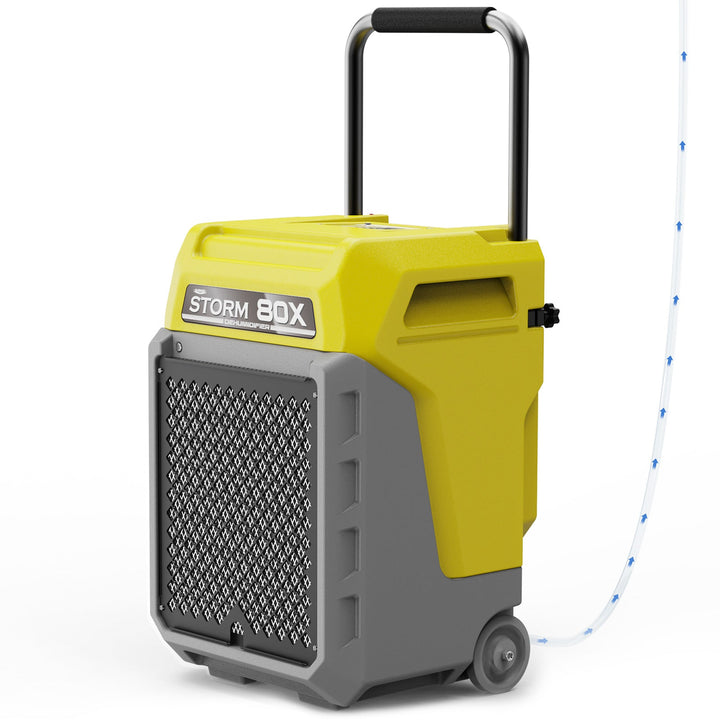
A refrigerant dehumidifier pulls room air across a cold coil, the water vapor condenses and drains away, and drier air goes back into the room. It changes the humidity number. It does not filter the air in a meaningful way, and its job is moisture, nothing else. For the full mechanism, see how a dehumidifier works.
An air purifier or HEPA air scrubber pulls air through filter stages and returns it to the room. It captures particles such as dust and construction debris at the filter, and it leaves water vapor in the air, so the humidity reading barely moves. To learn what the HEPA label means, read what a HEPA filter is. For the job-site version of the comparison, see air scrubber vs air purifier.

Side by side: what each machine moves
| Point | Dehumidifier | Air purifier or HEPA air scrubber |
|---|---|---|
| Removes | Water vapor | Airborne particles caught in its filters |
| Moves the RH reading | Yes, that is its job | Barely |
| How it works | A cold coil condenses water, which drains or collects | A fan pulls air through filter stages |
| Rated by | Pints per day at a stated temperature and RH | Rated airflow in CFM |
| Range in this guide | 24 pints per day at 80°F and 60% RH, to 52 pints at AHAM conditions | Rated at 550 to 750 CFM |
| Power in this guide | 4 to 5 A, 470 to 480 W | 2.8 to 4.5 A |
| Water to deal with | A drain hose or a reservoir to empty | None |
| Upkeep | Clean the coil, filter and drain | Clean or replace stages when the filter change light comes on |
| Heat added | Air leaves about 2°C warmer, per Ebac's brochure | Motor heat only |
| Damp rooms | Built for them | XPOWER's manuals warn high humidity can block and damage the filters |
| Fixes the cause | No, the water source still needs fixing | No, the dust source still needs control |
| Price in our range | From about $430 | From about $500 |
The figures below are the makers' ratings as listed on our product pages, with the CD30-S figures from Ebac's brochure. Pints per day and CFM are different measurements and cannot be compared with each other. Dehumidifiers are rated in water per day and scrubbers in air moved. XPOWER's specs and manuals give no noise figure for either scrubber.
| Machine | Job | Rated output | Power | Noise | Price |
|---|---|---|---|---|---|
| Ebac CD30-S | Moisture | 24 pints per day at 80°F and 60% RH (Ebac brochure) | 4 A, 480 W (Ebac brochure) | 47 dB | $1,207 |
| Ebac Neptune | Moisture | 52 pints per day at AHAM conditions | 5 A, 470 W max | 57 dB max | $1,667 |
| XPOWER X-2830 | Particles | Rated at 550 CFM, 4 stages ending in HEPA | 2.8 A | $615 | |
| XPOWER X-4700AM | Particles | Rated at 750 CFM, 3 stages with a HEPA50 filter | 4.5 A, 520 W motor | $901 |
Ebac's brochure rates the CD30-S at 24 pints per day at 80°F and 60% RH, and at 15 pints per day at 65°F and 60% RH, so a cool crawl space gets less than the headline figure. Compare pint ratings only at the same temperature and humidity. For how pints, AHAM and saturation ratings differ, see what size dehumidifier you need.
What they share
Both move air with a fan and both are sized to a space. Both need regular filter care. Neither can fix the cause of the problem. A leak keeps adding water, and a source of dust keeps adding particles.
Difference 1: what leaves the air
The dehumidifier takes out water. The purifier takes out particles. Running a purifier in a damp room will not bring the RH down, and running a dehumidifier in a dusty room will not clear the dust. That answers the question many people search: can you use an air purifier as a dehumidifier? No. A purifier has no cold coil and no condensate drain, so it has nowhere to put the water. It would only circulate the same wet air.
Difference 2: how you size them
You size a dehumidifier by the water to remove, using pints per day with the condition stated. You size a scrubber by airflow. The XPOWER X-2830 is rated at 550 CFM and the X-4700AM at 750 CFM by XPOWER. Our calculation: multiply rated CFM by 60, then divide by the room's cubic feet. A 12 x 15 ft room with an 8 ft ceiling holds 1,440 cubic feet, so the X-2830 at its rated 550 CFM turns the air about 23 times an hour; lower speeds and loaded filters move less. If you want a dehumidifier sizing method with a chart, use our sizing guide.

Difference 3: running cost and upkeep
The Neptune lists 5 A and 470 W and Ebac's brochure gives the CD30-S 4 A and 480 W, while the X-4700AM lists 4.5 A with a 520 W motor. With draws that close, running cost comes down to hours. Ebac's CD30-S brochure says its humidistat switches the unit on and off to hold the set humidity, while a scrubber runs until you switch it off or its timer does (the X-2830 has a 0.5 to 24 hour off-timer, per XPOWER's manual). What a dehumidifier costs to run shows the watts-to-dollars math. Upkeep differs as well: a dehumidifier needs its coil, filter and drain cleaned (see dehumidifier maintenance), and a scrubber needs its stages changed when the indicator says so.
Disadvantages of a dehumidifier
Noise: the two Ebac models list 47 dB (CD30-S) and 57 dB maximum (Neptune). Power: the Neptune draws up to 470 W and Ebac's brochure lists 480 W for the CD30-S. Heat: Ebac's Neptune brochure says the air passes back into the room about 2°C warmer, so a closed room warms while it runs. Water handling: the water has to go somewhere, so you either empty a reservoir or run a hose. Operating floor: both list a lowest operating temperature of 33°F, so they are not for freezing rooms.
When a job needs both
Water damage is the classic case. Wet drywall, carpet and framing give up their water only as it evaporates, so air movers speed the evaporation and the dehumidifier pulls the vapor out of the air over days. Demolition, sanding and mold work throw particles into the air that a scrubber captures. XPOWER's scrubber manuals also warn that high humidity can block and damage the filters, so getting the RH down protects the scrubber as well. See basement mold remediation for a full job that uses both, and what an air scrubber is for the filtration side. Mold is dealt with by remediation, not by a machine.
How to choose by space
Start with where the complaint lives. In a crawl space, basement or utility room the usual cause is moisture, so read the RH there first. A compact unit with a gravity drain, such as the CD30-S, suits a small enclosed space because the hose can run to a drain and you never empty a reservoir. Ebac's brochure says the unit must sit higher than the drain for the water to flow, so check for a lower drain point before you choose it. For a larger wet area with materials to dry, the Neptune's 52 pints at AHAM conditions and 282 CFM fan give it more to work with.
In an office, shop or finished room where the complaint is dust, the XPOWER X-2830 is the smaller of the two scrubbers and lists a PM2.5 sensor.

On a job site where several units share one run of power, the X-4700AM has two GFCI outlets for daisy-chaining, but XPOWER's manual caps them at 8.5 A in total while the scrubber runs: enough for a Neptune at 5 A, not for a Neptune plus a second X-4700AM (5 A plus 4.5 A is 9.5 A, our calculation). XPOWER's manuals also say to plug its scrubbers only into GFCI-protected receptacles. Whichever you choose, check the amps against the circuit before you add a second machine.
If the reading is high and the complaint is also dust, fix the water source and get the dehumidifier running first, then let filtration handle what is left in the air.
Which machine fits which job
| Job or symptom | Machine type | Pick from this guide |
|---|---|---|
| Damp smell, condensation, small crawl space or utility room | Dehumidifier | Ebac CD30-S |
| Wet materials after a leak, restoration work | Dehumidifier | Ebac Neptune |
| Dust or fine particles in an office or small space | HEPA air scrubber | XPOWER X-2830 |
| Demolition or sanding dust on a job site | HEPA air scrubber | XPOWER X-4700AM |
| Not sure which problem you have | Hygrometer first | Extech 445703 |

Damp crawl space or utility room
Ebac CD30-S Series Industrial Dehumidifier
From $1,207
Compact, 24 pints per day at 80°F and 60% RH (15 at 65°F), 47 dB, an adjustable humidistat and a gravity drain. Skip it if the unit cannot sit higher than a drain point, or for a large wet job where the Neptune's 52 pints fits better.

Water-damage restoration
Ebac Neptune 52 Pint Compact Restoration Dehumidifier 10199GR-US
$1,667
52 pints at AHAM conditions in a 60 lb body with a collapsible handle, a 4.9 ft drain hose and auto-restart. Skip it if 57 dB maximum is too loud for an occupied room.

Small spaces and offices
XPOWER Commercial 4 Stage Filtration HEPA Mini Air Scrubber With PM2.5 Air Quality Sensor X-2830
$615
Rated at 550 CFM with a PM2.5 sensor, 5 speeds and 4 stages ending in HEPA, at 2.8 A. Skip it if you need a unit built for daisy-chaining on a job site.

Job-site filtration
$901
Rated at 750 CFM with a HEPA50 third stage, built-in GFCI outlets and an hour meter, at 4.5 A. Skip it if you want the lightest, smallest unit.
Browse every dehumidifier, HEPA air scrubber and air scrubber we carry.
Frequently asked questions
Can I use an air purifier as a dehumidifier?
No. An air purifier has filter stages and a fan, but it has no cold coil to condense water and no drain. It circulates the same humid air, and the RH reading stays about where it was. Use a dehumidifier for moisture.
What are the disadvantages of a dehumidifier?
The main ones are noise, power draw and water handling. The Ebac models above list 47 dB and 57 dB maximum, the Neptune lists up to 470 W and the water has to be emptied or drained by hose. A dehumidifier also does nothing for dust or smoke.
What are the downsides of an air purifier or scrubber?
It does nothing for humidity, so a damp room stays damp. The filters load up and need cleaning or replacing when the filter change light comes on, and XPOWER's manuals say the carbon stage is not washable. Those manuals also warn that high humidity can block and damage the filters.
Would an air purifier help COPD or nasal congestion?
We give no health advice and make no claims about either condition, so ask your doctor. On the equipment itself, a purifier or scrubber captures airborne particles and does not change humidity, and a dehumidifier does the reverse.
Which one do I need for a musty smell?
Measure first. A hygrometer reading above the EPA's guidance of 60 percent RH points to a moisture problem, which a dehumidifier addresses. A musty smell can also come from a wet material, so find and dry the source as well.
Can I run both at once?
Yes, and on water-damage and remediation jobs that is common. The dehumidifier works on the water vapor while the scrubber works on particles, and XPOWER's manuals warn that high humidity can block and damage its scrubbers' filters. Add up the amps on each machine and the circuit they share before you plug both in, and on the X-4700AM's outlets keep the total within the 8.5 A its manual allows while the scrubber runs.
Measure the problem, then pick the machine