How we made this guide: picks, prices and specs come from our catalog and the makers' published specs, owner quotes come from customer reviews on our product pages and the guide was drafted with AI help, then checked and edited by Trevor Hall.
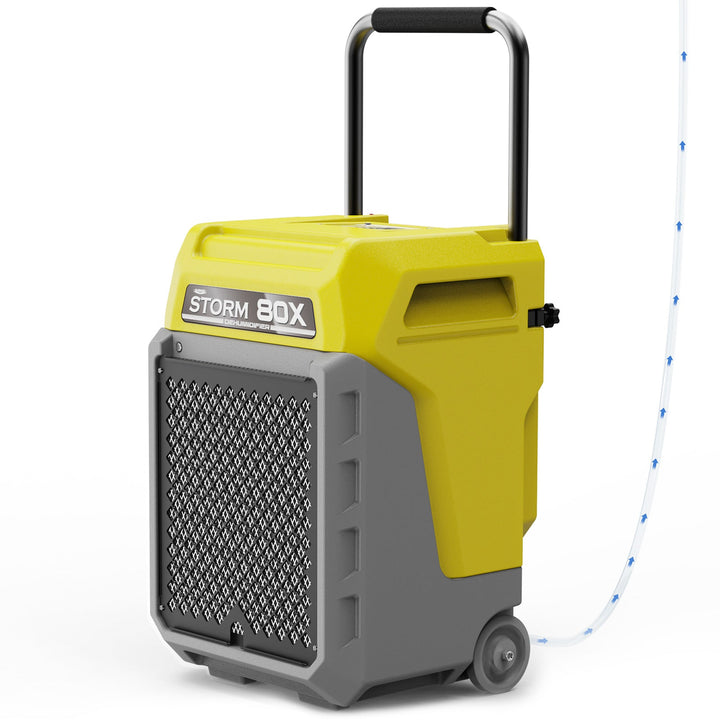
Basement mold remediation means fixing the water source, sealing the work area under negative pressure with a HEPA air scrubber, removing or cleaning the moldy materials, HEPA-vacuuming once everything is dry and then holding the basement below 60 percent relative humidity, the ceiling EPA's mold guidance gives (ideally 30 to 50 percent). The three machines that carry most of that job are the Abatement Technologies PRED1200 air scrubber at $2,230, the AlorAir Sentinel HD55S dehumidifier for basements up to about 1,300 sq ft at $648.66 and the XPOWER Viking BD-90P for bigger or wetter basements at $1,341; the seven tools in this guide run from under $100 to under $3,000.
The order of the job matters more than the machines. A dehumidifier controls moisture. Remediation, meaning cleaning and removal of the growth, is what gets mold out.
What basement mold remediation actually is
Mold remediation is the physical removal or cleaning of mold growth and of the moldy materials that cannot be cleaned, plus fixing the moisture that let it grow. No appliance does that for you. EPA's cleanup guidance puts it plainly: the key to mold control is moisture control, and mold on hard surfaces is scrubbed off with detergent and water and then dried completely.
Basements make this harder than other rooms. Below-grade walls stay cool, so warm summer air that drifts in meets a cold surface and leaves moisture behind. Concrete and block hold water for a long time, and stored boxes and carpet give mold something to grow on. For the same job in a smaller, harder-to-reach space, see our guide to crawl space mold remediation, and for a roof-level version, attic mold remediation.
The seven steps, with the equipment each one needs
1. Find and fix the water
Do this before anything else. Look for a leaking pipe or window well, a failed sump, a cracked wall, gutters dumping against the foundation or a laundry or dryer vent that exhausts inside. Cleaning mold off a wall that is still taking in water gives you the same wall in a few weeks. A pin and pinless moisture meter helps here: it maps which parts of a wall or slab are wet so you chase the source instead of guessing.
2. Decide who does the work
On size, EPA's cleanup page draws the line near 10 square feet, about a 3 ft by 3 ft patch: under that, most owners can do the work themselves. Anything bigger, or a basement hit by heavy water damage, falls under EPA's guide Mold Remediation in Schools and Commercial Buildings, which it says also suits other buildings. When sewage or other contaminated water caused the damage, EPA says to hire a professional with contaminated-water experience. Anyone with health concerns should see a health professional before cleanup starts. IICRC S520, the Standard for Professional Mold Remediation, is the reference professional remediators work from. This guide is for contractors and for owners doing the small jobs; it is not medical or legal advice.
3. Isolate the work area and run negative air
Shut off the furnace or air handler and seal any supply and return openings inside the work area before you disturb anything. EPA says not to run the HVAC system if you know or suspect it is contaminated with mold, because it could spread mold throughout the building.
Then seal the work area with poly sheeting and a zipper door, and exhaust it through a HEPA air scrubber so air moves into the work area instead of out of it. Negative pressure is how professionals keep disturbed spores from drifting upstairs. Run the scrubber's exhaust to outdoors where you can, and keep it running through demolition and cleaning. EPA's remediation guide generally recommends limited containment (a single layer of 6-mil fire-retardant poly) for 10 to 100 sq ft and full containment (double layers of poly) above 100 sq ft, kept under negative pressure with a HEPA-filtered fan unit exhausted outside the building. A pressure monitor shows whether the area really held negative, which matters when the job has to be documented.
4. Remove what cannot be cleaned
EPA guidance treats porous materials differently from hard ones. Moldy drywall, insulation, carpet and cardboard are generally bagged and removed, because the growth goes into the material. Double-bag them in 6-mil polyethylene inside the containment before moving them out, as EPA's remediation guide describes. Wear gloves, eye protection and at least an N-95 respirator: EPA's remediation guide gives those as the minimum.
5. Clean hard surfaces
Concrete, block, framing and metal can be scrubbed with detergent and water, then dried. For basement wall mold removal on painted block, wire-brush the loose paint first; in a house built before 1978, have the paint tested for lead before you brush it (see our guide to lead-safe paint removal). Repaint only once the wall is clean and dry: EPA says not to paint or caulk moldy surfaces, and paint applied over mold is likely to peel. If the surface is still damp after cleaning, the work is not finished.
6. Dry, then HEPA-vacuum
Dry every cleaned surface with dehumidifiers and air movement first. Once the materials are thoroughly dried, vacuum the whole work area, ceilings and framing first and floor last, with a HEPA-filtered vacuum; EPA's remediation guide uses HEPA vacuuming for final cleanup after materials have been thoroughly dried. A HEPA vacuum is a different tool from a shop vac: it ends in a rated HEPA filter sealed into the housing, so it can be used for fine dust that an ordinary vacuum would blow back into the room. Our guide on drying wet carpet after a leak or flood covers the carpet side.
7. Verify dryness and hold the humidity
Check wood and concrete with a moisture meter before you rebuild, and log the readings. Then control the air. EPA's mold guidance says to keep indoor humidity below 60 percent if possible, ideally between 30 and 50 percent. Its remediation guide says the job is done when the water or moisture problem is fixed and no visible mold, mold-damaged materials or moldy odors remain. A small hygro-thermometer on the wall tells you whether the basement is holding that range, and a dehumidifier with a humidity setpoint does the holding.

Why a basement changes the equipment choice
Four things separate a basement from a living room. It is cool, so a dehumidifier's output at 60 degrees is lower than the headline figure. It often has a floor drain or a sump, which decides how the machine drains. Ceilings are low and stairs are narrow, so weight and size matter. And the air is often stagnant, so a machine that can be ducted or moved room to room helps. The machines below were picked against those four constraints, from the makers' specs and our catalog data.
Sizing a dehumidifier and an air scrubber for your basement
Sizing in two lines
Dehumidifier: match the maker's coverage figure to your floor area, then go one size up for a wet basement. Air scrubber: air changes per hour = CFM x 60 / room volume in cubic feet. Our calculation, from the makers' ratings.
Maker coverage figures: the Sentinel HD55S is listed for up to 1,300 sq ft and the Viking BD-90P for 2,600 sq ft. A leaking or just-flooded basement needs more capacity than a damp one. For the air scrubber, Abatement Technologies lists the PRED1200 at 6 air changes per hour in 9,000 cubic feet, which matches our arithmetic below (900 CFM x 60 / 9,000 cu ft = 6). This uses the maker's top-speed airflow rating, so a loaded filter or lower speed gives fewer.
| Basement floor area | Volume at 8 ft ceiling | PRED1200 air changes per hour at 900 CFM | Dehumidifier coverage fit (maker figures) |
|---|---|---|---|
| 500 sq ft | 4,000 cu ft | 13.5 | HD55S (up to 1,300 sq ft) |
| 1,000 sq ft | 8,000 cu ft | 6.75 | HD55S (up to 1,300 sq ft) |
| 1,500 sq ft | 12,000 cu ft | 4.5 | BD-90P (up to 2,600 sq ft) |
| 2,000 sq ft | 16,000 cu ft | 3.4 | BD-90P (up to 2,600 sq ft) |
Subtract anything permanent that takes up volume, and add the volume of a ceiling higher than 8 ft. For negative air during the work, use the volume of the contained work area, not the whole basement. If the numbers fall between two sizes, size up.
Basement mold remediation equipment compared
| Pick | Job | Price | Key spec | Power | Used in |
|---|---|---|---|---|---|
| AlorAir Sentinel HD55S | Dry a basement up to 1,300 sq ft | from $648.66 | 55 pints/day AHAM; 120 at saturation | 115 V, 4.1 A | Steps 6 and 7 |
| XPOWER Viking BD-90P | Bigger or wetter basements | $1,341 | 85 pints/day AHAM; 195 at saturation | 115 V, 720 W | Steps 6 and 7 |
| Abatement Technologies PRED1200 | Negative air during the work | $2,230 | Up to 900 CFM; 99.97% at 0.3 microns | 120 V, 3.5 A | Step 3 |
| Abatement Technologies RPM-RT1 | Prove the area stayed negative | $1,210 | Reads -0.10 to +0.10 inWC; alarm range -0.04 to +0.04 inWC | 9 to 24 V AC or DC | Step 3 |
| Novatek 3.3 gal HEPA backpack | Final vacuuming | from $2,125 | 110 CFM electric; 170 CFM air | 120 V, 11 A (electric) | Step 6 |
| FLIR MR60 Pro | Map and verify moisture | $453.99 | Pin and pinless | Battery | Steps 1 and 7 |
| Extech 445580 | Check the humidity target | $74.99 | 10% to 90% RH | 3 V lithium battery | Step 7 |
Compare AHAM with AHAM (55 vs 85 pints) and saturation with saturation (120 vs 195), never one with the other.
How we picked
We worked from our catalog data, the makers' published specs and the order of the job above. Every pick has a role in a specific step. We did not test the machines, and none of these seven has owner reviews on our product pages, so there is no owner sentiment to report.
Best dehumidifier for most basements: AlorAir Sentinel HD55S

Best for most basements
AlorAir Sentinel HD55S 55-Pint Crawl Space Dehumidifier
$648.66
55 pints a day at AHAM, Energy Star listed, 1,300 sq ft coverage.
The HD55S is rated at 55 pints a day at AHAM conditions (80 degrees, 60% RH) and 120 pints a day at saturation (90 degrees, 90% RH). The maker lists coverage up to 1,300 sq ft, a setpoint range of 36% to 90% and operation down to 33.8 degrees. At the cooler DOE condition of 60 degrees and 60% RH, the rated output is 34.53 pints a day, which is the more realistic number for a cold basement in spring. It carries AlorAir's 12-month limited warranty from delivery.
It drains by gravity, with terminals for an external condensate pump, and has a 6 inch supply collar for ducting. It weighs 44 lb, draws 4.1 A on a grounded GFCI outlet and a 15 A circuit, and runs at less than 52 dBA. The WiFi version adds app control. For other sizes, see our mold remediation dehumidifiers.
Pros
- Wide setpoint range and a continuous mode
- Light enough to carry down basement stairs
- Energy Star listed at 2.4 L/kWh
Cons
- No built-in pump, so the drain line must run downhill
- MERV-1 filter protects the coil but does not clean the air
Skip it if the basement is over about 1,300 sq ft, or if there is no floor drain and no way to run a gravity line; look at the pump-equipped Viking below.
Best for large or wet basements: XPOWER Viking BD-90P

Best for bigger basements
XPOWER VIKING Commercial Grade Dehumidifier for Crawlspace, Basement, Attic, Garage BD-90P
$1,341
85 pints a day at AHAM, built-in pump, 2,600 sq ft coverage.
XPOWER rates the BD-90P at 85 pints a day at AHAM and 195 at saturation, with coverage of 2,600 sq ft and airflow of 180 CFM. XPOWER lists a 1 year limited warranty. Drainage is gravity or a built-in pump, and the 20 ft drain hose lets it reach a sump or a laundry tub without extra parts. The housing is stainless steel and the machine weighs 69.2 lb. The 18 ft cord reaches a nearby outlet, and it draws 720 W on 115 V.

Pros
- Built-in pump for basements with no floor drain nearby
- Covers about twice the area the HD55S is listed for
Cons
- At 69.2 lb it is a two-person stair carry for some crews
- Priced about twice the HD55S
Skip it if the basement is under about 1,300 sq ft and a gravity drain is available. The smaller machine is enough.
Best air scrubber for the work area: Abatement Technologies PRED1200

Best for negative air
Abatement Technologies PREDATOR Series Portable Air Scrubber PRED1200
$2,230
Up to 900 CFM, True HEPA, 3.5 A, built-in dolly.
The PRED1200 is rated for variable airflow up to 900 CFM through a 99.97% at 0.3 micron True HEPA filter, behind a 1 inch coarse pre-filter and a 2 inch pleated pre-filter. The maker lists 6 air changes per hour at 9,000 cubic feet. It draws 3.5 A at 120 V and has 10 inch inlet and outlet collars for ducting to a window. A built-in dolly with non-marking wheels helps on stairs. It is NRTL-certified to UL and CSA standards. Read more on filters in what a HEPA filter is, and browse our HEPA air scrubbers for other sizes.
Pros
- Variable speed, so you can run it lower for cleanup
- Low amp draw leaves room on a basement circuit
Cons
- 900 CFM is the top of the variable range, and airflow drops as the filters load
- It filters air; it does not clean the surfaces mold grew on
Skip it if you are only drying a basement with no demolition or disturbance. A dehumidifier is the right tool there.
Best for proving containment: Abatement Technologies RPM-RT1

Best for documenting containment
Abatement Technologies Single Room Pressure Monitor RPM-RT1
$1,210
Our top seller in air scrubbers and containment; logs 12,000 events.
The RPM-RT1 is a wall-mounted pressure monitor. The spec rows give a display range of -0.10 to +0.10 inWC, a narrower alarm window of -0.04 to +0.04 inWC, green, yellow and red color coding and an 85 dB buzzer measured at 4 inches. Up to 12,000 events are logged, and they export to a USB flash drive. Abatement Technologies lists it for healthcare isolation rooms, and the same reading applies to a sealed mold work area: the log shows the area stayed negative while the scrubber ran.
Video from the maker
Pros
- Alarm and log prove the pressure relationship
- 0.5 lb and wall mounted
Cons
- Priced for contractors who document jobs
- Small owner-run jobs do not need one
Skip it if the job is a few square feet of surface mold and you are not documenting for anyone.
Best for the final vacuum: Novatek 3.3 gal HEPA backpack

Best for HEPA cleanup
Novatek 3.3 Gal HEPA Backpack Vacuum, Air or Electric
$2,125
Backpack format, four filtration stages ending in a tested and certified HEPA filter.
The Novatek 3.3 gallon backpack comes in an air model and an electric model. The electric version moves 110 CFM with 110 inches of static lift on 120 V at 11 A and takes a 25 ft hose run. The air version moves 170 CFM with 160 inches of lift and can run 75 ft of 1.5 inch hose from a compressor that supplies 50 cfm at 90 psi. The spec sheet lists four filtration stages ending in a tested and certified HEPA filter. A backpack suits basements because you carry it up and down stairs on your back and reach joists and framing without a drag hose.
Pros
- Wearable, so stairs and framing are easy
- Air model needs no electrical supply
Cons
- The 3 gallon bag fills fast on a big demolition
- The air model needs a compressor sized for the vacuum and any tool
Skip it if you need to vacuum a large open floor; a HEPA floor vacuum is faster. Browse our HEPA vacuums for larger units.
Best for moisture mapping: FLIR MR60 Pro

Best moisture meter
FLIR MR60 Pro Moisture Meter Pin and Pinless
$453.99
Pinless sweep plus pin readings, 11 material groups, 10,000 stored readings.
The MR60 Pro has a pinless sensor for scanning drywall and flooring without leaving a mark, and an external pin probe for resistive readings in wood and other materials. It offers 11 selectable material groups for pin readings, a programmable high-moisture alarm, a 2.3 inch color display, USB transfer of up to 10,000 saved screenshots and readings, and a 3 meter drop rating. FLIR lists a 2 year warranty. Use it to sweep the walls first, then confirm suspect spots with pins; it is also how you prove the studs are dry before the wall is closed. See all of our moisture meters.

Pros
- Both pin and pinless in one tool
- Saves readings for the job file
Cons
- A higher price than a pocket meter
- Reads moisture content, not mold
Skip it if you only want a quick check of an obviously wet spot and a pen-style meter will do.
Best for tracking the humidity target: Extech 445580

Best simple RH check
Extech 445580 Compact Digital Hygro-Thermometer 14 to 122°F
$74.99
Pen-style, shows temperature and humidity together, min/max memory.
The Extech 445580 is a pen-style hygro-thermometer that shows temperature and humidity at once, reads 10% to 90% RH and 14 to 122 degrees F, holds data and keeps minimum and maximum readings. Leave it on a shelf away from the dehumidifier outlet and check it against the 30 to 50 percent target. It runs on a 3 V lithium battery.
Pros
- Low-cost way to check the number that matters
- Min/max memory shows overnight swings
Cons
- No data logging to a computer
- Needs calibration bottles for self-calibration
Skip it if you want a graph of humidity over weeks; look at a datalogging meter instead.
Setup tips for the basement
- Start drying as soon as the water source is stopped: EPA says to dry water-damaged areas and items within 24 to 48 hours to prevent mold growth. On a mold job, cut out the moldy porous materials first, then dry; running a dehumidifier while water still gets in just pulls water out of a wall that is taking more in.
- Keep the inlet and discharge off the walls: AlorAir's HD55S manual asks for at least 36 inches of clearance at the discharge, with the discharge blowing away from a wall. Set the drain line before you plug it in, and give a gravity hose a steady downhill run.
- Keep stored items off the floor and away from exterior walls. Plastic bins on shelves dry; cardboard on concrete does not.
- Log humidity daily for the first week and weekly after. A reading that stays above 60 percent usually means the dehumidifier is undersized, a door or window is open or water is still getting in.
- Service the machine. A dirty filter or coil cuts output; see our guide to dehumidifier maintenance. To understand why different types behave differently, read how a dehumidifier works.
Frequently asked questions
What exactly is mold remediation?
It is the cleaning or removal of mold growth, the disposal of materials that cannot be cleaned, and the repair of the moisture problem that caused it. A dehumidifier or air scrubber supports the work but does not replace it.
Is it possible to clear mold out of a basement?
Yes, when the water source is fixed, the growth is cleaned or removed and the space is dried. Without those, it tends to return, because mold needs moisture. EPA's guidance centers on moisture control for exactly that reason.
Is it safe to live in a house with mold in the basement?
EPA says inhaling or touching mold or mold spores may cause allergic reactions in sensitive people, and that mold exposure can irritate the eyes, skin, nose, throat and lungs of both mold-allergic and non-allergic people. Fix the moisture and clean up promptly, and do not run the HVAC if you suspect it is contaminated. If anyone in the house has health concerns, EPA says to consult a health professional; this guide is not medical advice.
Is bleach or vinegar better for basement mold?
Neither replaces removal. EPA says routine use of a biocide such as chlorine bleach is not recommended during mold cleanup, and that the mold itself must be cleaned or removed. For hard surfaces, EPA's basic steps call for detergent and water, then complete drying. Do not mix bleach with other cleaners.
What do professional crews use on basement mold?
Method and equipment, not a magic product: containment with poly sheeting, HEPA air scrubbers running negative air, HEPA vacuums, detergent cleaning, removal of porous materials and dehumidifiers with air movement for drying. A moisture meter confirms the result.
What does basement mold remediation cost?
It depends on the affected area, how much drywall, insulation and carpet has to come out, the containment level (limited or full), access and whether the water was contaminated. Fixing the water source is a separate job with its own cost. For a contractor's equipment, the tools in this guide run from under $100 to under $3,000 each.
What time of year is mold worst in a basement?
Typically the humid summer months, when warm moist air meets cool basement walls and slabs. That is our reasoning from how humidity behaves, not a measured figure. A basement can grow mold in any season if water gets in.
Will homeowners insurance cover basement mold?
It depends on the policy and on how the water got in. Policies differ on sudden leaks, groundwater and long-term seepage, so read yours and ask your insurer before work starts. We cannot advise on a claim.
When should I call a professional?
EPA advises calling one for sewage or other contaminated water. Consider one too when the growth covers much more than a 3 ft by 3 ft patch or the water damage was heavy. Anyone in the house with health concerns should check with a health professional before cleanup begins. We can point you to equipment, but we cannot assess your job; contact us with questions about machines.
Can I do basement mold remediation myself?
For small areas of surface growth on hard materials, owners commonly do. Fix the water first, wear gloves, eye protection and a respirator, scrub with detergent and water and dry completely. Use the seven steps above as a checklist, and stop and call a pro if the job is larger than it first looked.
Dry the basement and keep it dry