How we made this guide: picks, prices and specs come from our catalog and the makers' published specs, owner quotes come from customer reviews on our product pages and the guide was drafted with AI help, then checked and edited by Trevor Hall.
Clean commercial carpet tiles on three levels: vacuum daily with a wide-area or upright vacuum, treat spots the day they happen and run low-moisture interim cleaning, such as encapsulation with a counter-rotating brush machine, on a schedule set by traffic. Keep hot water extraction for restorative cleaning, with extra dry passes and air movers: Interface's carpet maintenance guide says encapsulation typically dries in 30 to 60 minutes, while extraction needs at least 3 hours before the floor takes foot traffic again.
The vacuum that carries the daily level in our range is the Tornado CK 3030 at $2,799, with a 30 inch path. Tiles have one advantage over broadloom: a tile that is ruined can be swapped for a spare instead of recut and seamed.
Quick answer
Daily: vacuum. Same day: spot treat. Interim: low-moisture encapsulation. Restorative: hot water extraction with extra dry passes, then air movers. Pick the interval from foot traffic, not the calendar. See our carpet extractors for the restorative level and the floor machines for carpet for interim work.
Tools for each level
| Level | Machine | Key spec | Price |
|---|---|---|---|
| Daily vacuuming | Tornado CK 3030 wide-area vacuum | 30 in path, 224 CFM | $2,799 |
| Interim, low moisture | Mytee CRB3017 Carpet Shark | 17 in counter-rotating brushes, 6 A, 44 lb | $2,174 |
| Interim, orbital (where the tile maker allows) | Mytee ECO17-PRO orbital | 17 in path, 60 PSI, 4 gal tank | $3,158 |
| Restorative extraction | Tornado Marathon 2000 | 20 gal tanks, 100 PSI, 19 in path | $7,138 |
| Spots | Mytee S-300H Tempo | 55 PSI, 600 W heater, 1 gal | $967 |
| Drying | XPOWER PL-700A | 1,050 CFM, 2.8 A | $271 |
Before you start: stop soil at the door
Interface's carpet maintenance guide says interior walk-off mats should run at least 6 feet inside the entrance, and that at 15 feet they can remove 80% of soil and moisture before it reaches the carpet. Put mats at elevators, water coolers and food areas too, and vacuum them on the very heavy schedule.
Step 1: Vacuum daily
Interface's carpet maintenance guide calls vacuuming the single most important part of a maintenance program, because it removes dry soil before it wears the pile. Grit works down into the pile, cuts the fibers and turns the surface dull long before it looks dirty. A daily pass in entries, corridors and open-plan floors removes it before it grinds in.
A wide-area vacuum covers the floor faster than an upright. The Tornado CK 3030 lists a 30 inch cleaning path, a 224 CFM vacuum from dual 1 hp motors and 5 pile height settings, so you can set the brush to the pile of the tile you have. It has a 75 ft cord, which is useful in a long corridor. Its 30 inch path, 63 inch water lift and 224 CFM fall inside the width, water lift and airflow in the vacuum spec of Interface's guide, and Tornado rates it at up to 10,000 square feet an hour. Its filtration is a 4-stage clean-air system, not HEPA, which Interface's guide strongly recommends.

Daily vacuum
Tornado CK 3030 - 30" Wide Area Vacuum (93030)
$2,799
Our best seller in floor care among the machines in this guide, with a 30 inch path for corridors and open floors.
Pros
- 30 in path covers large floors in fewer passes
- 5 brush height settings for different piles
- 75 ft cord
Cons
- Tornado's spec sheet lists 95 lb net, heavy to lift on stairs
- 4-stage filtration, not HEPA
- Too big for small offices
Skip it if the building is a small office: a standard commercial upright does the same job for less money. Browse our wide-area vacuums for other sizes.
Step 2: Treat spots the same day
A fresh spill lifts out with a little water and a few passes. An old one has set into the fiber and takes a stronger product and more water, which is exactly what you want to avoid on a tile.
- Blot, do not rub. Lift as much as you can with a clean white cloth.
- Try plain water first. If the spot stays, test the spotter on a hidden area for color transfer, then apply a little, working from the edge to the center.
- Extract with a small machine. Rinse lightly, then extract again until the tile feels only damp.
- Rinse the spotter out with clean water.
- Blot dry, point a fan at the spot and wait about an hour before vacuuming.
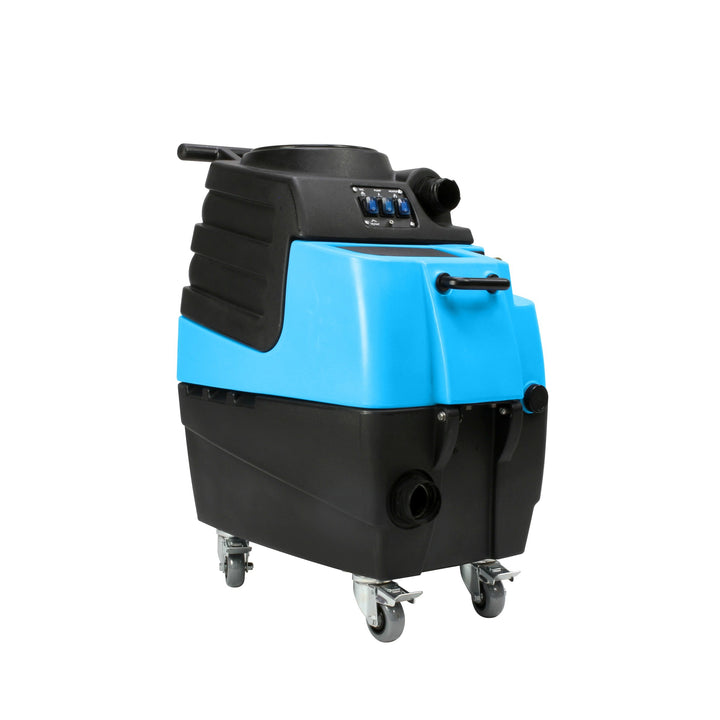
Interface's guide says a portable extractor significantly improves spot removal and makes flushing spots and removing excess moisture easier. The Mytee S-300H Tempo has a 1 gal solution tank, a 1 gal recovery tank, a 55 PSI pump and a 600 W heater. It weighs 28 lb.


Spot treatment
Mytee S-300H Tempo Heated Spotter Extractor, 1 gal., 55 PSI
$967 · 5.0 from 4 reviews
A 28 lb spotter that you can carry to a spill in a corridor or office.
“Highly recommend this over anything else.”
Mytee S-300H Tempo Heated Spotter Extractor owner · 5 out of 5 stars
Skip it if your spots are the size of a room: a 1 gal tank fills quickly. For a bigger spill, the self-contained extractor in step 4 is the better fit.
Step 3: Run interim cleaning with low moisture
Interim cleaning is the level most buildings skip, and it is the one that stretches the time between deep cleans. The method is encapsulation: a polymer cleaner is applied to the carpet, a counter-rotating brush machine works it in, the cleaner dries into crystals that hold the soil, and the next vacuuming removes both. Very little water goes into the tile. Our guide to counter-rotating brush cleaning covers the CRB method and our guide to extraction versus low-moisture cleaning explains when to choose each.
Interface's carpet maintenance guide says regularly scheduled interim cleaning can prolong the need for restorative cleaning, and it lists two low-moisture interim methods: dry extraction, a moist compound brushed in and vacuumed out after about 30 minutes, and encapsulation.
- Vacuum the floor thoroughly first.
- Pre-spot stains.
- Apply the encapsulation cleaner with the machine's tank and jets, or with a pump sprayer, at the mix on the label.
- Agitate with a counter-rotating brush machine to brush the solution into the pile, the method in Interface's guide. Use an orbital pad only if your tile maker's guide allows it.
- Let the floor dry, then vacuum the residue.
Interface's guide warns that a bonnet or any other type of rotary machine is not recommended for cleaning or drying its carpet and may void all warranties, so read your tile maker's guide before you put a pad machine on the floor.
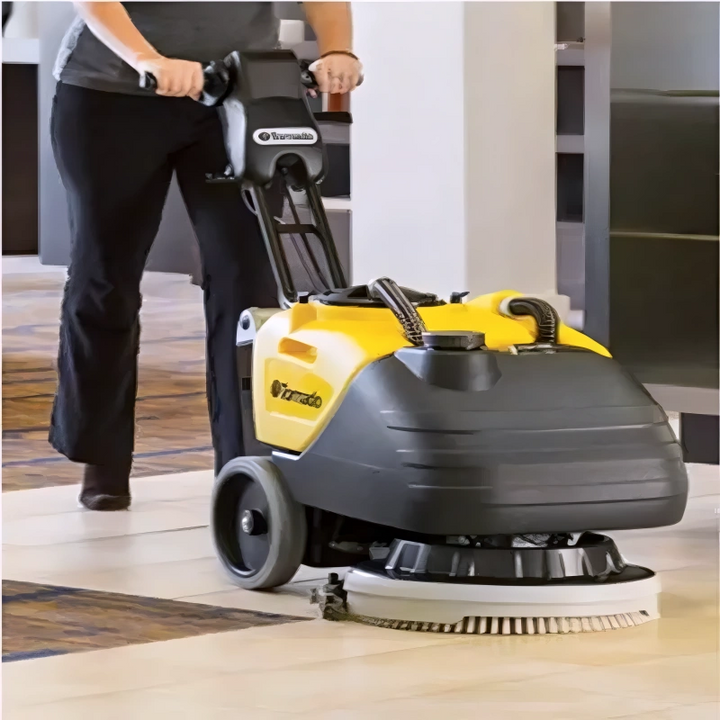
The Mytee CRB3017 Carpet Shark has two belt-driven counter-rotating brushes on a 17 inch path, draws 6 A and weighs 44 lb, and its listed uses include encapsulation and shampoo agitation. Its 6 A draw and 17 inch width sit inside the low-moisture applicator spec in Interface's guide (2 to 8 amps, 12 to 22 inches wide).


Interim cleaning
Mytee CRB3017 Carpet Shark 17″ Counter Rotating Brush
$2,174
A 17 inch counter-rotating brush machine for encapsulation, at 44 lb and 6 A.
If your tile maker's guide allows an orbital machine, the Mytee ECO17-PRO is an orbital that lists encapsulation and VLM carpet cleaning among its uses. It has a 17 inch cleaning path, a 4 gal solution tank and a 60 PSI pump feeding two V-jets. It draws 20 A at 115 V.


Interim, orbital
Mytee ECO17-PRO All Surface 17″ Orbital Floor Machine, 1.5 horsepower
$3,158
A top floor-care seller for encapsulation, with a 17 inch path and a built-in solution tank.
Pros
- Built-in 4 gal solution tank and jets
- Also lists tile and grout, LVT and VCT among its uses
Cons
- Listed at 120 lb
- Mytee's manual says it requires a 20 amp, 115 V outlet, so check the building's outlets before the job
Skip it if your tile maker's guide calls for counter-rotating brushes, as Interface's does: use the CRB3017 above. See floor machines for carpet for the options.
Step 4: Restore with hot water extraction, and keep the water down
Interface's carpet maintenance guide calls hot water extraction the most effective restorative method and the only one it recommends, and it sets out this procedure:
- Vacuum the floor first.
- Pre-spray the whole floor, not just the traffic lanes, with an electric or pump sprayer.
- Agitate with a counter-rotating brush machine and allow 10 minutes of dwell time.
- Extract with clean water only, in passes of about 3 to 5 feet that overlap the last by about 2 inches, going over each area two or three times.
- Make several more passes with the solution off to pull out as much water as you can.
- Run the HVAC, set air movers during and after the job and keep foot traffic off until the tiles are dry. Interface says to plan on at least 3 hours.
Interface recommends water between 110 and 130°F. Our guide to using a carpet cleaning machine has the pass-by-pass steps.
Check the tile maker's care guide before you extract a whole floor. Glued and loose-lay tiles are installed differently, and the written guide is where the maker sets its limits on water. Interface's guide says it is important not to over wet the carpet. Our guide to cleaning high-traffic carpet covers the same idea for broadloom.
The Tornado Marathon 2000 is a self-contained extractor with 20 gal solution and recovery tanks, a 100 PSI pump, a 19 inch cleaning path and a traction drive. It lists a productivity of 4,193 sqft/hour and a 135 inch waterlift. Tornado's manual says to fill it with hot water, never above 140°F, keep defoamer in the recovery tank and turn the spray off about 6 inches before the end of each pass. It runs on a standard 15 A, 115 V circuit. Its 100 PSI pump, 20 gal tanks and 135 inch waterlift at 95 CFM fall inside the pressure, tank and water lift ranges of the extractor spec in Interface's guide.


Restorative extraction
Tornado 20-Gal Marathon 2000 Self-Contained Carpet Extractor w/Traction Drive (98190)
$7,138
Large tanks and a traction drive for big floors, with a 135 inch waterlift.
Skip it if your floors are small. A 190 lb machine is a lot to move for a single office. Compare the self-contained extractors and, for smaller jobs, the carpet extractors range.
Step 5: Dry the tiles fast
Drying is part of cleaning. Interface's guide says to run the HVAC and use air movers on wet areas during and after cleaning, and to keep foot traffic off until the carpet is dry. Tornado's Marathon 2000 manual adds a tip for furniture: set a small square of foil or 6-mil poly under the legs so moisture does not mark the finish or rust metal glides. Open doors if the weather allows and set air movers at an angle across the wet area. Our guide on how long carpet takes to dry has drying times, and air mover versus fan explains which blower fits.
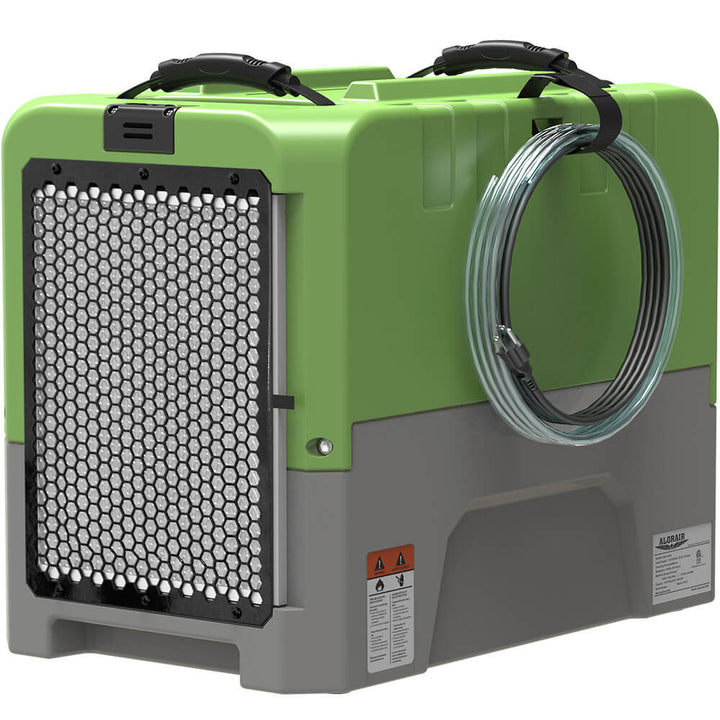
A low-profile air mover suits a floor you need to keep open. The XPOWER PL-700A lists 1,050 CFM at 2.8 A on its highest speed, stacks up to 6 units high for transport and has built-in daisy chain outlets.


Drying
XPOWER 1/3 HP 1050 CFM 3-Speed Professional Low Profile Air Mover with Daisy Chain Outlets PL-700A
$271
A low-profile air mover that fits under desks and along corridors.
Skip it if the area is small and a single standard fan already clears it overnight.
Cleaning schedule by foot traffic
Interface, a carpet tile maker, publishes a cleaning frequency chart by foot traffic in its carpet maintenance guide and labels it a recommended frequency guide per IICRC S100. Count or estimate the foot traffic through each zone, start from the chart, then adjust to what the tiles show. The zone examples in the last column are ours.
| Traffic (foot traffics per day) | Vacuum | Spot clean | Interim | Restorative | Typical zones (our examples) |
|---|---|---|---|---|---|
| Light: under 500 | 1 to 2 times a week | Daily or as soon as spots are noticed | 1 to 3 times a year | 1 to 2 times a year | Storage, low-use rooms |
| Medium: 500 to 1,000 | Daily in traffic areas, 3 to 4 times a week overall | Daily or as soon as spots are noticed | 3 to 6 times a year | 2 to 4 times a year | Private offices, meeting rooms |
| Heavy: 1,001 to 2,500 | Daily in traffic areas, 4 to 7 times a week overall | Daily or as soon as spots are noticed | 6 to 12 times a year | 3 to 6 times a year | Open offices, retail aisles |
| Very heavy: over 2,500 | 1 to 2 times a day in traffic areas, 7 times a week overall | Daily or as soon as spots are noticed | 12 to 52 times a year | 6 to 24 times a year | Entries, lobbies, main corridors |
Interface's guide adds that walk-off mats should be maintained on the very heavy schedule.
Clean or replace the tile
Some tiles are not worth cleaning. Replace a tile when a stain has gone through the backing, when an edge has curled or when the face is worn bare. Keep a few spare tiles from the original dye lot in storage, so the replacement matches. Lift the damaged tile with a flat bar or tile lifter and fit the new one the way the tile maker's installation guide says: it tells you whether to re-apply adhesive and which way the arrows on the back must point to match the installation. A loose-lay tile comes up by hand.
Rotate tiles from high-wear lanes to low-traffic areas to even out the wear, if the maker allows it for the pattern you have.
Notes by floor size
Small offices: a commercial upright, the S-300H for spots and a portable extractor on the restorative dates. Large floors and corridors: the CK 3030 for daily passes, the CRB3017 for interim cleaning and the Marathon 2000 for restorative work, with low-profile air movers to dry.
Common mistakes
- Skipping daily vacuuming, then trying to catch up with water.
- Soaking the floor with a solution when a spot only needs a damp tile.
- Leaving a tile wet with no air movement.
- Using too much encapsulation cleaner, which leaves residue that attracts soil.
- Using a cleaner the tile maker rules out. Interface's guide says to avoid products with a pH over 9.5, optical brighteners or oil-based defoamers, and to dry a little of any solution in a glass dish for 24 hours: if it leaves an oily, sticky or waxy residue, do not use it.
- Using a bonnet or rotary machine on tiles whose maker warns against it.
- Letting people walk on wet tiles, which Interface says can cause fiber damage and rapid re-soiling.
- Ignoring the maker's care guide.
Frequently asked questions
What's the best way to clean carpet tiles?
Use a layered program: daily vacuuming, same-day spot treatment, low-moisture interim cleaning and hot water extraction as often as the traffic calls for. Each level cuts the need for the next, and a tile that is cleaned often needs less water when it is deep cleaned.
Can carpet tiles be vacuumed?
Yes, and they should be vacuumed daily in busy areas. Set the brush height for the pile, so the brush agitates without fraying the face. A wide-area vacuum such as the Tornado CK 3030 covers corridors quickly.
Can you steam clean carpet tiles?
Yes. Hot water extraction, often called steam cleaning, is the only restorative method Interface's carpet maintenance guide recommends. It recommends water between 110 and 130°F, says not to over wet the carpet and says to plan on at least 3 hours of drying before foot traffic.
Is encapsulation good for carpet tiles?
Yes, where the tile maker allows it. Interface's carpet maintenance guide lists encapsulation as an interim method: the solution dries into crystals, typically in 30 to 60 minutes, and is vacuumed out, so the floor goes back into service quickly. It does not replace the periodic hot water extraction Interface recommends for restorative cleaning. Our guide to CRB carpet cleaning compares the machines.
Do I need to rinse carpet tiles after cleaning?
After spotting and extraction, yes. Interface's carpet maintenance guide says to flush spotting solutions out with clean water and to extract with clean water only after the pre-spray. Encapsulation is the exception: the residue dries into crystals that you vacuum up.
Do carpet tiles need chair mats?
Not always. Interface's guide says chair pads are not required with any Interface carpet. Other makers set their own rules, so check the guide for your tile.
What are the disadvantages of carpet tiles?
Seams can show, especially on plain colors, and a replacement from a new dye lot may not match, which is why spare tiles from the original lot matter. Glued tiles also limit how much water you can use, so the tile maker's care guide sets the method. The upside is that you can swap a damaged tile instead of replacing the whole floor.
How do I remove odor from carpet tiles?
Find the source, extract it lightly and dry the area fast. Our guide on getting rid of carpet odor covers the steps.
Build your carpet tile program
Related guides
- CRB Carpet Cleaning: How Counter-Rotating Brush Machines Work and When to Use One
- Hot Water Extraction vs Encapsulation and Low Moisture Cleaning: Which to Use When
- How to Use a Carpet Cleaning Machine: The Pro Extraction Steps, Passes and Settings
- How Long Does Carpet Take to Dry After Cleaning? (And How to Dry It Faster)