How we made this guide: picks, prices and specs come from our catalog and the makers' published specs, owner quotes come from customer reviews on our product pages and the guide was drafted with AI help, then checked and edited by Trevor Hall.
To deep clean a car interior, work from top to bottom and from dry to wet: take everything out, vacuum, blow out the seams, pre-spray the fabric, agitate, rinse with a hot water extractor, dry the cabin with airflow and only then add a protectant. A pro rig for that job starts with a heated detail extractor such as the Mytee HP90 Stingray at $2,070, plus a wet/dry vacuum such as the Dapper Supply 6 gallon at $110. It is moderate work, and drying is the longest part.
Quick answer
Dry soil first, wet cleaning second, drying last. The order matters more than the product: vacuuming after you wet the carpet turns dust into mud, and protectant sprayed on damp fabric seals the moisture in. For machines, browse our auto detailing extractors, the heated auto detail extractors, wet/dry vacuums and air movers.
If your job is mostly the seats, our guide on cleaning cloth car seats with an extractor goes deeper. Car carpet gets its own page in cleaning car carpet and headliners in cleaning a car headliner.
The eight steps at a glance
| Step | Tool | What to avoid |
|---|---|---|
| 1. Empty the cabin and pull the mats | Hands, trash bag | Leaving small items under seats where the vacuum cannot reach |
| 2. Vacuum everything dry | Wet/dry vacuum with a crevice tool | Wetting anything before the loose soil is gone |
| 3. Blow out seams and vents | Blower port on a wet/dry vacuum | Blowing debris onto surfaces you already finished |
| 4. Pre-spray fabric and carpet | Pre-spray made for carpet and upholstery | Soaking the fabric |
| 5. Agitate | Soft brush | Scrubbing hard enough to fuzz the fabric |
| 6. Rinse and extract | Heated extractor with a clear-top upholstery tool | Repeated wet passes on the same spot |
| 7. Dry the cabin | Air mover, doors open | Closing the car up while it is damp |
| 8. Wipe hard surfaces and protect | Microfiber, a product made for the surface | Protectant on damp fabric |
What you need
A full interior takes four machines or fewer. Two are non-negotiable: a vacuum that can pick up dry soil and a way to rinse and pull water back out. The air mover is the easiest to leave out, and it is what gets the fabric dry before the car is closed up.

Main extractor
Mytee HP90 Stingray Heated Automotive Detail Extractor, 120 PSI, 5 gal
$2,070
Heated rinse and extract for seats, carpet and mats in one machine.
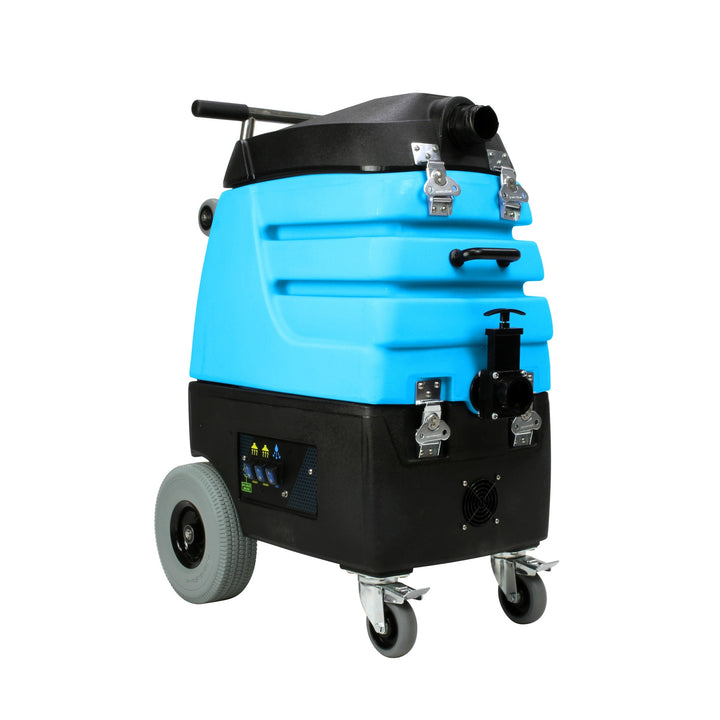
The Mytee HP90 Stingray is a 5 gallon heated detail extractor. The spec rows list a 1,200 watt in-line heater, a 120 PSI pump, 100 CFM of airflow, 130 inches of water lift, 5 gallon solution and recovery tanks and a 65 lb weight. Mytee's HP90 spec sheet lists a 15 ft vacuum and solution hose combo and the Air Lite upholstery tool in the box. Mytee rates the 1,200 watt heater at 210°F maximum, and it is one of our best-selling detail extractors. It draws 20 A at 115 V on a single 25 ft cord. Mytee's HP90 manual says it runs off a single grounded 20 amp outlet and tells you not to use extension cords, so park it within 25 ft of a 20 A outlet and keep other loads off that circuit.

Spare rinse tool
Mytee 8400P Air Lite Upholstery Tool
$169
The clear-top tool that ships with the HP90; buy it as a spare or a second tool.
The tool in that box is the Mytee 8400P Air Lite: a 4 inch nylon head with a clear top, a 1.5 inch vacuum connection, a brass spray jet and a comfort-grip lever, at 1.25 lb. Buy one separately only as a spare or a second tool.

Dry vacuum and blower
Dapper Supply 6-Gallon Wet/Dry Vacuum, 3.0 Peak HP, 3-in-1 Stainless Steel Shop Vac
$110
Budget dry vacuum for the first pass, with a blower port for air purging.

Lower-priced spot unit
Tornado Marathon 350 Carpet Spotter / Extractor (98132)
$564
Unheated spray-and-rinse spotter with 1.5 gallon tanks, for spot work and small rinse jobs.

Cabin dryer
$109
Small air mover with a 3-hour timer for drying carpet and seats with the doors open.
Step 1: Empty the cabin and pull the mats
Remove trash, child seats, cargo and the floor mats. Pulling the mats first gives you the carpet underneath, which is where most grit sits. Rubber mats can be washed outside the car, and carpeted mats go through the extractor later.
Step 2: Vacuum everything dry
Vacuum the headliner edges, seats, console, door pockets and carpet before any liquid touches the car. Work top to bottom so soil falls onto surfaces you have not done yet.
The Dapper Supply 6 gallon wet/dry vacuum lists 108 CFM of airflow, 74.3 inches of water lift and a 16.4 ft power cord. Its hose is 3.9 ft long, which is short for a car: you will carry the vacuum into the footwell rather than reach in from outside the door. If you plan to do cars all day, a vacuum with a longer hose saves trips. Skip it if you already own a longer-hosed vacuum and only need a blower.

If a vacuum is your main buying question, our guide to the best vacuums for car detailing compares shop vacs, backpacks and extractor combos.
Step 3: Blow out seams and vents
Air purging pushes dust out of places a nozzle cannot enter: vent louvers, seat rails, the gap between the console and the seat and stitching on the dash. The Dapper Supply vacuum has a blower port, listed in its functions as wet, dry and blower. Move the hose to that port, aim from the inside out and then vacuum up what lands on the carpet.

Wear eye protection for this step, because purging is dusty.
Step 4: Pre-spray fabric and carpet
Mist a pre-spray made for carpet and upholstery onto the fabric, one section at a time, such as one seat or one footwell. Test it on a hidden spot first, and check the vehicle maker's care guidance for the seat fabric, as Mytee's manual advises for upholstery. Use enough to wet the surface, not enough to soak into the foam beneath it.
Then let it dwell for the time printed on the product label. Times differ from one pre-spray to the next, so the label is the number to follow.
Step 5: Agitate
Work a soft brush across the fabric in two directions to lift soil out of the weave. On carpet, a stiffer brush is fine. On seat fabric, keep it soft: hard scrubbing fuzzes the surface and leaves the seat looking worn even when clean.
Step 6: Rinse and extract
This is where a heated extractor earns its place. Spray clean water through the tool and pull it straight back into the recovery tank, so the soil goes with it instead of staying in the fabric. The Air Lite tool does that in one stroke: the jet sprays under the clear head while you hold the lever, and the vacuum pulls the water back up through the same head.

Move in slow overlapping strokes. Mytee's HP90 manual recommends one wet pass followed by two dry passes, which it says keeps you from over-soaking the material and keeps the water hotter. Watch the clear top: when the water coming through runs clean, that area is finished. More wet passes at that point only add moisture.
Heat helps the rinse in cold weather, because a cold rinse leaves more residue behind. Mytee rates the Stingray's 1,200 watt heater at 210°F maximum. Start it in the order its manual gives to avoid a vapor lock: pump on and pull the lever until water flows steadily, then the heater on and a few minutes' wait for the water to heat, then the vacuum. Its 130 inch water lift is what pulls water back through dense floor carpet.

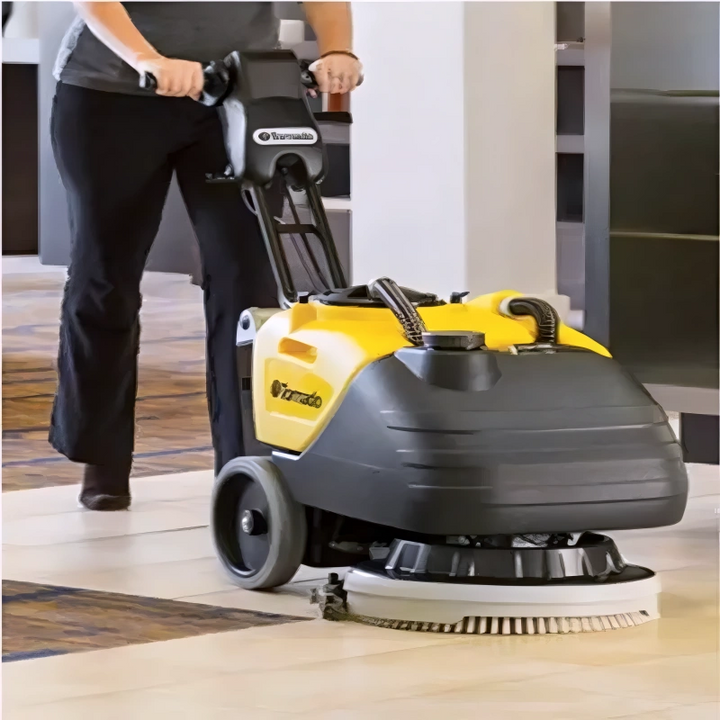
For a lower-priced route, the Tornado Marathon 350 spotter extractor rates 58 PSI with 79 inches of water lift and 1.5 gallon tanks. It weighs 22 lb and draws 9 A at the vacuum motor. Tornado's spec sheet lists an 8 ft hose and a clear-view hand tool in the box. It has no heater and small tanks, so it suits spot cleaning and small rinse jobs better than full interiors. Skip it if you do a car or more a day.

Our guide to how to use a carpet cleaning machine covers extraction passes in more detail, and the best extractors for car detailing compares heated machines by shop size.
Step 7: Dry the cabin
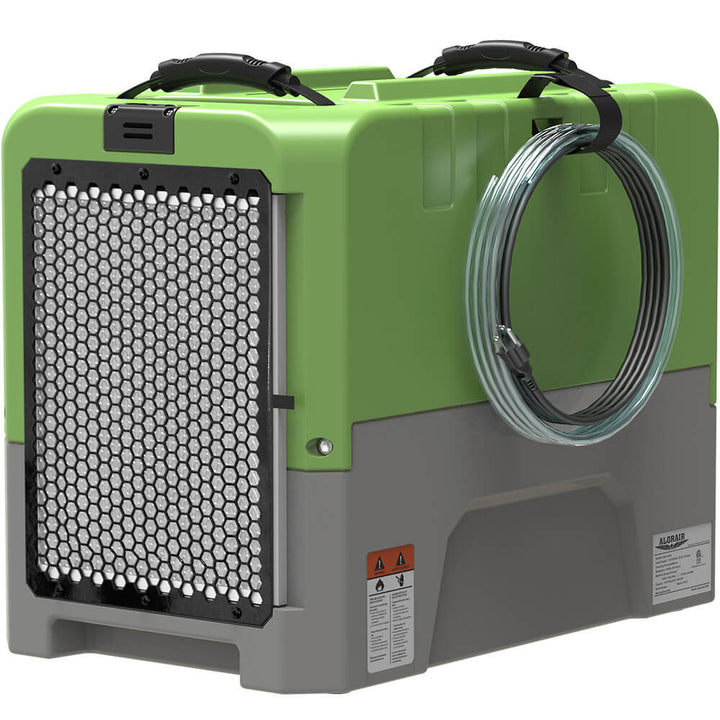
Drying is where good extraction jobs fail. Open the doors, point an air mover at the seats and footwells, and keep air moving until a dry white towel pressed hard into the seat and the footwell comes up dry, not just until the surface feels dry. The XPOWER P-230AT is a 1/4 HP centrifugal mini air mover rated at 925 CFM, drawing 2.3 A on a 10 ft cord. It has three speeds, a 3-hour timer and a kickstand that tilts it to several angles, and it comes in blue, green or red.

Mytee's HP90 manual adds that the extractor's vacuum exhaust can help dry an interior: fit a hose to the exhaust port with Mytee's Cuff-Lynx adapter (H136V for a 2 inch hose, H145V for a 1.5 inch hose) and run the vacuum.
The numbers matter for your circuit. The HP90 draws 20 A and the P-230AT draws 2.3 A, which adds up to 22.3 A, over a 20 A circuit (our calculation). Run them on separate circuits, or finish extracting before you start the dryer. See how long carpet takes to dry after cleaning. A car that still smells damp after drying points to a bigger moisture problem, covered in getting rid of carpet odor.
Step 8: Wipe hard surfaces and protect
With the fabric dry, wipe the dash, doors and console with a microfiber cloth and a cleaner made for the surface. Wipe the steering wheel, shifter, seat belt buckles and cupholders while you are there. Apply a protectant only to dry surfaces, and use it on vinyl and plastics as the label says. Use a product made for leather on leather and keep it out of the extractor.
Do the interior glass last with a glass cleaner and a separate towel, so dressing overspray does not streak it. On screens and switches, spray the cloth instead of the part, per the owner's manual.
Surfaces: what to extract and what to wipe
| Surface | Method | Watch for |
|---|---|---|
| Fabric seats | Pre-spray, agitate, extract | Soaking the foam under the cover. Some vehicle makers, Mazda among them, warn that liquid on or under the front passenger seat can affect the airbag occupant sensor, so check the owner's manual. |
| Floor carpet and mats | Pre-spray, agitate, extract, dry with airflow | Wet padding under thick carpet |
| Vinyl and plastics | Wipe with a cloth | Spraying cleaner into switches and vents |
| Leather | A leather product, applied by hand | Running it through an extractor |
| Headliner | Low moisture only | Wet glue that lets the fabric sag. See the headliner guide |
| Interior glass | Glass cleaner, separate towel, last | Dressing overspray that streaks |
| Screens and displays | Lightly dampened microfiber, per the owner's manual | Liquid sprayed straight onto the screen |
Notes by job size
Spot work and the odd full interior: the Tornado Marathon 350 and the Dapper Supply 6 gallon wet/dry vacuum, under $700 together at today's prices. Daily detailing or dealer prep: the HP90 Stingray (its Air Lite tool is in the box), the Dapper vacuum and an XPOWER P-230AT, about $2,300 at today's prices. Add a second P-230AT on its own circuit if cars queue for drying.
Common mistakes
- Overwetting. Extra passes with the spray lever pressed leave water in the foam and padding. Make one wet pass, then two dry passes, as Mytee's manual recommends.
- Leftover residue. Too much solution in the pre-spray means more to rinse out. Use the label's dilution and rinse until the water in the clear tool runs clean.
- A cold rinse in winter. Cold water rinses less well. A heated extractor or warm water supply helps.
- Skipping the dry step. Closing the car on damp fabric is how a clean car starts to smell. If it does, how to get mold out of car carpet and seats explains how to find the source.
- Protectant on damp material. It seals moisture in and leaves a blotchy finish.
Frequently asked questions
What is the best thing to clean the interior of a car with?
The method matters more than the product. Vacuum first, use a solution made for extractors on fabric and carpet, and rinse with an extractor so the soil leaves with the water. Use a cloth and a surface-specific cleaner on hard trim. Our guide to upholstery cleaning machines covers the machine side.
Can I use Dawn dish soap to clean my car interior?
You can use it by hand on a small stain, but we would not put it in an extractor. Dish soap foams. Mytee's HP90 manual says to use only low or non-foaming, non-powdered detergent, warns that damage from the wrong chemical may void the warranty, and lists foam building up in the recovery tank as the cause of water blowing out of the vacuum exhaust. Leftover soap is residue, and residue is what the rinse step is meant to remove. Follow your extractor's manual for the solution it calls for.
What household products can I use to clean my car interior?
A vacuum, microfiber cloths, a soft brush and clean water cover most of a basic clean. For a deep clean of fabric and carpet, an extractor with a solution made for it does the part household products cannot, which is pulling the dirty water back out.
What natural products can I use to clean my car interior?
Plain water and a microfiber cloth handle most dust on hard trim. On fabric and carpet, the clean-water rinse from an extractor does most of the work once a pre-spray has loosened the soil. Avoid soap-based home mixes in an extractor, for the foam reason above.
What is the best way to clean interior car seats?
Vacuum the seats, pre-spray, agitate lightly, then rinse with a clear-top upholstery tool and finish with dry passes. Then dry the cabin with the doors open. The full seat method is in how to clean cloth car seats with an extractor, and for stains see how to remove carpet stains.
What do professionals use to clean a car interior?
Detailers typically use a heated extractor with an upholstery tool, a wet/dry vacuum and an air mover for drying. For mobile work, a mobile detailing setup lists what three real rigs include.
Set up for interiors