How we made this guide: picks, prices and specs come from our catalog and the makers' published specs, owner quotes come from customer reviews on our product pages and the guide was drafted with AI help, then checked and edited by Trevor Hall.
To use a floor scrubber (an auto scrubber), dust-mop or sweep first, fill the solution tank with water and cleaner at the label's dilution and fit the right brush or pad. Then lower the deck and squeegee and walk straight, overlapping passes at the flow your manual gives. At the end of the shift, drain and rinse both tanks, clean the squeegee and float screen, then charge the batteries. The Tornado BD 17/6 is a good compact example at $4,042.
The short version
Every step below comes from the makers' own operating manuals for the machines we carry, so check your model's manual for exact control names. Browse all floor scrubbers or go straight to the walk-behind scrubbers.
What you need before you start
An auto scrubber does the washing and the drying in one pass, so the kit is short: the scrubber, a low-foam cleaner, a brush or pad that suits the floor, a sweeper or dust mop, wet floor signs and a charged battery.
Here is how the five machines in this guide compare on the numbers you need for planning a job.
| Machine | Cleaning path | Solution and recovery tanks | Power | Price |
|---|---|---|---|---|
| Tornado BD 17/6 | 17 in | 6 gal and 6 gal | 24 V AGM battery | $4,042 |
| Tornado BD 20/11L | 20 in | 11 gal and 12 gal | 24 V; lead-acid, AGM or TPPL | Lead-acid: $4,687 |
| Minuteman E20 | 20 in disc | 12 gal and 13 gal | 24 V wet lead-acid or AGM; one corded model | Brush drive, no batteries: $5,970.28 |
| Powr-Flite Phantom PFS24 | 24 in | 16 gal and 16 gal | 24 V, two 12 V batteries | $6,837.30 |
| Minuteman Max Ride 20 | 20 in disc | 18 gal and 18 gal | 24 V DC, two 12 V batteries | ECO, no batteries: $8,578.29 |

Compact example
Tornado BD 17/6 Compact Cordless Auto Floor Scrubber, AGM Battery (99617)
$4,042
A 17 in path with 6 gallon tanks and no cord, sized for restrooms, cafes and small retail floors.
Pre-start checklist
Run through these before the first pass. They are drawn from the Minuteman E20 manual's before-use and after-use checks and from the Powr-Flite and Tornado manuals.
- Sweep or dust-mop the floor. Powr-Flite's manual says loose dirt can quickly clog the vacuum system.
- Remove cords, debris and loose objects from the path. Put out wet floor signs.
- Check under the machine for leaks.
- Look at the rear squeegee blades for wear or damage.
- Check the solution and recovery tank levels and that the recovery tank is empty.
- Check the battery gauge. Start on a charge, not a warning light.
- Check for string, twine or wire wrapped around the brush.
- Stay on level floors: the E20 and Phantom manuals limit use to grades of 2%, and the Phantom manual says never to pick up flammable liquids.
Step by step: operating a walk-behind scrubber
1. Fill the solution tank
Fill with clean water at no more than 122°F (50°C), which is the limit in both the Tornado BD 17/6 and BD 20/11L manuals, then add liquid cleaner at the dilution on its label. Both Tornado manuals say to use low-foam detergent and the minimum dose, and the Powr-Flite manual says to use only non-foaming detergent. Do not mix different cleaners. Both Tornado manuals also say to put a small amount of anti-foam product in the recovery tank before you start. Do not use acid cleaners: Tornado's BD 17/6 manual says never use acid because acid solutions can damage the machine, and the BD 20/11L manual says never use pure acid.

2. Fit the brush or pad
Match the brush to the floor. Tornado's BD 20/11L manual says thicker, stiffer bristles suit smooth floors with small joints, softer bristles suit irregular floors with deep joints, and a pad holder suits smooth floors. For a deeper look at pads and brushes, read our floor scrubber pad and brush guide. Switch the machine off and disconnect power before changing a brush.
Minuteman's E20 manual loads the brush by centering the deck over it, lowering the deck and pressing down the bail handle with the key on. The brush locks onto the deck.

Brush or traction drive
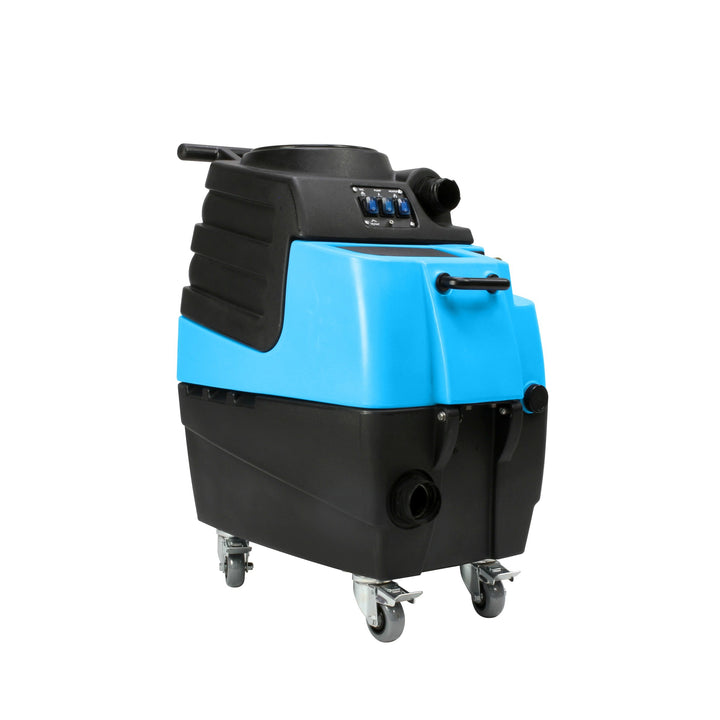
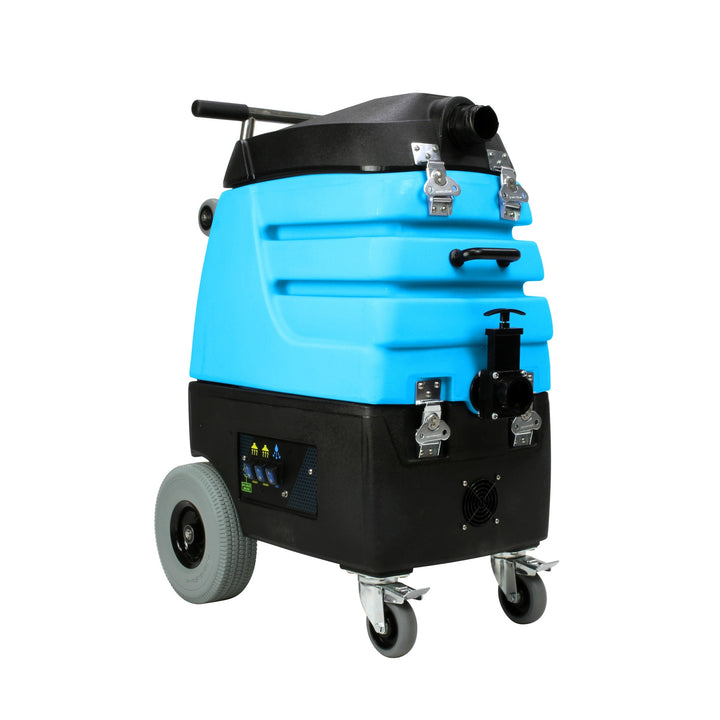
Minuteman E20 20" Disc Walk-Behind Floor Scrubber
From $5,970.28
A 20 in disc scrubber with a 33 in squeegee, in brush-drive and traction-drive versions.
3. Start the machine and set the flow
The order differs by model, so follow your manual. On the Tornado BD 17/6 you switch on, check the battery level, lower the squeegee with its lever, then press the brush, vacuum and solution switches. On the BD 20/11L you press the brush switch, check that the battery light is green, press the vacuum switch, open the solution lever, then lower the brush base with the pedal and the squeegee with its lever. On the E20 you turn the key, lower the squeegee (which starts the vacuum), lower the deck, set the solution lever and press down the bail handle.
Set solution so the floor is evenly wet without leaking out from under the splash guard. Tornado's manual says the right amount depends on the floor, how dirty it is and how fast you walk. Watch the first few feet of the first pass and adjust.
4. Scrub in straight, overlapping passes
Engage the control levers (the bail handle on the E20) and walk forward. Tornado's BD 20/11L manual says its brush, working on an inclined axle, moves the machine forward. Minuteman's E20 manual says the brush-drive model's brush assists to propel it. The BD 17/6 manual says to push the unit forward, and a traction-drive machine such as the Phantom drives itself at the speed you set. Keep the machine moving: both Tornado and Powr-Flite warn against letting the brush spin in one spot, which can damage the floor. Overlap each pass slightly with the last so no strip is missed. Release the levers to stop.
When you stop for more than a moment, close the solution valve. The E20 manual warns that solution keeps flowing if you leave the lever open.
5. Empty the recovery tank when the float shuts off suction
Each of these machines has a float that closes the vacuum intake when the recovery tank is full. When suction drops, stop, lift the squeegee and drain the tank through the drain hose into a suitable container, following local rules for disposal. On the Powr-Flite Phantom a tank-full light also shuts off the vacuum and the solution until you empty the tank and switch the key off and on.


Traction drive, 24 in path
Powr-Flite 24" Phantom Traction-Drive Scrubber PFS24
$6,837.30
Two 12 V batteries and 16 gallon tanks, with a key switch and a speed dial for the traction drive.
Squeegee setup: blade edge, height and tilt
Most streaks are a squeegee problem, so set it up before you blame the cleaner.
- Blade edge. The Tornado BD 20/11L manual says the lower blade of the rear rubber should work slightly bent backwards, evenly along its length. Check the blades weekly. The E20 manual says each blade can be turned four times to use all four edges.
- Height. On the BD 20/11L, two height registers set the bend and must be set to the same height so the squeegee runs parallel. On the E20, the caster washers set the clearance, which is 2 mm from the factory. Minuteman says to try 3 mm on uneven floors such as grouted tile and 4 mm on very uneven floors.
- Tilt. Minuteman's E20 manual adjusts angle with a screw: turning it counterclockwise raises the blade's clearance in the center, and turning it clockwise lowers it. The goal is full contact along the blade while the machine runs. Tornado's BD 20/11L manual uses a separate register for tilt.
- Keep it down. Tornado's BD 17/6 manual has you lower the squeegee with its lever before you start scrubbing. That model can also rotate its squeegee to the front so you can dry in reverse, for example in a tight corner, with the brush stopped while the machine is lifted.

Batteries and charging
Charge in a well-ventilated area, away from flames and sparks, with the battery compartment open: the Minuteman E20 manual says to charge with the battery cover removed completely, and the Powr-Flite Phantom manual with the tanks raised and locked. The Powr-Flite and Minuteman manuals both warn that charging batteries gives off explosive gas and call for protective clothing and safety glasses around battery acid, and Powr-Flite adds protective gloves when you top up the batteries. Do not leave batteries fully discharged: Tornado's BD 20/11L manual says to recharge within minutes of the discharge light blinking.
The watering routine depends on the battery type. The Minuteman E20 manual says to check wet batteries before each use and before and after charging: if the level is low before a charge, add distilled water only until the plates are covered, and never overfill. The Tornado BD 20/11L manual asks you to check the electrolyte of traditional lead batteries every 20 recharge cycles and to top up with distilled water after a complete recharge. Tornado's NexSys battery flyer describes the thin plate pure lead (TPPL) battery as one that never needs watering. The BD 20/11L is listed with lead-acid, AGM and TPPL options at different prices, so pick the battery for how much maintenance you want to do.

Three battery choices
From $4,687
A 20 in brush-assist machine rated for 3 to 4 hours of run time as listed, in lead-acid, AGM and TPPL versions.
Troubleshooting table
| Symptom | Check, in this order | From |
|---|---|---|
| Streaks or water left behind | Clean the blades, check blade height and tilt, check the suction hose is seated, clean the suction filter, replace worn rubber, check the vacuum switch is on, empty a full recovery tank | Tornado BD 17/6 and BD 20/11L manuals |
| Poor water pickup | Worn or torn blades (rotate or replace), full recovery tank, drain hose cap seated, lid gasket sealed, debris in the squeegee or hose, too much solution | Minuteman E20 manual |
| Little or no solution on the brush | Solution valve open, tank not empty, solution filter clean, water switch on | Tornado and Powr-Flite manuals |
| Too much foam | Low-foam detergent, minimum dose, a small amount of anti-foam in the recovery tank; foam can be heavier on lightly soiled floors, so dilute the solution | Tornado BD 20/11L manual |
| Floor not getting clean | Worn or wrong brush (Tornado says replace when bristles are about 15 mm), too little solution, walking too fast | Tornado BD 20/11L and Minuteman E20 manuals |
| Vacuum or brush will not run | Battery level light, battery connector plugged in, switches on, control levers squeezed | Tornado BD 17/6 manual |
| Vacuum stops mid-job | Recovery tank full; on the Phantom, empty it and cycle the key switch | Powr-Flite Phantom manual |
Notes by machine type
Brush assist, traction drive and riders
Traction drive machines add a drive motor and a speed control: the Powr-Flite Phantom has a speed dial, and Minuteman's E20 traction-drive version adds a 1/5 HP drive motor.
A rider is operated seated. Minuteman's Max Ride manual says the machine will not run unless the operator is in the seat and the tank lid is closed. With the vacuum button on, it lowers the squeegee when you move forward and raises it automatically when you select reverse. It needs a 50.5 in aisle to turn around. The ECO and SPORT versions differ in brush speed, with SPORT running 185 to 400 rpm.


Rider, ECO and SPORT
Minuteman Max Ride 20 20" Disc Rider Floor Scrubber
From $8,578.29
A 20 in disc rider with 18 gallon tanks, for large open floors where walking behind would take too long.
Common mistakes
- Too much cleaner. Even low-foam detergent foams when overdosed, and Tornado's manual warns that foam can damage the vacuum motor.
- Reversing with the squeegee down. Tornado's BD 20/11L manual says to make sure the squeegee is lifted when moving backwards. The BD 17/6 is the exception: rotate its squeegee to the front to dry in reverse.
- Pressure washing the machine. Tornado and Minuteman both say not to wash the machine with direct water jets or a pressure washer. Rinse the tanks, filters and brush instead.
- Letting batteries sit flat. Tornado's BD 17/6 manual says a completely discharged battery can be permanently damaged, and Powr-Flite's says avoiding full discharge gives a longer battery life.
End-of-day checklist
- Close the solution valve and lift the deck and squeegee, then switch the machine off.
- Take the machine to a drain. Empty the solution tank and rinse it, so dried cleaner does not clog the plumbing.
- Empty the recovery tank and flush it with a hose. Clean the float shut-off screen and the suction filter.
- Remove the brush or pad holder, rinse it and hang it to dry.
- Remove the rear squeegee, rinse it, check the blades and wipe the suction inlet and hose.
- Put the machine on charge in a well-ventilated area with the battery compartment open. On wet batteries, add distilled water before charging only if the plates are exposed, then top up to your manual's level once the charge finishes.
- Store it indoors in a dry place that does not freeze, with the tank lids open so odor does not build up. Remove the key.
The Tornado BD 17/6 manual adds that if you will not use the machine for more than two weeks, you should disconnect the battery connector. It can also be stood upright on its back for storage, which that manual recommends if the machine will sit for two to three days so the weight does not bend the brush.

Weekly, check the squeegee rubbers and flush the squeegee hose, per the Tornado BD 20/11L manual. The Minuteman E20 manual says to rinse the screened float daily and remove and inspect it monthly, and both Tornado manuals call for a service check by an authorized technician every 200 working hours.
Frequently asked questions
How do I use a walk-behind scrubber?
Sweep, fill with water and low-foam cleaner, fit the brush, lower the deck and squeegee, then walk straight, overlapping passes. Empty the recovery tank when suction drops, and drain, rinse and charge at the end of the shift.
What is an automatic scrubber?
It is a floor machine that puts cleaning solution on the floor, scrubs with a brush or pad and vacuums the dirty water back up through a rear squeegee in one pass.
What is the difference between a floor scrubber and an auto scrubber?
Nothing, in everyday use: auto scrubber is the trade name for a floor scrubber that lays down solution, scrubs and picks the wash water up again on a single pass. A rotary floor machine also scrubs, but the water is picked up separately; our burnisher vs buffer vs scrubber guide explains which machine does which job.
How do I scrub my floors: mop and bucket, or an auto scrubber?
A mop and bucket works for a small area and spills. An auto scrubber suits larger floors because it applies solution, scrubs and recovers the dirty water in one pass, leaving the floor ready for foot traffic sooner. For the right machine for tile and grout, read our best floor scrubber for tile guide.
Do you have to be certified to use a floor scrubber?
The manuals we read name no certification. They do say operators must be trained or experienced: Tornado's manual says the machine must be used by authorized staff instructed in its use, and Powr-Flite's says operators must read the manual and have training or experience. Your employer may have its own rules.
What is the best walk-behind floor scrubber?
It depends on floor size, floor type and how much battery maintenance you want. Our best floor scrubber for tile and grout picks compare eight machines, and the battery powered scrubbers and ride-on scrubbers collections cover the rest of our range. If you are still choosing a machine type, our autoscrubber buying guide compares walk-behind, stand-on and ride-on machines.
What are floor scrubbers used for?
Auto scrubbers wash and dry hard floors such as tile, sealed concrete and vinyl in one pass. Floors with a finish need the right pad and chemical: see our guides to cleaning epoxy floors and stripping and waxing VCT.
Pick the scrubber for your floor
Related guides
- Best Floor Scrubber for Tile and Grout: 8 Machines by Floor Size and Grout Condition
- Floor Burnisher vs Buffer vs Scrubber: Speeds, Pads and Which Machine Does What
- How to Clean Epoxy Floors Without Dulling the Coating: Daily, Weekly and Machine Scrubbing
- How to Strip and Wax VCT Floors: Steps, Pads, Coats and Dry Times