
How we made this guide: picks, prices and specs come from our catalog and the makers' published specs, owner quotes come from customer reviews on our product pages and every guide is checked and edited by Trevor Hall.
To clean marble floors, dust-mop or vacuum the grit every day, then damp-mop or auto-scrub with a pH-neutral cleaner made for stone and a soft pad. Acids etch marble, and that includes vinegar and lemon juice, and harsh alkaline cleaners dull it. When the shine is gone, the floor needs honing and polishing with a weighted floor machine and stone pads, which is restoration work and not routine cleaning.
Quick answer
Daily: remove grit with a dust mop or a backpack vacuum. Daily in busy lobbies, weekly in light-traffic areas: damp-mop or auto-scrub with a stone-safe, pH-neutral cleaner. Periodic: hone and polish. Browse every floor machine we carry, or start with the low-speed floor machines used for pad work.
This guide is written for the people who look after marble lobbies, corridors and showrooms with machines. One short section near the end covers a small marble floor cleaned by hand. If your floor is terrazzo, which is stone or glass chips, often marble, set in cement or resin, read our terrazzo restoration guide instead, because its rules about acid are the same but its restoration path is different.
What you need
- Walk-off matting at every entrance.
- A dry dust mop or a backpack vacuum with a soft floor tool.
- A pH-neutral cleaner labeled for natural stone.
- A microfiber mop, or a walk-behind scrubber with a soft brush for large floors.
- For honing and polishing: a weighted low-speed floor machine, a pad driver and stone pads from a stone care maker.
Why marble etches and what that means for cleaning
Marble is a soft, reactive stone. The Natural Stone Institute's consumer site, Use Natural Stone, warns that "some stones such as marble, travertine, or limestone react adversely with vinegar because it is acidic" and that vinegar and bleach "will etch or burn the surface of your stone." Lemon juice is acidic too, so the same rule applies to it.
An etch is not a stain. It is a dull patch where the acid has changed the polished surface itself, so wiping or scrubbing harder does not bring the shine back. The same site says the only way to fix an etched stone is to have it honed and restored. Scrubbing pads can make this worse, because they "act like abrasives on stone."
That gives you three working rules for every marble floor:
- Keep grit off it, because fine grit scratches the polish and dulls it.
- Use only a pH-neutral cleaner labeled for stone. The Use Natural Stone article puts the target at a pH of seven.
- Treat shine loss as a restoration job, not a cleaning job.
A care schedule for commercial marble
The table is our suggested schedule for a busy lobby or corridor. The Natural Stone Institute's consumer site recommends a dry dust mop used daily or every other day. The rest is a starting point, so adjust it to your traffic, entrances and weather.
| Frequency | Task | Tool | Watch for |
|---|---|---|---|
| Daily | Remove grit and dust | Dust mop or backpack vacuum with a soft floor tool | Sand and salt at entrances |
| Daily | Wipe spills at once | Soft cloth and clean water | Wine, coffee, juice and anything acidic |
| Daily in busy lobbies, weekly in light-traffic areas | Damp-mop or auto-scrub | Mop, or a walk-behind scrubber with a soft pad or brush the maker approves for stone | Too much cleaner left behind, standing water |
| Ongoing | Keep walk-off matting at every entrance | Matting | Worn or buried mats that stop catching grit |
| Every few years, as the shine fades | Hone and polish | Weighted low-speed machine with stone pads | Etch rings and lost gloss across traffic lanes |
Step 1: Control grit every day
Grit acts like sandpaper underfoot, and keeping it out costs the least of any step. Use walk-off matting at every entrance. The Use Natural Stone article says matting helps keep the dust and debris that scratch floors to a minimum.
For daily dust control on a large floor, a backpack vacuum covers ground fast. The Tornado Pac-Vac 10 AirComfort is rated at 110 CFM with 110 in of water lift, and its listed filtration is 4-stage with a HEPA cartridge. At 14 lb it is light enough to wear for a full shift, and it plugs into 120 V at 69.5 dB(A). Its price is $399. Fit a soft hard-floor tool and keep hard wheels and metal edges off the stone, since a hard edge dragged across polished marble leaves the same fine scratches that grit does. Empty the bag before it fills, so suction stays up for the whole floor.

Daily grit control
Tornado Pac-Vac 10 Aircomfort Backpack Vacuum (93014B)
$399
A 14 lb backpack for lobbies and corridors where a dust mop is too slow. Skip it for a single small room.

Step 2: Damp-mop or auto-scrub with a pH-neutral stone cleaner
Choose a cleaner whose label says it is for natural stone and neutral in pH. We do not sell stone cleaners, so we do not name one. Mix it exactly as the label says, because leftover residue leaves a film that looks like dullness.
A mop and bucket works for a small corridor. On a large floor, a walk-behind scrubber saves time and recovers the water as it goes. The compact scrubbers are the right size for aisles and lobbies. The Tornado 18/11 lists these specs:
- 18 in cleaning path and a 31 in squeegee.
- 11 gal solution tank and 12 gal recovery tank.
- Brush speed of 1,300 RPM and a noise level of 67 dB.
- 24 V battery, offered as a wet-acid or a TPPL variant, and a weight of 157 lb.
It is priced from $6,148.24, and the two battery variants are priced apart. Tornado's BR 18/11 brochure and manual do not mention marble. The brochure lists a Super Soft Scrub Brush (part 48901230) alongside medium, grit and grout brushes, so on polished stone start with the super soft brush and test it in a hidden corner first (source: Tornado BR 18/11 brochure and operation manual). Keep the grit brush off polished marble, because grit bristles are abrasive.

Walk-behind scrubbing
Tornado 18/11 Compact Cylindrical Brush Assist Auto Scrubber, Battery with Charger
From $6,148.24
Fits aisles and lobbies. Skip it if the floor is small enough for a mop.

For a full walk-through of setup, passes and the squeegee, see our guide to using an auto scrubber.
Step 3: Read what the floor is telling you
Before you reach for a machine, match the symptom to the cause. Only some of these are cleaning jobs.
| What you see | What it usually means | What to do |
|---|---|---|
| Dull lanes where people walk | Grit has scratched the polish | Tighten daily dust control and matting, then polish the lane |
| Round or splashed dull marks | Acid etching from a spill | Cleaning will not fix it. Hone and polish the spot |
| Fine scratches in a pattern | Grit under a pad or wheel | Inspect pads and wheels, then polish the area |
| Dark or colored marks | A stain that has soaked in | Call a stone restoration specialist, because the right poultice depends on the stain |
| A hazy film that returns after mopping | Too much cleaner left on the floor | Mop with clean water, then dilute the cleaner as the label says |
| Raised tile edges, cracks or deep etches | Lippage or damage beyond a machine | Call a stone restoration specialist |
Step 4: Hone and polish when the shine is gone
Honing removes a thin layer of stone to take out etches and scratches, and polishing then brings back the gloss. The Natural Stone Institute's consumer site says honing is the only repair for an etch. It is slow, and a mistake is permanent, so on a large or high-value floor many owners hire a stone restoration specialist.
If you do it in house, the machine matters less than the pads. We sell floor machines, pad drivers and brushes. We do not sell stone or diamond pads, so we do not name a pad brand as a pick. Follow the pad maker's instructions for grit order, for wet or dry use and for the slurry, because those rules differ by product.
The weighted low-speed buffer
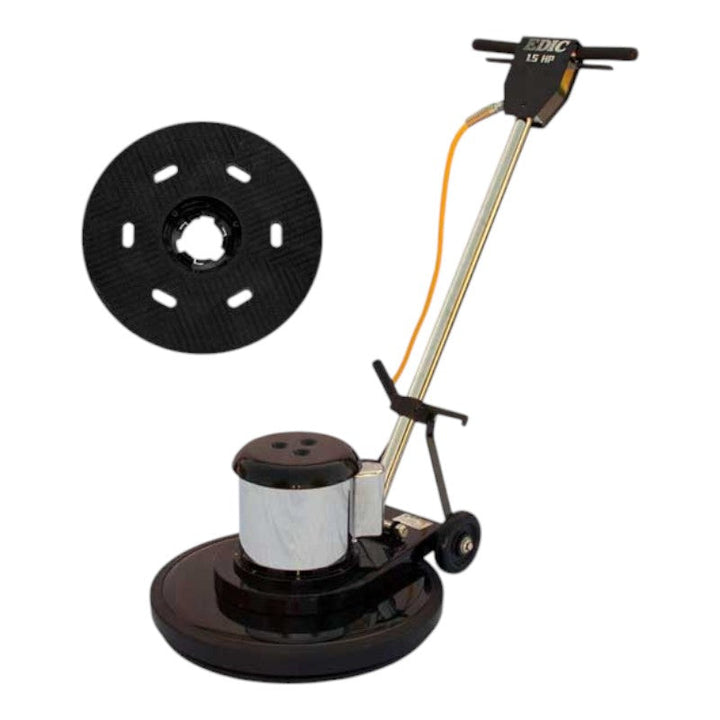
Pad work on stone is usually done with a heavy, low-speed machine, because weight gives the pad pressure without a lot of speed. The EDIC Saturn 17LS4 lists a 17 in head, 172 RPM, a 1.5 HP TEFC motor and triple planetary steel gears. It weighs 113 lb, draws 13 amps on a 50 ft cord and carries a 5-year warranty as listed. The price is $1,635. Browse the EDIC collection for related models.

Low-speed pad work
EDIC Saturn 17 Inch Heavy Duty Low Speed Floor Buffer 17LS4-BK-SV
$1,635
A heavy 17 in machine for pad work. Skip it if you only need to clean, not hone.
The orbital machine for mixed hard floors
The Mytee ECO17-PRO is a 17 in orbital machine with a 4 gal solution tank and a 60 PSI pump. It weighs 120 lb and uses a 1.5 HP motor. The manual lists 20 amps at 115 V on a 50 ft 12/3 twist-lock cord and says it needs a 20 amp, 115 V outlet, so plan the circuit before you plug in. Its price is $3,158. Mytee's ECO-PRO Orbital Spec Sheet names tile and grout and "other hard surfaces", not marble, so on polished marble use it only with pads whose maker approves them for stone, and test a hidden corner first (source: Mytee ECO-PRO Orbital Spec Sheet). It is one of our best-selling floor machines.

Orbital hard-floor cleaning
Mytee ECO17-PRO All Surface 17″ Orbital Floor Machine, 1.5 horsepower
$3,158
Suits sites with tile, LVT and marble side by side. Skip it if the floor is all marble and your pad maker does not approve orbital use.
The high-speed burnisher
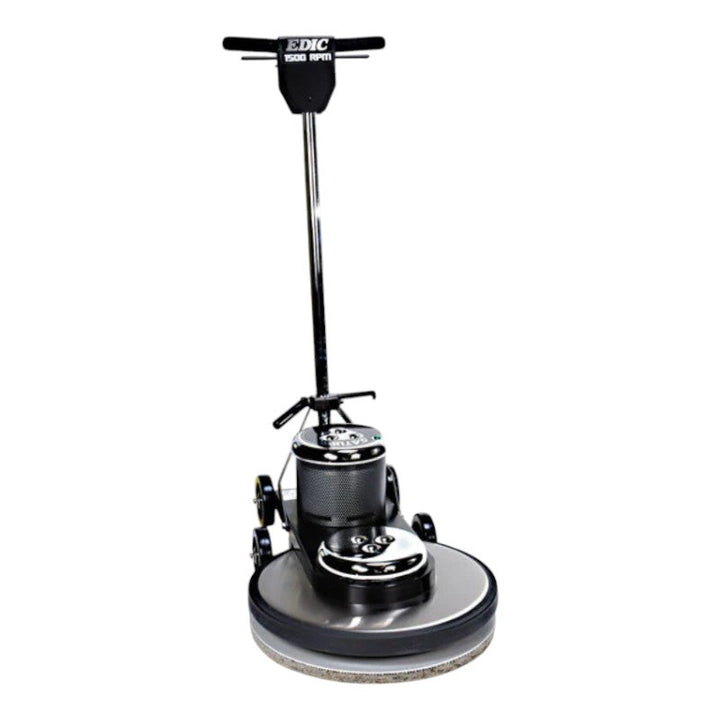
The Mercury Ultra D.C. 19 in burnisher runs at 1,500 RPM with a 1.5 HP D/C rectified motor and weighs 84 lb. It has a 50 ft, 14/3 cord. Its price is $1,399.95. Mercury's manual is written for hard-floor finish, so use stone pads on it only when the pad maker allows it. For how burnishers, buffers and scrubbers differ, read our burnisher vs buffer vs scrubber guide, and browse the 1,500 RPM burnishers.

High-speed burnishing
Mercury Ultra D.C. High-Speed Burnisher 19", 1.5 HP Motor, 1500 RPM Brush Speed DC-19-1500
$1,399.95
A light 84 lb machine for finish work. Skip it for honing.
New to swinging a heavy machine? Our floor buffer guide covers control, cord handling and pad changes.
Which machine for which marble job
| Job | Machine | Price | Key listed specs |
|---|---|---|---|
| Daily grit control | Tornado Pac-Vac 10 AirComfort | $399 | 110 CFM, 14 lb |
| Weekly scrubbing | Tornado 18/11 | from $6,148.24 | 18 in path, 11 gal solution, 12 gal recovery |
| Pad work | EDIC Saturn 17LS4 | $1,635 | 113 lb, 172 RPM, 13 A |
| Orbital hard-floor cleaning | Mytee ECO17-PRO | $3,158 | 17 in path, 4 gal tank, 20 A |
| High-speed finish work | Mercury Ultra D.C. 19 in | $1,399.95 | 1,500 RPM, 84 lb |
Sealing: what it does and does not do
An impregnating sealer soaks into the stone to slow staining. The Use Natural Stone article calls sealing "preventative maintenance, but it's not a be-all, end-all cure," and still tells you to wipe up spills quickly to avoid staining or etching. It recommends a solvent-based impregnating sealer for do-it-yourself work and says a professional usually gives better results. One expert quoted there reseals every three to five years.
The same article warns that harsh chemicals can break down any sealer on the stone. So even a sealed floor keeps the same cleaning rules: no acids and a pH-neutral cleaner.
When to call a stone restoration specialist
- Deep etches that remain after a light polish.
- Uneven tile edges (lippage) or cracks.
- Stains that have soaked into the stone.
- A high-value floor where a mistake would be costly.
A specialist brings the pad sequence, the slurry control and the experience. A machine from us handles daily care and the in-house polish between visits.
A small marble floor cleaned by hand
For a bathroom-sized entry or a small foyer, skip the machines. Dust-mop first, then wipe with a soft mop or cloth wrung well in a pH-neutral stone cleaner mixed as labeled. Rinse with clean water and buff dry with a soft towel so no cleaner film is left. Use a microfiber head and no scouring pads.
Common mistakes
- Using vinegar, lemon, bleach or "natural" acid cleaners on marble.
- Skipping the dust mop and scrubbing grit across the polish.
- Using a scouring pad on a stain or etch.
- Leaving cleaner residue on the floor.
- Putting a burnisher or buffer on polished stone without the pad maker's instructions.
For hard-floor care beyond marble, see our guides to cleaning tile and grout with a machine and buffing and polishing concrete.
Frequently asked questions
What is the best cleaner for marble flooring?
Use a pH-neutral cleaner labeled for natural stone. The Use Natural Stone article says the cleaner needs a neutral pH of seven. Mix it as the label says and rinse if the label tells you to.
Can I use Dawn dish soap on marble floors?
Not as your regular cleaner. The Natural Stone Institute's Use Natural Stone site calls for a cleaner with a neutral pH of seven, and dish soap is not made or labeled for stone, so its residue builds a dull film.
Can you use Swiffer wet pads on marble floors?
Check the product label for a stone-safe, pH-neutral claim before you use any pre-moistened pad. If the label does not say so, use a damp microfiber mop with a stone cleaner instead.
Can vinegar be used to clean marble floors?
No. The Natural Stone Institute's consumer site names marble as a stone that reacts adversely to vinegar because it is acidic. It says vinegar will etch the surface.
Can I use Murphy's oil soap on marble?
Use a cleaner labeled for natural stone and pH-neutral instead. Oil soaps are made for wood, and anything left on the stone builds a film that looks like dullness.
How do I get my marble floor to shine again?
If the dullness is from grit, better matting and daily dust control stop it from getting worse. If it is from etching, the floor needs honing and then polishing. That is restoration work, and a stone specialist can tell you how far it can go.
How do I clean white or black marble?
Use the same method for every color: daily grit control, then a pH-neutral stone cleaner. Dark marble shows dust, film and etches more clearly, so wipe cleaner residue off with clean water.
Keep the lobby floor bright