
How we made this guide: picks, prices and specs come from our catalog and the makers' published specs, owner quotes come from customer reviews on our product pages and every guide is checked and edited by Trevor Hall.
To use a floor buffer, unplug it, tip it back with the handle locked upright and fit the pad centered on the driver, then stand it up, lower the handle to about waist height and lock it, plug in with the cord behind you and steer by lifting the handle slightly to move right and pushing it down slightly to move left. Minuteman's manual says a few minutes of practice in a large open area gives you fingertip control. The EDIC Saturn 20LS3 at $1,202 is a good example: a 20 inch head, 175 RPM, a 50 ft cord and a 14.4 amp draw as listed.
Quick answer
A floor buffer, also called a swing machine or low-speed floor machine, spins a pad over the floor and walks itself sideways. You do not push it. You steer it by tilting the handle, and you keep it moving so the pad never sits in one spot. Browse every low-speed floor machine or the full floor machine range.
What a floor buffer does
A floor buffer is a single-disc rotary machine. A motor turns a pad driver, and the pad cleans, strips, scrubs or polishes depending on the pad and the chemical. Tornado's manual for its M Series lists these hard-floor jobs: spray buffing with a red pad, dry buffing a buffable finish with a tan, beige or white pad, scrubbing with a green or blue pad and stripping with a black pad. For carpet at low speed it lists bonnet cleaning and shampooing with a shower-feed brush.
A buffer is not a sander. A floor sander removes wood or finish with abrasive paper and is a different machine. This guide covers the swing machine only. For the difference between buffers, burnishers and scrubbers, read floor burnisher vs buffer vs scrubber.
Tools and equipment list
You need a machine, a pad driver or brush, the right pad, a 15 amp circuit and wet-floor signs. We sell machines, pad drivers and brushes. We do not sell floor pads, so buy those from your chemical supplier and choose the color with the floor pad color guide.

Example used in this guide
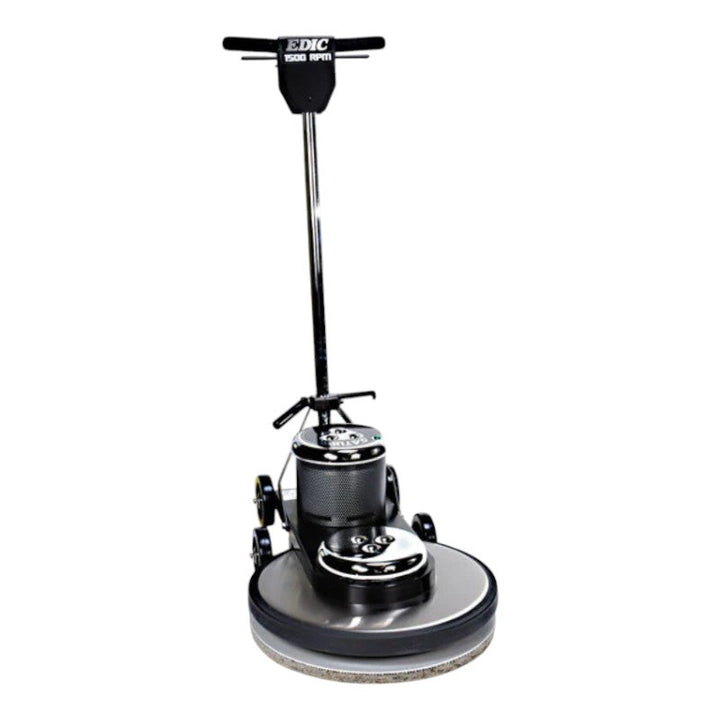
EDIC Saturn 20 Inch Low Speed Floor Buffer Machine w/ Pad Driver - 175 RPM 20LS3-BK-SV
$1,202
A 20 inch, 175 RPM single-speed buffer with a 1.5 HP motor, triple planetary steel gears and anti-fatigue grips.
Step 1: Run the pre-start checklist
Run this list at the start of every shift. Each item comes from a maker's manual.
- Get trained first and dress for it. Tornado's manual says you must have training before you operate the machine, and Mercury's says never operate it with bare feet.
- Inspect the cord and plug. Tornado's manual says to check the cord for cuts, gashes or loose prongs and replace it if needed. Minuteman says not to use a machine with a damaged cord or plug.
- Check the circuit. The Minuteman Front Runner manual says the 115 V models are designed for a standard 15 amp, 120 volt, 60 Hz circuit. Its listing gives a 14.4 amp average draw. The EDIC 20LS3 is listed at 14.4 amps too. Keep other tools off that circuit.
- Skip the extension cord. Mercury's manuals for the Lo-Boy and BOSS-2 say use of extension cords is not recommended, and both machines carry their own 50 ft cord.
- Use a grounded outlet. Tornado says a circuit protected by a ground fault circuit interrupter gives maximum protection against electric shock.
- Look at the pad. Mercury's manual says to check and clean pads after each job and replace worn or damaged ones.
- Keep flammables away. Tornado and Minuteman both warn against using the machine near fuels, solvents, thinners or grain dust. Minuteman says to use only commercially available floor cleaners and waxes intended for machine application.
- Put out wet-floor signs and clear the room. Minuteman says to keep bystanders at least 25 feet from the area of operation.

Step 2: Fit the pad driver and pad
Always unplug first. Tornado says to remove the plug before changing the pad and before leaving the machine. Then lock the handle in the upright position and tip the machine back so the underside faces you. Hold the pad driver or brush in both hands, line up the three slots in its clutch plate with the three lugs on the driving plate and turn it counter-clockwise as far as it goes. Tornado calls this the only proper way to install a drive block, brush or attachment. It warns never to place it on the floor and run the machine over it.
Center the pad on the driver. Mercury's Lo-Boy manual lists pads that are not centered on the pad driver as a cause of high vibration, and says to tip the machine back and re-center the pad. Mercury also says to match the tool to the apron: a pad driver with riser should be 1 inch smaller than the machine apron, and a scrub brush 2 inches smaller. On the Lo-Boy 17 inch apron that is a 16 inch driver with riser, as listed.

Step 3: Choose the pad or brush for the job
The pad sets the job, not the machine. Use the colors in Tornado's list above as a starting point, then follow your pad and chemical maker's label. Mercury's BOSS-2 manual describes brush filaments from soft nylon for gentle scrubbing of decorative floors to heavy-duty stripper bristle for concrete, brick and quarry tile. For finish work and stripping routines, see how to strip and wax VCT floors. For a floor type that suits a buffer, see what VCT flooring is.
| Job | Pad or tool (Tornado manual) | Chemical |
|---|---|---|
| Spray buffing | Red spray buff pad | Spray buff chemical |
| Dry buffing a buffable finish | Tan, beige or white pad or brush | None named |
| Scrubbing | Green or blue pad or scrubbing brush | Cleaner per its label |
| Stripping | Black pad | Stripping chemical |
| Bonnet cleaning carpet (low speed) | Yarn bonnet | Carpet maintainer chemical |
Step 4: Set the handle height
Raise the locking lever, lower the handle to a comfortable height and lock it again. Tornado recommends a handle position close to the waist with arms extended down. Minuteman says to lower the handle assembly to a waist-high position. Mercury's BOSS-2 manual says typically waist height, and adds never to operate the machine with the handle unlocked.
Do not over-tighten the cam lever. Tornado says its hardened steel cam release lever does not need extreme tightening, and over-tightening shortens its life. On the Minuteman Front Runner the handle is adjusted with a foot-operated release, as listed.

Foot-operated handle
Minuteman Front Runner 20" Floor Machine
$1,424.12
A 20 inch buffer with a 1.5 HP motor, a 50 ft 14-3 cord with a hospital-grade plug and foot-operated handle adjustment.
Step 5: Start the machine
- Plug in and stand behind the machine with the cord behind you.
- Hold the machine firmly with both hands. Mercury calls the BOSS-2 a high-torque motor and says to hold it firmly when starting.
- Release the safety interlock (push it forward on Mercury and Tornado machines; Minuteman's diagram shows push down) and squeeze the triggers under the grips. On the BOSS-2, once power is on, either trigger keeps the motor running.
- To stop, release the triggers. Tornado says the safety switch resets every time you release them, so you repeat the push and squeeze to restart.
Never lock the power switch on. Tornado says never to use any device to hold the switch in the ON position. When you leave the machine, unplug it and return the handle to the locked upright position to prevent accidental starting.
Step 6: Steer by the handle
A single-disc machine drifts sideways because of the way the disc turns. Minuteman's manual says it tends to move to the right or left depending on slight pressure up or down on the handle. You steer with that drift instead of fighting it.
| Handle movement | Machine moves | Maker's manual |
|---|---|---|
| Lift the handle slightly | To the right | Tornado, Minuteman, Mercury BOSS-2 |
| Push the handle down slightly | To the left | Tornado, Minuteman, Mercury BOSS-2 |
| Keep pressure on the pad even | Stays in place | Minuteman |
Tornado adds that the higher you lift the handle, the faster the machine moves right. The further you lower it, the faster it moves left. Start with small movements. Minuteman says a few minutes of practice in a large open area gives you fingertip control.

Step 7: Work the floor
Sweep or dust mop first. Mercury says to sweep abrasive soils before scrubbing. Then work side to side in overlapping arcs, steering at the end of each pass. Keep the machine moving. Mercury warns that a spinning pad left in one spot can leave a "donut" burn on the floor.
Keep the cord behind you and clear of the pad, driver and wheels. Tornado says to lift the power cord over the machine and never let the pad, pad driver or wheels touch the cord while it runs. Minuteman adds that the cord should be completely unwound during operation. For concrete floors, see how to buff and polish concrete floors, and for resilient plank floors, how to clean vinyl plank and LVT floors.
Using a solution tank
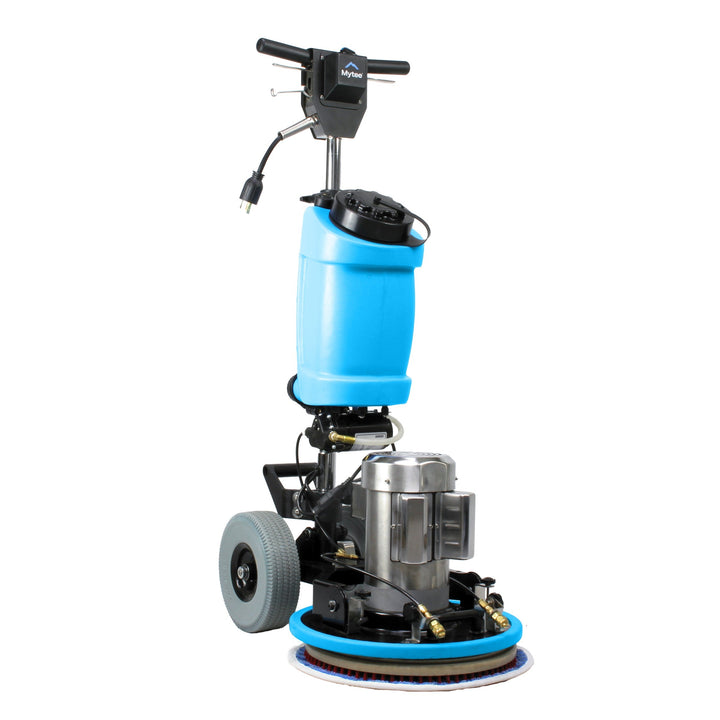
Some jobs, such as carpet shampooing, feed solution through the machine. Tornado's optional 3 gallon tank mounts to the front of the handle, and its manual says the tank should be used only with a shower-feed drive block or brush. The Mercury BOSS-2 lists an optional 4 gallon polyethylene tank (model SST-4) with a chemical-resistant hose. Open and close the solution valve only while the machine is moving, so solution does not pool under a stationary brush.

Optional solution tank
$1,969.95
A 175/300 RPM dual-speed machine with five interchangeable apron sizes, an optional 4 gallon tank and an optional weight kit.
Spray buffing on a dual-speed machine
A dual-speed machine runs at a low speed for scrubbing and stripping and a higher speed for polishing. The Tornado M Series 17 is listed at 175 and 320 RPM, and the BOSS-2 at 175 and 300 RPM. Tornado's manual names spray buffing with the red pad and spray buff chemical among the hard-floor jobs. Which speed to use for a given chemical comes from the chemical's label, so read it before you start. A machine at a higher speed also travels faster, so slow your steering movements.
To spray buff, dust mop first. Mist a light coat of spray buff solution on a small section ahead of the machine as the label directs, buff it with the red pad until it is dry and glossy, then move on. Turn or change the pad when it loads with finish and soil. Mercury's manual says to check and clean pads after each job.

Dual speed, 17 inch
Tornado M Series 17" Metal Floor Machine, Dual Speed,175/320 RPM (98476)
$1,099
A rolled steel, 100 lb machine at 175/320 RPM with an optional 3 gallon solution tank.
Step 8: Finish, store and move the machine
- Release the triggers and unplug by gripping the plug, not the cord.
- Lock the handle upright and tip the machine back to remove the pad driver or brush.
- Wind the cord around the handles and cord hook. Mercury and Minuteman both give this storage method.
- Wash pads or brushes and hang them to dry. Mercury says never to store the machine standing on the brush.
- To move it, lock the handle up, tip the machine back onto its wheels and push or pull by the handle, not the cord.
- Once a month Tornado says to remove the motor cover and vacuum out dust and debris, and to check that all fasteners are tight.
Troubleshooting: why the machine misbehaves
Every row below comes from the Tornado, Minuteman or Mercury manuals. If a fix needs the motor opened, use an authorized service center.
| Symptom | Likely cause | What to do | Manual |
|---|---|---|---|
| Machine walks off to one side | Uneven pressure on the handle | Balance the pad pressure on the floor; lift slightly to go right, push down slightly to go left | Minuteman |
| Machine bucks when you start | High-torque motor (Mercury's wording) | Hold it firmly with both hands before squeezing the triggers | Mercury BOSS-2 |
| Burn ring on the floor | Pad left spinning in one spot | Keep the machine moving while the pad turns | Mercury |
| High vibration | Pad not centered, or pad worn or warped | Tip the machine back and re-center the pad, or replace it | Mercury Lo-Boy |
| Pad or brush clogged with soil and chemical | Residue not cleaned off after use | Check and clean pads after each job; replace worn ones | Mercury |
| Will not start | Tripped breaker, unplugged, bad switch, cord or plug | Check the breaker and plug; Tornado says to let a breaker cool 2 minutes before resetting | Tornado, Mercury |
| Will not reach operating speed | Overdrawn circuit | Unplug everything else on the circuit or move to another one | Tornado |
| Motor runs but pad does not turn | Broken coupling | Have the coupling replaced | Tornado |
| Shock to the operator | Wiring fault or poor grounding | Stop and seek authorized service; test the outlet with a ground fault interrupter | Mercury |

Machine choice by operator and floor
All five weigh about 90 to 107 lb, so the real differences are head size, speed and handle adjustment. A 17 inch head covers less floor per pass and fits into corridors and small rooms more easily, while a 20 inch head covers open floors faster.
| Machine | Head | Speed | Weight | Cord | Price |
|---|---|---|---|---|---|
| Mercury Lo-Boy L-17E | 17 in apron, 15 in brush | 175 RPM | 99 lb | 50 ft, 14/3 | $1,089.95 |
| Tornado M Series 17 | 17 in | 175 / 320 RPM | 100 lb | $1,099 | |
| EDIC Saturn 20LS3 | 20 in | 175 RPM | 98 lb | 50 ft | $1,202 |
| Minuteman Front Runner 20 | 20 in | 175 RPM single; 180 / 320 RPM 2-speed | 98 lb single speed | 50 ft, 14-3 | from $1,424.12 |
| Mercury BOSS-2 | 13 to 21 in aprons | 175 / 300 RPM | 90 to 107 lb by apron | 50 ft, 14/3 | $1,969.95 |
The Mercury Lo-Boy is the smaller first machine of the group: a 17 inch apron with a 15 inch rotary brush, listed with a 13 to 15 amp draw.

Smaller first machine
Mercury Lo-Boy Ultra Quiet Floor Machines 17" Apron, 1.5 HP Motor, 175 RPM Brush Speed L-17E
$1,089.95
A 17 inch apron machine at 175 RPM with 6 inch non-marking retractable wheels and a polished aluminum chassis.
For a wider choice, see the dual-speed floor machines and the floor buffers and polishers. For tile floors, there is also a floor machines for tile list.
When an orbital or a burnisher is the better tool
A swing machine takes practice. If new staff will run it with little training, an orbital does not swing sideways. The Powr-Flite Orbital 20 ORB1420 uses a 14 x 20 inch pad, is listed at 3,500 RPM and 69 dBA and weighs 111 lb. An orbital is not a buffer, so do not expect it to behave like one. For a high-gloss finish on a finished floor, a high-speed burnisher does the job a buffer cannot. Floor burnisher vs buffer vs scrubber explains which machine does what.

Orbital option
Powr-Flite Orbital 20" Floor Machine ORB1420
$1,712
A 14 x 20 inch pad with a 50 ft cord and 1.5 HP motor. It moves without swinging.

For daily soil removal on larger floors, how to use an auto scrubber covers the machine most facilities run first.
Frequently asked questions
What does a floor buffer do?
A floor buffer spins a pad or brush over a hard floor to clean, strip, scrub or polish it, depending on the pad and chemical. A low-speed machine (around 175 RPM) is the usual choice for scrubbing, stripping and spray buffing. High-speed machines are called burnishers and polish a floor finish.
How do you buff tile floors with a buffer?
Sweep the floor, fit the pad your cleaner or finish maker names, and work in overlapping arcs with the handle at waist height, keeping the machine moving. Match the pad to the floor and follow the label of the product you apply. Buffing means polishing a floor finish, so it applies to finished vinyl composition tile (VCT) and to stone or terrazzo. Glazed ceramic and porcelain tile is scrubbed, not buffed. Mercury's BOSS-2 manual says soft nylon bristle will not scratch tile, terrazzo or coated floors, so use a nylon brush or a light pad when you scrub tile.
How do I buff a hardwood floor?
Only as the floor finish maker and the machine maker allow. Hardwood needs a pad, product and speed that the finish maker approves, so read its instructions before you put a machine on the floor. The machines in this guide are listed for commercial hard-floor maintenance.
What is the best way to polish a floor?
On a finished hard floor, dust mop, then spray buff with a red pad on a low or dual-speed machine, or dry buff with a white or tan pad as Tornado's manual lists. For a high gloss, a high-speed burnisher does more than a 175 RPM buffer. Follow the floor finish label for the pad and speed.
Is a floor buffer the same as a sander?
No. A buffer turns a pad or brush to clean and polish. A sander uses abrasive paper to remove material. Minuteman warns that sanding can produce an explosive mixture of fine dust and air, so a sander needs a well-ventilated area with no flame.
Do you mix floor cleaner with water?
Most floor cleaners are concentrates, so dilute them as the label says. Use only products intended for machine application, and never use a flammable or combustible liquid to clean a floor. Tornado warns against that to avoid fire.
How do you run a floor sander?
Follow the sander maker's manual, because a floor sander is a different machine from a buffer and this guide does not cover it.
Pick a buffer that fits the floor