
How we made this guide: picks, prices and specs come from our catalog and the makers' published specs, owner quotes come from customer reviews on our product pages and every guide is checked and edited by Trevor Hall.
A floor buffer cannot take raw concrete to a polish. What a floor machine does is clean, maintain and restore the shine of concrete that has already been ground, densified or sealed, and the machine for the shine step is a high-speed burnisher such as the Mercury Ultra D.C. DC-20-2000 at $1,499.95. The lower-priced 2,000 RPM option is the Tornado Brute Force 20 at $1,399. For the scrubbing step before it, a dual-speed machine such as the Mercury BOSS Multi-Tasker at $1,969.95 does the cleaning. The job is sweep, scrub, dry and burnish, and a careful first-timer can do it.
Quick answer
Buffing concrete is maintenance. Sweep, scrub at 175 or 300 RPM, let the floor dry, then burnish at 1,500 to 2,000 RPM. Taking bare or stained concrete to a polish is grinding with diamonds on a planetary grinder, a job for a polishing contractor or a rented grinder, not a buffer. Compare floor burnishers and dual speed floor machines.
Grinding versus buffing: which job do you have?
Most searches for "how to polish a concrete floor" mix two different jobs. The split below decides what you need.
| Job | What it does | Machine | Do we sell it? |
|---|---|---|---|
| Grinding and polishing | Removes the top surface with metal-bond diamonds, then finer resin diamonds, with a densifier applied along the way | Planetary floor grinder | No. Rent one or hire a polishing contractor |
| Scrubbing | Cleans a polished, sealed or finished slab | Floor machine at 175 or 300 RPM | Yes |
| Burnishing | Brings back gloss on a ground or sealed floor with a high-speed pad | Burnisher at 1,500 to 2,000 RPM | Yes |
| Orbital prep | Light surface prep with an orbital pad action | Orbital prep machine | Yes |
If your slab is bare, stained or rough, a buffer will not give it a polish. If your slab is already ground, densified or sealed and has gone dull, a buffer and a burnisher are the right tools. The rest of this post covers that second case.
Can you polish a concrete garage or basement floor yourself?
You can, but not with a floor buffer. A do-it-yourself polish of a garage or basement slab means a rented grinder with dust extraction, several grits of diamond pads and a densifier, and it is a long, physical job. If you want that result without the work, hire a polishing contractor. If your slab already carries a coating, sealer or guard that its maker says can be burnished, you can scrub it and burnish it with the machines in this post.
Dust is the reason the grinding route needs care. Dry grinding or cutting concrete makes fine dust that can contain respirable crystalline silica. OSHA's construction silica standard, 29 CFR 1926.1153, applies to workers' exposure to that dust in construction work and puts the duties on the employer. For walk-behind floor grinders, its Table 1 lists two controls: a machine that feeds water continuously to the cutting surface, or the maker's recommended dust collector with a filter of 99 percent or greater efficiency and a filter-cleaning mechanism, plus a HEPA-filtered vacuum between passes when the work is indoors. A floor buffer does not grind, so this post does not cover those controls step by step. For the dust-control side of renovation work, read our post on dust control in construction.
Which floor machine does which step
Speed sets the job. A scrubbing machine turns slowly with weight on the pad. A burnisher turns fast with a light, even pad pressure. The table lists the machines we carry for each step, with the maker's listed numbers.
| Machine | Step | Speed | Price | Weight | Power |
|---|---|---|---|---|---|
| EDIC Saturn 17DS3-BK-SV | Scrubbing | 180 or 320 RPM | $1,417 | 86 lb | 14.4 A, 50 ft cord |
| Mercury BOSS Multi-Tasker BMT-175/300-Y | Scrubbing | 175 or 300 RPM | $1,969.95 | 175 lb | 1.5 HP, 50 ft cord |
| Square Scrub Pivot 12 x 18 | Orbital prep | 3,450 RPM listed (orbital action, not a spinning pad) | $4,779 | 156 lb | 7 A, 50 ft cord |
| Mercury Ultra D.C. DC-20-2000 | Burnishing | 2,000 RPM | $1,499.95 | 84 lb | 15 A listed (manual: 13 A nominal), 50 ft cord |
| Tornado Brute Force 20 (98482B) | Burnishing | 2,000 RPM | $1,399 | 89 lb | 1.5 hp motor |
| EDIC Saturn 20HS1500 | Burnishing | 1,500 RPM | $1,488 | 96 lb | 15 A, 75 ft cord |

Scrubbing step
$1,969.95
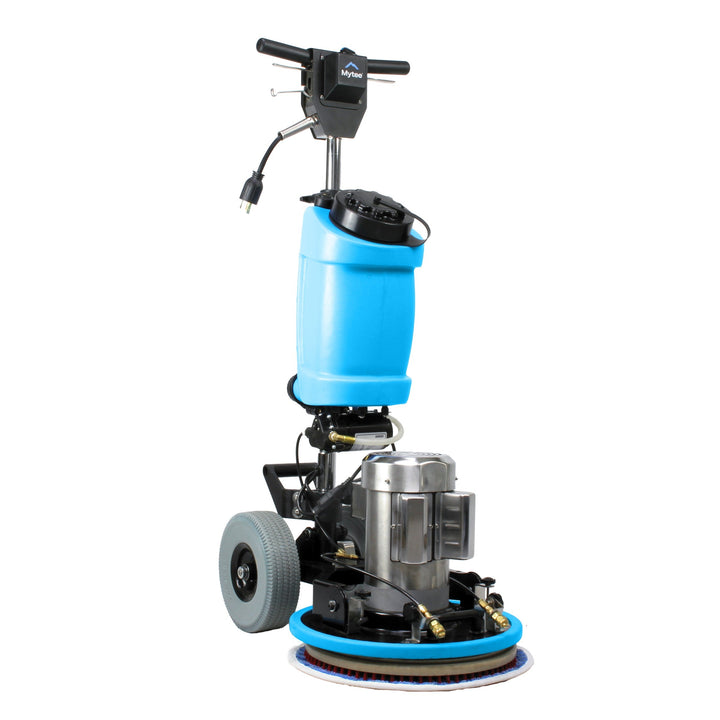
Dual speed at 175 and 300 RPM, with a 4 gallon solution tank and a weight kit that adds up to 50 lb of pressure.

Lower-priced scrubbing step
EDIC Saturn 17 Inch Dual Speed Floor Buffer Machine w/ Pad Driver 17DS3-BK-SV
$1,417
A 17 inch dual speed machine at 180 and 320 RPM, 86 lb, with a 1.5 HP motor and a 5 year parts and labor warranty.
What you need before you start
- A dust mop or sweeper for the first pass over the slab.
- A scrubbing floor machine with a pad driver and a cleaning pad, such as the BOSS Multi-Tasker.
- A burnisher for the shine step.
- Pads for each step. On polished or densified concrete the usual maintenance pad is diamond-impregnated. 3M, for example, lists its Scotch-Brite Purple Diamond Floor Pad Plus for polished concrete on machines from 175 to 3,500 RPM, so one pad type can run on a dual-speed machine or a burnisher. On a floor with a guard, use the pad the guard maker names (PROSOCO names a white polishing pad for its PolishGuard). We do not sell diamond pads, so buy them from a pad maker.
- A wet vacuum or mop and bucket to pick up the cleaning solution.
- A cleaner that the sealer, guard or densifier maker allows. PROSOCO's PolishGuard sheet, for example, says off-the-shelf and household cleaners may contain acidic or alkaline ingredients that can dull the finish.

Step 1: Sweep and check the floor
Sweep or dust mop the whole area before any pad touches it. Grit under a pad scratches a finished floor. Mercury's Ultra D.C. manual puts it first in its operating tips: sweep abrasive soils before burnishing. Walk the slab and note stains, oil spots and any area where the sealer has worn through, because those need different treatment from a general buff.
Check what the floor is. If it is sealed, polished or densified, go on. If it is bare, rough concrete, stop here and decide whether you are hiring a grinding job.
Step 2: Scrub at 175 or 300 RPM
Fit a cleaning pad and use the lower speed first. A dual-speed machine such as the BOSS Multi-Tasker runs at 175 and 300 RPM, and it carries a 4 gallon solution tank with a hose that feeds solution through the apron to the floor. The weight kit (five 10 lb weights) adds up to 50 lb of pressure for heavier cleaning, and the maker lists a weight of 175 lb.
Work in overlapping passes, keep the pad flat and keep the machine moving. Use a cleaner that suits your floor finish, then pick up the solution with a wet vacuum or a clean mop. For the longer story on cleaning a coated slab, see our post on how to clean epoxy floors. For plain commercial slabs, see how to clean commercial concrete floors.
The Mercury sell sheet describes the BOSS as a machine for cleaning, scrubbing or stripping floors. Its sell sheet lists stone, carpet, tile and wood as the floor types, not concrete by name, so check the finish on your slab rather than assuming.
Step 3: Let the floor dry fully
Burnishing a damp floor smears residue and leaves streaks. EDIC's manual says not to run its burnisher on wet floors, so wait until the surface is dry to the touch everywhere, edges included. Drying can take longer in a basement or a closed garage. If you plan to coat the slab, our post on testing concrete moisture covers the readings to take first.
Optional: apply a guard before you burnish
A guard is a thin protective coat for concrete that can be burnished to a gloss. PROSOCO's data sheet for its Consolideck PolishGuard is one example. It says the guard can go on broomed, troweled, honed or polished interior concrete that is clean, dry and sound, and works best on a slab treated with the maker's densifier. It goes on in two thin coats with a pump sprayer and a damp microfiber pad. For more gloss, the sheet says to wait at least 60 minutes after the final coat, then burnish with a high-speed burnisher and a white polishing pad at a fast walking pace. If you use a different guard, follow that product's sheet.
Step 4: Burnish with a high-speed machine
Fit a clean burnishing pad, centered on the driver with the center lock tight. EDIC's Saturn manual gives the start-up: lean the machine back so the pad is off the floor, start the motor, wait 5 seconds for full speed, then set the pad on the floor. Walk it in straight, overlapping passes, forward and reverse rather than swinging it side to side, at a steady pace. PROSOCO's PolishGuard data sheet says to burnish at a fast walking pace. Mercury's Ultra D.C. manual says to keep the burnisher moving while the pad driver spins, to avoid "donut" burns on the floor. A burnisher turns at 1,500 to 2,000 RPM, so it needs steady forward motion: if you let it stand in one spot, the heat and friction can mark the floor.

Burnishing step
Mercury Ultra D.C. High-Speed Burnisher 20", 1.5 HP Motor, 2000 RPM Brush Speed DC-20-2000
$1,499.95
A 20 inch head at 2,000 RPM, 84 lb, with a 50 ft cord and a 13 A nominal draw per Mercury's manual.
On the 2,000 RPM model, Mercury's manual says the front wheel assembly sets the pad's down pressure: raise the apron height to reduce it and lower it as the pad wears. The manual also says running the machine without that assembly voids the warranty.
Three burnishers on our list differ in speed and weight. The Mercury and the Tornado Brute Force turn at 2,000 RPM. The EDIC Saturn 20HS1500 turns at 1,500 RPM and is listed with a 75 ft cord, which means fewer plug changes on a large floor.

2,000 RPM option
Tornado Brute Force 20" 2000 RPM High Speed Burnisher (98482B)
$1,399
A 20 inch rotary disc with 16 lb of disc pressure and an 89 lb body.

1,500 RPM option
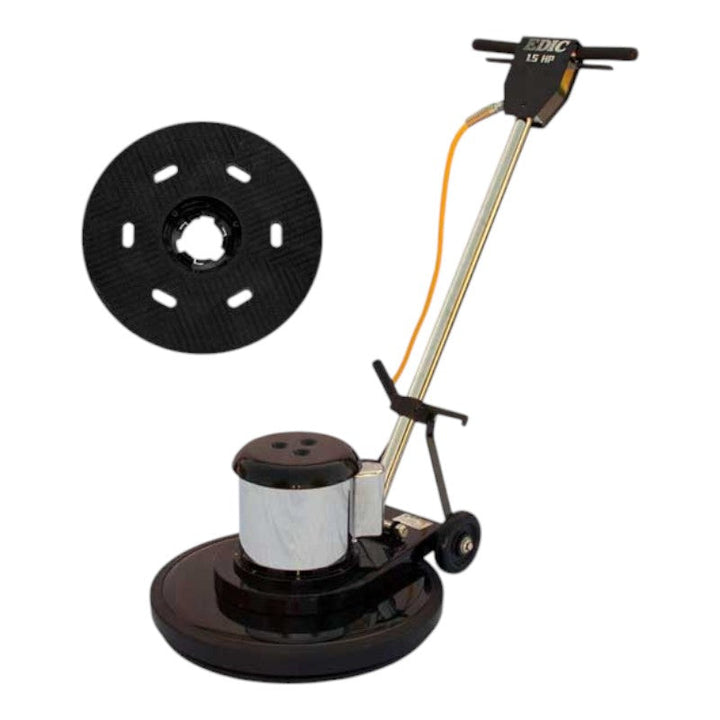
EDIC Saturn 20" High-Speed Floor Burnisher, 1500 RPM 20HS1500-BK-SV
$1,488
Belt-driven 1.5 HP motor, a 75 ft cord and a listed 5 year parts and labor warranty.
EDIC's manual says the Saturn is designed for a standard 15 amp, 120 volt circuit and that voltage below 105 volts can seriously damage the motor. Any extension cord must be a 12 gauge, three-wire cord no longer than 25 feet. Mercury's Ultra D.C. manual says extension cords are never recommended: plug its 50 ft cord straight into a properly grounded outlet. For the full difference between a buffer, a burnisher and a scrubber, see floor burnisher vs buffer vs scrubber.


Step 5: Buffing out light scratches
Light scuffs and traffic marks on a sealed floor can sometimes be worked out with the burnisher. Clean the area first, then burnish it at a steady walking pace with a fresh pad. If the marks are still there, move to a more aggressive pad (EDIC's manual: darker pads are more abrasive), or on polished concrete a diamond-impregnated maintenance pad, and test it in a corner before you do the room.
A scratch that has cut through the sealer or the polished surface is no longer a buffing job. That is the point where a grinder, a re-sealing or a recoat comes in, and a floor machine alone will not fix it.
Speeds and pads by step
EDIC's Saturn manual gives the rule of thumb for pads: lighter pads are less abrasive and darker pads are more abrasive. The table sums up the RPM range and pad for each step.
| Step | Speed | Machine type | Pad type |
|---|---|---|---|
| Scrub | 175 or 300 RPM | Dual-speed floor machine | A light cleaning pad, or on polished concrete a diamond-impregnated maintenance pad (3M lists its Scotch-Brite Purple Diamond Floor Pad Plus for polished concrete on machines from 175 to 3,500 RPM) |
| Orbital prep | 3,450 RPM listed (orbital action, not a spinning pad) | Orbital prep machine | A 12 x 18 inch prep pad (our listing names Square Scrub's EcoPrep pads) |
| Burnish | 1,500 to 2,000 RPM | High-speed burnisher | A white polishing pad on a guarded floor (PROSOCO's PolishGuard data sheet), or a diamond-impregnated maintenance pad on polished concrete |
Where the Square Scrub Pivot fits
The Square Scrub Pivot is not a burnisher. It is an orbital prep machine with a 12 x 18 inch pad, a listed speed of 3,450 RPM in an orbital pattern, a 7 A draw and a 69 dB sound output. Its listing says it works on marble, concrete, VCT and wood floors, and that an optional vacuum kit can be added to capture airborne particulates. Use it for surface prep, not for gloss.

Prep step
Square Scrub 12” x 18” Pivot Floor Prep Machine
$4,779
An orbital 12 x 18 inch machine with a 7 A draw, for surface prep ahead of cleaning or burnishing.
How often to burnish, and how to look after the pad
There is no calendar that fits every floor. Foot traffic, grit and the finish on the slab decide how fast the shine fades, so set your routine by how the floor looks. A busy entry will dull before a back corridor does. PROSOCO's sheet for its PolishGuard says to sweep daily with a microfiber pad or dry dust mop and to dry buff with a high-speed burnisher and a white pad when needed.
Check the pad before every session. A pad packed with dirt or worn flat will not burnish well and can scratch, so clean or replace it as the pad maker advises. Check the cord too. The Mercury burnisher lists a 50 ft, 14/3 gauge safety cord and the EDIC lists 75 ft, so plan your route so you never have to stretch a cord or run over it.
Weight matters when you move the machines around. The burnishers on this list weigh 84 to 96 lb, and Mercury lists the BOSS Multi-Tasker at 175 lb, so plan a ramp or a second person for steps and for loading a van.
Common mistakes
- Burnishing a dirty floor. Dirt under the pad scratches the finish. Sweep and scrub first.
- Burnishing a wet floor. The pad smears moisture and residue. Let it dry.
- Standing still. A fast pad that stays in one place can mark the floor. Keep moving.
- Expecting a buffer to polish raw concrete. It will not. That is a grinding job.
- Using the wrong chemical. Follow the sealer or densifier maker's instructions for what is safe to apply.
- Adding the wrong extension cord. Mercury's Ultra D.C. manual says never to use one. EDIC's allows only a 12 gauge, three-wire cord up to 25 feet and warns that voltage below 105 volts can seriously damage the motor.
Which machine for which floor
- Small shop or garage with an existing sealer: a 20 inch burnisher plus a dual-speed machine for cleaning.
- Large retail or warehouse floor: a burnisher with a longer listed cord, such as the EDIC with its 75 ft cord.
- Floors that need surface prep: the Square Scrub Pivot, then the burnisher.
Browse the full range of floor machines for concrete, or narrow it to 2,000 RPM burnishers.
Frequently asked questions
Can you buff concrete floors?
Yes, if the concrete is already ground, densified or sealed. A floor machine can clean it and a burnisher can bring back the shine. It cannot turn raw concrete into polished concrete, which takes diamond grinding.
Can I polish a concrete floor myself?
You can, but the real polishing step means renting a grinder with dust extraction and working through diamond grits. A floor buffer will not do it. If you only want to restore a floor that is already finished, scrubbing and burnishing is a job you can do yourself.
What are the steps to burnish concrete?
Sweep the floor, scrub it at 175 or 300 RPM, let it dry fully, then run a burnisher at 1,500 to 2,000 RPM in straight, overlapping passes at a steady walking pace. Check the sealer maker's instructions before you apply any cleaner.
Can you polish an existing concrete slab?
An existing slab can be ground and polished, but that is a contractor or rental-grinder job. If the slab already has a finish, you can maintain it with a floor machine and a burnisher.
How do you make old concrete floors look new?
Start by cleaning the slab, then burnish it if it is sealed or polished. If the surface is worn, stained or rough, restoring it takes grinding or a new sealer, not a buffer.
How do you sand a concrete floor?
Concrete is not sanded like wood. It is ground with diamond abrasives on a floor grinder, from coarse metal-bond diamonds to finer resin diamonds. That is a rental-grinder or contractor job with dust control. A floor machine with a diamond-impregnated pad only refines a surface that is already ground or polished.
What can you put on a concrete floor to make it shine?
A guard or sealer that its maker says can be burnished. PROSOCO's PolishGuard sheet, for example, calls for two thin coats, a wait of at least 60 minutes, then a high-speed burnisher with a white polishing pad. Bare, unpolished concrete will not shine from burnishing alone.
What speed should I use to burnish a floor?
The burnishers we carry run at 1,500 RPM (EDIC Saturn 20HS1500) or 2,000 RPM (Mercury Ultra D.C. DC-20-2000 and Tornado Brute Force 20). Scrubbing before it is done at 175 or 300 RPM on a dual-speed machine.
Bring the shine back