
How we made this guide: picks, prices and specs come from our catalog and the makers' published specs, owner quotes come from customer reviews on our product pages and every guide is checked and edited by Trevor Hall.
VCT stands for vinyl composition tile, a hard commercial floor tile, usually 12 in square, that costs less to buy than LVT but needs a floor finish program to look good. LVT (luxury vinyl tile) is a layered product with a factory wear layer that is usually cleaned rather than polished, which is the main difference you feel in the maintenance budget.
Most of the work on a VCT floor is done by three machines: a low-speed floor machine to scrub and strip, a high-speed burnisher to shine and an auto scrubber for daily cleaning. A 175 RPM machine such as the Powr-Flite Millennium 20 at $979 covers the first job, and a 2,000 RPM burnisher such as the Mercury Ultra D.C. 21 at $1,499.95 covers the second.
What does VCT stand for and what is it made of?
VCT is short for vinyl composition tile. Armstrong, a major flooring maker, lists its VCT in 12 in x 12 in tiles with a through-color wear layer, meaning the color and pattern run the full thickness of the tile. Armstrong says the tile is strengthened by 85 percent North American limestone content, and it is glued down to the subfloor.
Because the color runs through, a scuffed tile shows the same color underneath. Armstrong notes it still covers much of the floor in retail and education, and a damaged tile can be cut out and replaced on its own. New tile carries only a thin factory-applied layer that Armstrong describes as protection during installation, so the floor needs polish before it goes into service. Armstrong's guidance for VCT calls for 3 to 5 coats of commercial floor polish at the start, then periodic scrubbing and recoating.

VCT vs LVT
Both are vinyl tile, so the two get mixed up. Armstrong's own comparison says LVT is almost always more expensive than VCT to buy, while VCT needs 3 to 5 coats of polish from day one and then periodic scrubbing, recoating and stripping. Armstrong adds that polish on LVT is optional, worth weighing only in high-traffic spaces.
| Point | VCT | LVT |
|---|---|---|
| Name | Vinyl composition tile | Luxury vinyl tile |
| Build | Through-color wear layer, same color through the tile | A base layer, a printed visual, a clear wear layer and a UV-cured coating, in planks, tiles and other sizes (per Armstrong) |
| Purchase cost | Lower | Higher, per Armstrong |
| Install | Glued down | Glued down or floating |
| Where it is common | Retail and education, per Armstrong | Commercial spaces of every kind, in many formats |
| Floor finish needed | Yes, several coats of polish at the start | No initial polish or sealer, per Armstrong |
| Upkeep | Scrub, recoat, polish and periodic strip | Regular cleaning |
| Machines that fit | Low-speed floor machine, burnisher, auto scrubber | Auto scrubber and mop-style cleaning |
If you inherit a building, look at the floor before you plan upkeep. Check the tile size and a chipped edge. VCT usually comes in 12 in squares with the same color right through, so a chip shows the same color. LVT usually imitates wood or stone, often in planks, and under the printed layer is a plain base. Finish build-up alone does not settle it, because some LVT floors get polish too. The install records or the maker's spec sheet settle it.
VCT floor maintenance: from daily to annual
Here is a standard VCT care program, with the machine for each step. Traffic sets the calendar, so treat the frequencies as typical.
| Step | What it does | Machine and pad | How often (typical, set by traffic) |
|---|---|---|---|
| Dust mop or sweep | Removes grit that scratches the finish | Dust mop, or a sweeper in large areas | Daily |
| Auto scrub | Cleans soil without stripping the finish | Walk-behind scrubber with a soft pad or brush | Daily to a few times a week |
| Spray buff or burnish | Restores gloss on cured finish | High-speed machine with a polishing pad | Daily to weekly, when the gloss drops |
| Scrub and recoat | Cleans the worn top layer and adds new finish | Low-speed floor machine with a scrub pad | Every few months |
| Full strip | Removes all old finish before a fresh set of coats | Low-speed floor machine with a strip pad | Once or twice a year, or when finish builds up or yellows |
Stripping is its own job with its own order of work. We cover pad choice, coats and dry times in how to strip and wax VCT floors. For the difference between the machines, see floor burnisher vs buffer vs scrubber.
The floor machine for scrubbing and stripping
A low-speed floor machine does the scrubbing, stripping and recoat prep. Browse our low-speed floor machines or the wider floor machine range.
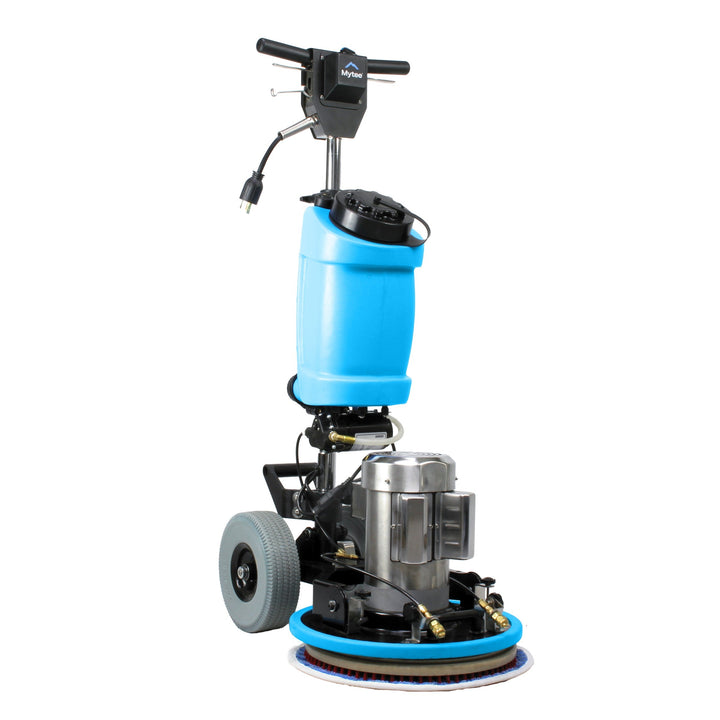
The Mercury Cleanmaster TS-17 is a dual-speed model rated at 175 and 300 RPM. The listing gives a 17 in apron, a 1.5 HP motor and a 50 ft, 14/3 gauge cord. Our listing gives a 15 in rotary brush and a 16 in pad driver with riser under the 17 in apron. The 175 RPM speed handles scrubbing and stripping, and the 300 RPM speed handles spray buffing. It is not a substitute for a 2,000 RPM burnisher's gloss, and its high speed should not be used to strip older tile (see the asbestos box).


Dual speed for scrub and buff
Mercury Cleanmaster Dual Speed Floor Machine 17" Apron 1.5 HP Motor 175/300 RPM Brush Speed TS-17
$1,499.95
Scrubs and strips on low, spray buffs on high.

Wider pad, 175 RPM
Powr-Flite Millennium Edition Floor Machine 20" 1.5 HP 175 RPM w/50' power cord NM201HD
$979
A 20 in pad covers more tile per pass on stripping and scrubbing days.
The Powr-Flite Millennium 20 runs at 175 RPM with a 20 in pad and weighs 110 lb. Our listing gives 1 year parts and labor and 10 years on the housing. Pick a 20 in machine for open floors and a 17 in machine such as the Cleanmaster where aisles are tight.
The burnisher for shine
A high-speed machine puts the gloss on a polished VCT floor. See the full range of floor burnishers.
The Mercury Ultra D.C. 21 runs at 2,000 RPM, draws 15 amps on a 50 ft cord and weighs 84 lb. The listing gives a 5-year warranty on the motor and chassis. Burnish only after the finish has cured, as the finish label directs, because a burnisher at this speed can mar a soft or fresh coat. Use a finish whose label says it suits high-speed burnishing.

2,000 RPM burnisher
Mercury Ultra D.C. High-Speed Burnisher 21", 1.5 HP Motor, 2000 RPM Brush Speed DC-21-2000
$1,499.95
Built for the final shine on cured finish.
The auto scrubber for daily cleaning
For daily cleaning, a walk-behind scrubber saves time over a mop. Our walk-behind floor scrubbers run from compact units to large ones. For the daily routine see how to use an auto scrubber.
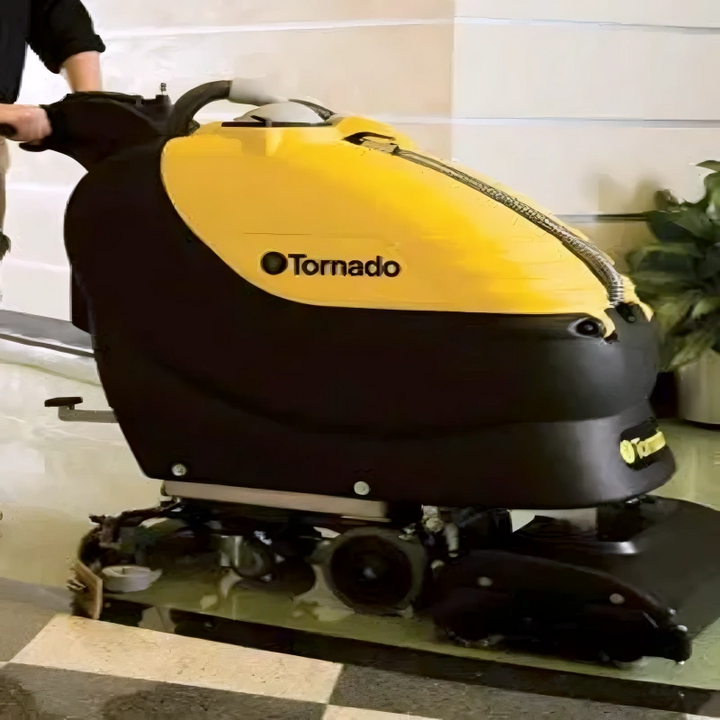
The Tornado Vortex 18 is the compact option. The listing gives an 18 in cleaning width, a 650 RPM brush, 1 gallon solution and 1 gallon recovery tanks, and a productivity of 4,844 sq ft per hour as listed. It weighs 68 lb, and Tornado lists 71 dB(A) and a 2-year parts and 2-year labor warranty. It fits corridors and small shops, not large open floors.

Compact daily scrubber
$2,468
An 18 in path for VCT corridors and small floors.
Older tile may contain asbestos
Some older vinyl floor tile contains asbestos, and you cannot tell by looking. OSHA's asbestos standard (29 CFR 1910.1001) says asphalt and vinyl flooring installed no later than 1980 must be treated as asbestos-containing unless shown otherwise. On that flooring it prohibits sanding, requires stripping with low-abrasion pads at speeds lower than 300 rpm and wet methods, and allows burnishing only where there is enough finish that the pad cannot contact the tile. EPA's homeowner guidance adds: never use a power stripper on flooring that may contain asbestos. So strip older tile at 175 RPM, never on a dual-speed machine's high setting. Lab testing is the reliable check. Our post on asbestos floor tile removal covers the rules in more detail.
Common VCT care mistakes
Most VCT problems come from the finish program, not the tile. Skipping the daily dust mop lets grit grind the finish down faster. Burnishing a coat that has not cured can leave marks. Stacking new coats over worn finish traps dirt, so scrub and recoat or strip first. Daily cleaning should use a neutral cleaner, since strong cleaners dull the finish.
Keep a simple log of when each floor was last recoated or stripped. It tells you whether a dull patch needs a quick burnish, a scrub and recoat or a full strip. It also stops the same corridor from being skipped for months.
Which machine fits which floor
Match the machines to the floor size: a small floor can run on one dual-speed machine plus a mop, and a large one usually needs three. A dual-speed machine such as the Cleanmaster scrubs on the low speed and spray buffs on the high one. A larger school or store floor is faster with a 20 in low-speed machine, a separate burnisher and an auto scrubber.
Cords matter on big floors. The Cleanmaster and the Ultra D.C. 21 both list a 50 ft cord, so plan outlets along the route. The Vortex 18 is corded too: Tornado's own product page lists a 40 ft cord, so plan outlets for it the same way. Browse every walk-behind scrubber to compare tank sizes before you buy for a large floor.
Frequently asked questions
Is VCT the same as vinyl flooring?
VCT is a type of vinyl flooring, a tile that is sold in commercial sizes such as 12 in x 12 in. It differs from LVT and sheet vinyl in build and in upkeep, since VCT needs a floor finish program.
Does VCT need to be sealed or waxed?
It needs a floor finish. Armstrong's guidance for new VCT is 3 to 5 coats of commercial floor polish, then periodic scrubbing and recoating. LVT, by contrast, gets no initial polish or sealer.
How long does VCT flooring last?
Armstrong calls VCT an economical choice with decades of proven performance and durability, but it gives no year count for a floor. How long it lasts depends on foot traffic, the finish program and how often it is stripped. Because the color runs through the tile, a worn tile can also be replaced on its own.
How do you shine VCT flooring?
Apply finish, let it cure as the label says, then buff or burnish. A high-speed floor burnisher brings up the gloss, and a scrub and recoat restores it when it dulls.
Is there asbestos in VCT tile?
It can be in older tile. OSHA says vinyl flooring installed no later than 1980 must be treated as asbestos-containing unless shown otherwise. See asbestos floor tile removal before you touch an older floor.
Is VCT or LVT more expensive?
Armstrong says LVT is almost always more expensive than VCT to buy. VCT then needs polish from day one and periodic stripping, while polish on LVT is optional.
Keep VCT shining between strips