How we made this guide: picks, prices and specs come from our catalog and the makers' published specs, owner quotes come from customer reviews on our product pages and the guide was drafted with AI help, then checked and edited by Trevor Hall.
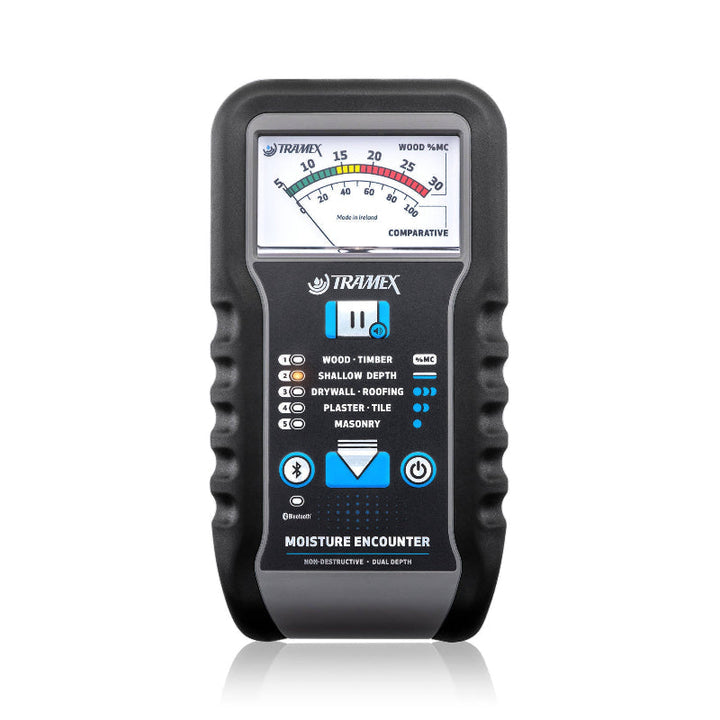
There is no single normal moisture meter reading. Wood is read in percent moisture content. Drywall and plaster are usually read on a meter's relative scale and judged against a dry area of the same material. Concrete needs its own scale or a humidity test. A pinless meter like the Tramex ME5 at $600 shows you the number; the chart below tells you what to compare it with.
Quick answer
Take a reading on a dry, undamaged area of the same material, then read the wet area. The gap between the two matters more than the raw number. Example: a dry stud reads 9% and the wet stud reads 17%, so it sits 8 points above its dry reference and is still wet. For interior trim and flooring, the USDA Wood Handbook recommends about 8% moisture content in most of the US (6 to 10% for single pieces). For drywall read in pin mode on a drywall %MC scale, Tramex treats anything over 0.5% as higher than generally acceptable. See our moisture meter collection for meters that read these scales.
Moisture meter readings chart by material
Use this chart to find the scale each material uses and how to judge a reading. Each row names its source. Where no maker or standard publishes a band, judge the reading against a dry reference.
| Material | Scale the reading uses | How to judge it | Source |
|---|---|---|---|
| Drywall (gypsum board) | Drywall %MC on a meter with a drywall scale in pin mode, or a 0 to 100 comparative (reference) scale in pinless mode | Pin-mode drywall %MC: 0 to 0.5% green (acceptable), 0.6 to 0.7% yellow, 0.8 to 8.5% red. On the comparative scale there is no fixed band: compare with a dry wall of the same board | Tramex drywall guidance (meter maker) |
| Interior trim, flooring and woodwork | Percent moisture content (%MC), set for species on a pin meter or for specific gravity on a pinless meter | Recommended at installation: about 8% in most of the US (6 to 10% for single pieces), 6% in the dry Southwest (4 to 9%) and 11% in damp, warm coastal areas (8 to 13%). A reading well above the dry reference is wet | USDA Forest Products Laboratory Wood Handbook, Table 13-2 |
| Framing lumber (studs and joists) | %MC on the wood scale | Softwood framing lumber is usually dried to a target average of 15%, not over 19%. In a finished building, compare with a dry stud in an unaffected room | USDA Forest Products Laboratory Wood Handbook; your own dry reference |
| Subfloor and sheathing | Wood scale, or a plywood or OSB group if the meter has one | No published band: compare with dry subfloor in an unaffected room of the same house | Your own dry reference |
| Plaster | Comparative scale on a pinless meter | No published band: compare with dry plaster on a wall that never got wet | Your own dry reference |
| Concrete slab | A concrete scale, or relative humidity in the slab | Do not read it on a drywall or wood scale. Use a concrete meter or an in-slab humidity test, covered in how to test concrete moisture before installing flooring | ASTM F2170 (in-slab relative humidity test method) |
| Carpet pad and carpet | Comparative scale | No published band: compare with a dry area of the same pad and carpet. See how to dry wet carpet | Your own dry reference |
Restorers call that dry reference the dry standard: a reading on the same material in an area the water never reached, which then becomes the drying goal. Tramex, the meter maker, describes the same baseline method: a reading in a known dry location serves as the "acceptably dry" level, and readings above it may indicate elevated moisture.
Above about 30%, wood readings are only a rough guide: the Wood Handbook puts the reliable range at about 4 to 30% for pinless meters and 6 to 30% for pin meters.
Why one number never fits every material
A moisture meter does not measure water directly. A pin meter measures electrical resistance between two pins, and a pinless meter reads the material's electrical properties through a flat sensor. Most are calibrated for wood. Some add a scale for another material, such as the drywall %MC scale Tramex calibrates for pin readings. On any material without its own scale, the number is a relative reading, useful for comparison but not a true percent of water.
That is why a reading of 25 on a wood scale and a reading of 25 on a relative drywall scale mean different things. Always note which scale the meter was on before you write a number in a report.
A high reading means moisture is present. It does not tell you about mold. Mold is confirmed by a trained assessor and removed by remediation, so treat the meter as a moisture finder only.
How to set your dry reference, step by step
- Pick an area of the same material that was not wet, ideally in the same building and on the same floor.
- Set the meter to the right material group or scale before you start.
- Take at least three readings in the dry area and note the typical value. This is your dry reference.
- Scan the suspect area slowly, overlapping your passes and mark every spot that reads above the dry reference.
- Confirm the worst spots with a second method, such as a deeper pinless reading or a pin probe.
- Record the reading, the material, the scale, the depth and the location each visit so you can see the drying curve.

A worked example, with illustrative numbers
Say a dry stud in the unaffected room reads 9% on the wood scale. After a leak, the stud behind the wet wall reads 17%. The gap is 17 minus 9, which is 8 percentage points above the dry reference, so the wall is still wet. Our calculation: drying goal = dry reference reading, and the job is done when the wet area reads at or near it. The numbers here are an example to show the method, not a limit to work to.
How to read your moisture meter
Pin or pinless
A pinless meter scans without making holes, so you can map a whole wall fast. A pin meter pushes two pins into the material and reads resistance, which is more specific to one spot and to the material group you select. Many restorers scan with pinless and confirm with pins. Our write-up on pin vs pinless moisture meters goes further.
Reading depth
Depth changes the answer. A dual-depth pinless meter reads a shallow zone near the surface and a deeper zone behind it. The Tramex ME5 lists a shallow depth up to 3/8 in and a deep reading up to 1-1/4 in, so a shallow reading can look dry while the deep one shows water behind the paint. Always check both when a surface looks fine.
Reference scale or percent moisture content
If the meter shows percent moisture content, that figure is only a true percent on the material it was calibrated for. If it shows a relative number, use it to rank spots, not to name a percent. Check your meter's manual for which materials it converts.
Temperature, humidity and surface effects
Dew point and relative humidity tell you whether materials will dry or take on water from the air. See how to read a psychrometric chart for grains per pound and dew point. A surface that reads wet only in the shallow setting may be condensation: if the surface temperature is at or below the room's dew point, water is forming on the surface rather than coming from inside the wall. The MEX5 reads both with its built-in infrared thermometer and dew point. Metal behind a wall, foil-backed insulation and very dense materials can skew a pinless reading, which is why you confirm a worrying spot a second way.
Meters that read these scales
These are the meters in our range that fit the chart. Prices are what our store lists today.

Dual-depth pinless
Tramex ME5 - Moisture Encounter ME5
$600 · 4.9 from 16 reviews
A pinless survey meter for wood, drywall, plaster, tile and masonry.
The ME5 is a non-invasive pinless meter with two depth settings, a wood range of 5 to 30% MC and a 9V battery that is included. It also pairs with the Tramex Meters App for iOS and Android. One owner review on our product page says it plainly:
“Very accurate and very easy to read!”
Tramex ME5 owner · 5 out of 5 stars
Pros
- Pinless, so no holes in finished walls
- Dual-depth readings to 3/8 in and 1-1/4 in
- App support for notes and records
Cons
- Pinless only, so there is no resistive pin reading
- Wood range tops out at 30% MC
Skip it if you want one meter that also reads relative humidity and dew point. The MEX5 does.

Moisture plus climate
Tramex MEX5 - Moisture Encounter MEX5
$1,020 · 5.0 from 2 reviews
Dual-depth readings plus relative humidity, dew point and grains per pound.

The MEX5 reads at two depths like the ME5, has a wood range of 0 to 30% and adds relative humidity, temperature, dew point and grains per pound. It takes pin-type and in-situ RH probes, has a built-in infrared thermometer for surface temperature and logs data through the Tramex Meters App. Its reviews are few, two on our product page averaging 5.0.
“As a mold assessor I really on my Tramex daily to give me accurate readings .”
Tramex MEX5 owner · 5 out of 5 stars
Skip it if you only survey walls and never need humidity or dew point. The ME5 costs less at $600 against $1,020 for the MEX5.


Imaging meter
FLIR MR176 Plus Imaging Moisture Meter with IGM Technology and Lepton Image Detector
$1,109
A thermal image shows where to measure, then pinless or pin readings confirm.
The MR176 Plus pairs a pinless sensor with an external pin probe and a thermal image that guides where to measure. It lists a relative humidity range of 0% to 100% with an accuracy of plus or minus 2.5% RH, an 80 x 60 pixel thermal image and image capture with reporting through FLIR Tools software. A thermal image shows surface temperature, not moisture, so confirm every cold patch with a reading. Our moisture meter vs thermal camera post explains the split, and thermal imaging for home inspection covers cameras in more depth.

Skip it if you do not need the camera. Our thermal imagers collection has stand-alone cameras, and a plain meter costs less.

Best budget pin and pinless
FLIR MR60 Pro Moisture Meter Pin and Pinless
$453.99
Both reading modes with 11 selectable material groups for pin readings.
At $453.99, the MR60 Pro is the budget pick in this guide and still reads both ways. For pin readings you choose from 11 material groups. A high moisture alarm is programmable, up to 10,000 readings and screenshots can be stored, and its listed specs include a 3 meter drop test. The warranty is 2-10 (2 years parts and labor, 10 years on the detector).

Skip it if you need dew point or dual-depth readings in a single pass.

Restoration kit
Extech MO280 Water Restoration Kit
$526.89
A kit with a pinless meter, a pocket meter and a hygro-thermometer in one case.
The Extech MO280 Water Damage Restoration Kit packs the MO280 pinless moisture meter, an MO210 pocket moisture meter and an RH490 precision hygro-thermometer in a carrying case. The listing gives the MO280 10 wood types and a reading depth of 0.75 in, the MO210 a wood range of 6 to 44% and a building-material range of 0.2 to 2% on its pins, and the RH490 dew point and humidity readings. It suits a restoration tech who wants moisture and room conditions recorded for insurance documentation. Skip it if you want a thermal image or dual-depth readings in one meter.
What changes the answer
- Material: Reading wood on a drywall setting, or the reverse, gives a number that means nothing.
- Depth: A shallow reading can miss water behind a coating or board.
- Temperature and humidity: Indoor wood follows room humidity, so a dry house in winter reads differently from a humid one in summer.
- Wood temperature: The USDA Wood Handbook says pin (resistance) readings shift by about 0.5% for every 10 F the wood is above or below the meter's calibration temperature, so correct cold crawl space or attic readings. Newer pinless meters correct for temperature themselves but need the right specific gravity setting.
- Contact: A pinless sensor must sit flat. A gap or a curved surface lowers the reading.
- Species and coatings: A pin meter needs the wood species set. Pinless meters such as the ME5 are built to read through paint and wallpaper, but confirm any high spot with a second method.
Moisture meter guides and more
For concrete slabs go to testing concrete moisture before flooring. For mold jobs see the mold remediation equipment list, and for hardwood floors see drying hardwood floors after water damage. Browse the Tramex collection for the full meter range.
Frequently asked questions
What is a normal moisture meter reading?
It depends on the material and the scale. For interior trim, flooring and woodwork, the USDA Wood Handbook recommends about 8% moisture content in most of the US, 6% in the dry Southwest and 11% in damp, warm coastal areas. For drywall on a true drywall %MC scale, Tramex treats 0 to 0.5% as acceptable. For plaster, and for any reading on a comparative scale, normal is the reading on a dry area of the same material in the same building.
Is 25 a high damp reading?
It can be, but it depends on the meter and the scale. On a wood %MC scale, 25% is far above the 6 to 10% the USDA Wood Handbook recommends for interior wood in most of the US and close to the 30% ceiling the Handbook gives for reliable meter readings, so the wood is wet. On a relative scale used for drywall or plaster, 25 has no fixed meaning until you compare it with a dry reference on the same material.
How do I read my moisture meter?
Select the right material or scale, read a dry area first, then scan the suspect area and compare. Check both the shallow and deep readings if your meter has them, and confirm high spots with a second method.
How do I interpret moisture meter readings?
Treat the reading as a comparison. A number well above your dry reference means moisture is present. Track the same spots over several days: falling readings mean the area is drying, flat readings mean drying has stalled (check the equipment and room conditions) and rising readings point to a source that is still active.
What is an acceptable moisture level for drywall?
Tramex states that drywall readings over 0.5% moisture content should be considered higher than generally acceptable and need further drying or investigation. That figure is a true drywall %MC reading taken in pin mode on a drywall scale, such as the MEX5 with its pin probe. A pinless meter like the ME5 reads drywall on a 0 to 100 comparative scale, so aim for the reading on a dry wall of the same board.
Is 15% or 20% moisture in drywall bad?
It is not a true drywall percent. Tramex's pin-mode drywall %MC scale runs from 0 to 8.5%, with red from 0.8%, so a 15 or 20 on drywall comes from a wood scale or a comparative scale. Compare it with a dry wall of the same board read on the same setting: if the dry wall reads far lower, the wet one needs drying.
Read moisture with confidence
Related guides
- How to Test Concrete Moisture Before Flooring: Meter, RH Probes and Calcium Chloride
- Pin vs Pinless Moisture Meters: Which One Should Restorers and Inspectors Buy?
- Best Moisture Meters for Water Damage, Drywall and Building Inspection
- Hardwood Floor Water Damage: How to Dry the Boards Before They Cup