How we made this guide: picks, prices and specs come from our catalog and the makers' published specs, owner quotes come from customer reviews on our product pages and the guide was drafted with AI help, then checked and edited by Trevor Hall.
To dry wet carpet, pull the water out first, then move air across it and dry the room's air until a moisture meter reads dry. A wet/dry vac such as the Dapper Supply 16-gallon at $220 handles a small household leak, and a flood extractor such as the Mytee 7000LX Flood Hog at $3,260 suits a whole room or a professional job.
Speed matters. EPA's mold guidance says wet or damp materials dried within 24 to 48 hours after a leak or spill will not grow mold in most cases. Fans alone rarely get a soaked carpet there, because fans evaporate water slowly and extraction removes it fast.
The order that works
- Stop the water and work out what kind it is. Clean supply-line water is a different job from sewage or flood water.
- Extract with slow, overlapping passes.
- Decide whether the pad can dry in place or has to come out.
- Place air movers, and float the carpet over the pad if you can.
- Run a dehumidifier in the closed-up room.
- Measure. Stop only when readings match a dry reference.
Tools and equipment
You do not need all of this for a small leak. A wet/dry vac, one air mover and a meter cover a bathroom-sized spill. The list below is what a restorer runs on a larger loss, with our prices and the figure that matters for each tool.
| Tool | Job | Price | Key rating |
|---|---|---|---|
| Dapper Supply 16-gallon wet/dry vac | Small leaks, spot extraction | $220 | 76.3 in water lift, 108 CFM |
| Mytee 7000LX Flood Hog | Room-size or commercial extraction | $3,260 | 182 in water lift, 66 GPM pump-out |
| AlorAir GE3000HTC air mover | Drying carpet and floors | $279 | 3,000 CFM maximum, 5.6 A |
| XPOWER XD-85L2 LGR dehumidifier | Drying the room's air | $2,148 | 85 pints/day AHAM |
| Extech MO290 moisture meter | Proving the carpet and subfloor are dry | $569 | Pin and pinless, plus air temperature and humidity |
Step 1: Stop the source and judge the water
Shut off the supply, fix the leak or wait for the source to stop, and switch off the breaker for any wet outlets before you plug in anything. If reaching the breaker panel means standing in water, stay out and call an electrician or your utility. Then ask where the water came from.
Restorers sort water by how contaminated it is, and the IICRC S500 water damage standard is the reference for that sorting. Water from a clean supply line is the easiest case. Water from a washing machine drain or a dishwasher is the middle case that restorers call gray water. The IICRC's position is that gray (Category 2) and black (Category 3) water losses need contamination controls before drying starts, and the pad under gray water is usually pulled rather than dried. Water that has come up from a sewer line, a drain backup or a flooded yard is different: carpet and pad soaked by it are generally removed rather than dried, and that call belongs with a trained technician. This guide covers the clean-water leak. We give no medical advice, so if anyone in the building is unwell or the water source is unclear, treat it as a professional job.
Move furniture off the wet area, or set foil or plastic blocks under the legs, and photograph the damage before you pull anything up. Call a restorer when the water is sewage or outside floodwater, came through a ceiling or has wicked into drywall or baseboards. Call one as well if the carpet has stayed wet for more than 48 hours.
Step 2: Extract the water
Extraction does most of the drying work. A carpet holds far more water than a fan can lift off it in a day, so every gallon you pull out is a gallon the air movers and dehumidifier never have to handle.

Small leaks
Dapper Supply 16-Gallon Wet/Dry Vacuum, 4.5 Peak HP, 3-in-1 Function
$220
A 16-gallon stainless tank for a burst supply line or a leaking water heater in one room.
For a small leak the Dapper Supply 16-gallon wet/dry vac is the practical choice. The spec sheet lists 76.3 inches of water lift, 108 CFM of airflow and a 16-gallon stainless steel tank, with an 8.2 ft hose and a 13.2 ft cord. Ignore the 4.5 "peak HP" in the name. Peak horsepower is not a performance rating; water lift and airflow are the numbers to compare. Its dual filter and wet, dry and blower modes make it a general shop vac, so it needs a floor tool and patience on a soaked carpet.
Skip it if the whole room is wet. A 16-gallon tank fills quickly, and emptying it every few minutes slows the job.


Whole-room and professional
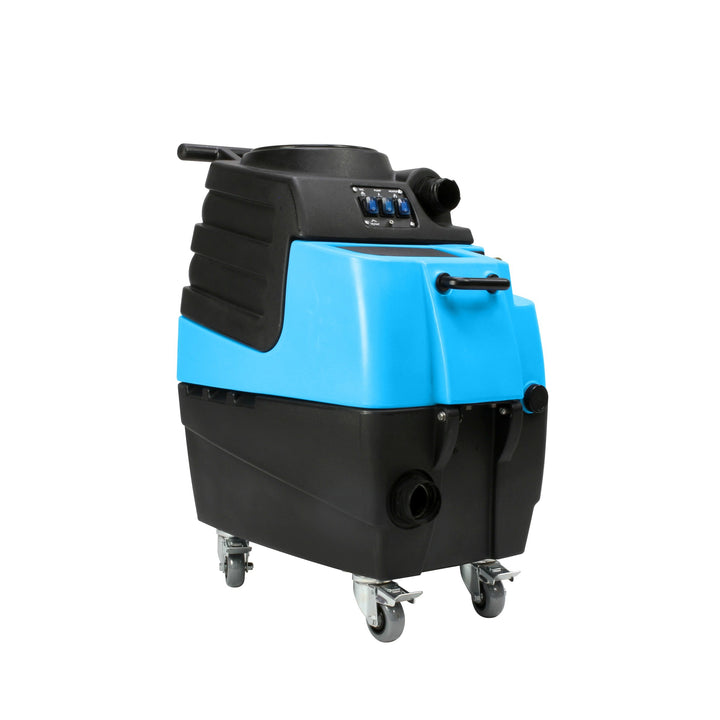
Mytee 7000LX Flood Hog Flood Extractor, 12 gal., 66 GPM, LX vacuums
$3,260
A 12-gallon flood extractor that pumps itself out, so you keep working.
For a whole room, a basement or a commercial space, the Mytee 7000LX Flood Hog is built for the job and is one of our best-selling extractors. Mytee's spec lists a 12-gallon recovery tank, dual LX vacuum motors rated up to 250 CFM, 182 inches of water lift and a stainless steel auto pump-out rated at 66 GPM. The pump-out sends the water down a hose to a drain, so you do not stop to empty the tank. It has no solution pump, so it only removes water and never sprays it. Mytee's manual lists two 50 ft cords and a 25 ft pump-out hose in the box. The vacuum hose and flood wand come in Mytee's A138 Accessory Kit, so check what ships with the listing before the job.
Power is the catch. It carries two 50 ft cords drawing 18 A and 13 A at 115 V. Mytee's manual says each cord requires a grounded 20 amp outlet, and that with only one 20 amp outlet you can run the primary cord alone, which powers one vacuum and the pump-out. A dual circuit indicator light and tone on the switch plate come on when both cords have power. Mytee's manual lists it at 124 lb, on 10 inch foam-filled rear wheels and 4 inch locking front casters. Mytee covers it for 1 year, parts and labor. Major components such as the pump-out and vacuum motors carry 2 years, and the roto-molded housing and tank carry 10.
Skip it if you only have a few square feet to dry. It is a lot of machine for one damp corner.


How to make each pass count
- Match the tool to the depth. Mytee's manual suggests a flood wand for shallow or light flooding and a stand-on flood extraction tool for heavier flooding.
- Work in slow, overlapping passes. Pull the tool toward you slowly so the vacuum has time to lift the water.
- Go over each strip more than once. Stop when the tool returns only a trickle.
- Work from the wettest area outward, and empty or pump out before the tank fills.
- Do not step on soaked carpet more than you must. Footsteps push water down into the pad.
Step 3: Decide what happens to the pad
Carpet pad acts like a sponge, and water sits in it long after the surface feels better. With clean water caught early, many restorers dry the pad in place or lift the carpet from a corner and prop it so air reaches the pad and the floor. Carpet pulled off the tack strip will need re-stretching when it goes back down. If the water was contaminated, the pad has been wet for a long time or it smells, pull the pad and replace it.
Whichever you choose, the subfloor under the pad needs to be dry as well. For a hardwood or plank subfloor, see our guide to drying hardwood floors after water damage.
Step 4: Place the air movers
Air movers dry by moving air across a wet surface so water leaves it faster. Set them along the walls, angled so each unit's airflow sweeps the wet carpet and the base of the wall and overlaps the next one's, until air is moving across the whole wet area. Start with fewer units and add one where the meter shows a spot drying slowly.

Floats the carpet
AlorAir GE3000HTC 3000 CFM Air Mover with Wheels, Timer and Carpet Clamp
$279
A carpet clamp holds the carpet edge over the outlet so air flows under it.
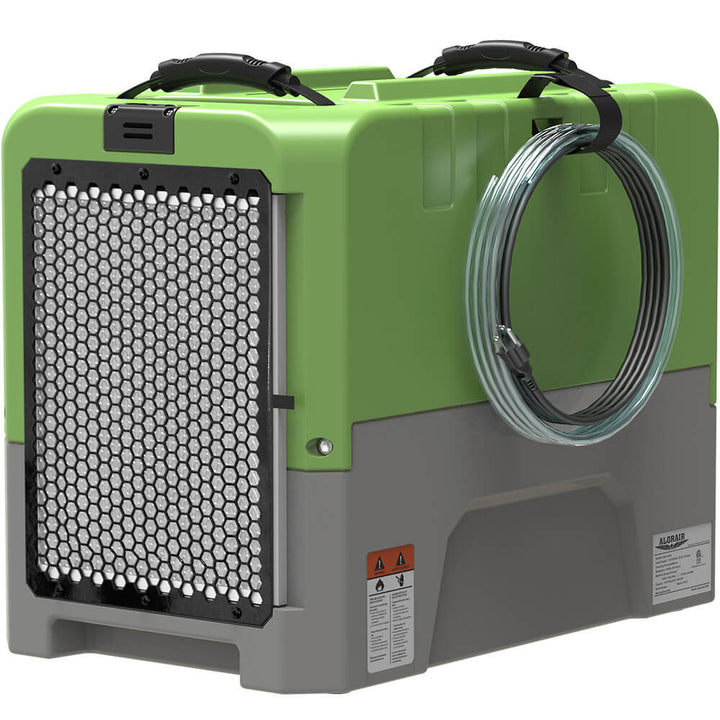
The AlorAir GE3000HTC is made for this job. AlorAir rates it at up to 3,000 CFM from a 4/5 HP motor and 5.6 A at 115 V, with a 20 ft cord. The carpet clamp holds a lifted carpet edge over the outlet, so air blows between the carpet and the pad instead of only over the top. It has three speeds, four operating positions and a 3-hour dial timer, and it rides on a pull-out handle and wheels. It weighs 27.51 lb and is rated at 77 dB, so expect noise at full speed.
Power adds up. Our calculation: two of these draw 5.6 A x 2 = 11.2 A, which is most of a 15 A circuit before anything else is plugged in. Count the amps on each circuit before you add units. In a wet room, plug drying equipment into GFCI-protected outlets.
Skip it if the carpet is glued down or the water is barely past the surface. A glued carpet cannot be floated, and a damp spot may need only a small fan.
For drying times and ways to speed them up, see our guide to how long carpet takes to dry, and browse all air movers.
Step 5: Dehumidify
Air movers push water into the air. A dehumidifier takes it out of the air, and without one the moisture lands back on cold walls, the ceiling and the carpet. Close windows and doors, put the unit in the room and let it run.

Dry the room's air
$2,148
An LGR dehumidifier with an automatic purge pump and a 40 ft drain hose.
The XPOWER XD-85L2 is rated at 85 pints per day at AHAM conditions (80°F, 60% RH) and 145 pints per day at saturation conditions (90°F, 90% RH). Those are two different test conditions, so compare AHAM figures with AHAM figures only. It draws 6.7 A at 115 V and works from 33°F to 105°F. The purge pump and 40 ft drain hose carry the water away, so nobody has to empty a bucket. It weighs 70.5 lb and has a handle and wheels. The warranty is 1 year limited, and it comes in blue or red.

Skip it if the room is small and the loss is minor. A household dehumidifier may do, and our LGR dehumidifiers page shows the full range. To understand how these work, read how a dehumidifier works.
Step 6: Measure until it is dry
A carpet that feels dry can still hold water in the pad and the subfloor. A meter shows what your hand cannot. First take readings on a similar, unaffected carpet in the same building to get a dry reference, then keep drying until the wet area matches it.

Prove it is dry
Extech MO290 8-in-1 Moisture Meter and IR Thermometer
$569
Pin and pinless readings, plus air temperature and humidity, in one meter.
The Extech MO290 reads moisture with a pinless sensor and a pin-type probe, and it adds air temperature, humidity and a non-contact infrared thermometer. Check the carpet, then the pad edge and the subfloor, at the lowest spots and those farthest from the air movers. Browse the moisture meters we carry for other models.
Do not pull the equipment on the first good reading. Check again the next day. A reading that climbs back means water is still in the pad or the floor.
Notes by job size
| Job | Extract with | Dry with | Check with |
|---|---|---|---|
| Small leak, one room corner | Wet/dry vac | One air mover, window closed | Moisture meter |
| Whole-room clean-water leak | Wet/dry vac or flood extractor | Air movers plus a dehumidifier | Meter on carpet, pad and subfloor |
| Basement or commercial floor | Flood extractor with pump-out | Several air movers plus an LGR dehumidifier | Meter and a daily re-check |
| Sewage or flood water | A trained restorer | Per the restorer's plan | Per the restorer's plan |
How to stop the wet carpet smell
The smell comes from carpet and pad that stayed damp, so the fix is the same as the dry-out: extract, move air, dehumidify and measure. If the smell comes back after the carpet looks dry, put the meter on the pad edge and the subfloor again.
Baking soda does not dry carpet. If you use it, use it only on carpet that already reads dry, then vacuum it up. Deodorizers cover a smell without removing the moisture behind it.
Wet carpet and mold
CDC's flood cleanup guidance says that if you could not dry your home, including furniture and other items, within 24 to 48 hours, you should assume you have mold growth. EPA's guidance says absorbent or porous materials, such as carpet, may have to be thrown away if they become moldy, because mold can fill the spaces in porous materials and may be difficult or impossible to remove completely. Growth that returns or spreads needs remediation by a trained crew, not a machine; our guide to basement mold remediation explains the steps. We give no medical advice about mold.
Common mistakes
- Relying on fans before extracting. The water stays in the pad.
- Skipping the dehumidifier. Water moves into the room's air and then back to the surfaces.
- Leaving the windows open on a humid day, so the room takes on moisture.
- Stopping because the surface feels dry. Measure the pad and subfloor.
- Overloading a circuit with air movers.
Frequently asked questions
Will wet carpet dry on its own?
It can but slowly. The pad and subfloor stay wet longest. Dry it within the 24 to 48 hour window that EPA's guidance names, and use extraction, air movement and a dehumidifier to do it.
What absorbs moisture out of carpet?
A wet/dry vac or flood extractor pulls out the bulk of it. After that, moving air picks up what is left and a dehumidifier removes it from the room's air. Powders do not dry a soaked carpet.
How long will wet carpet take to dry?
It depends on how much water got in, the pad, the temperature, the humidity and how much equipment you run. We cannot give a fixed time, so measure with a meter and stop only when the readings match a dry reference.
How long does it take for mold to grow under wet carpet?
EPA does not give a start time. Its guidance says that if wet materials are dried within 24 to 48 hours, mold will not grow in most cases. Past that window, assume growth may be starting and check the pad and subfloor.
Can a soaking wet carpet be saved?
Often, when the water was clean and you act quickly. If the water was contaminated or the carpet stayed wet for days, a restorer may advise removing it. Pad is usually the first thing to replace.
How do I get rid of wet carpet odor?
Remove the moisture that causes it. Extract, then dry the carpet, the pad and the subfloor and confirm with a meter. If the smell stays after everything reads dry, contact us to ask about the next step or call a restorer.
Which tool should I buy first?
Start with the extractor that fits the size of the loss, then add air movement and a dehumidifier. Browse wet/dry vacuums for small jobs, or the Flood Hog for whole rooms.
Move air across the carpet, not just the room