
How we made this guide: picks, prices and specs come from our catalog and the makers' published specs, owner quotes come from customer reviews on our product pages and every guide is checked and edited by Trevor Hall.
Blot a fresh spot right away, but an old urine smell sits in the backing and pad, so a pro maps the spill, treats it as deep as it went, flushes it out with an extractor and dries it fast. A fresh spot is a quick job; an old smell across a room is pro-level work, with dwell time, drying time and new pad wherever it is soaked through.
For flushing, the machine we would start with is the Mytee 1000DX-200 Speedster at $2,421: a 220 PSI pump and 130 inches of water lift. For small spots, the Sandia Super Spotter starts at $734.
The short version
Find every wet area, treat it as deep as it went, flush it with clean water, extract until the water coming back looks clear, then dry the carpet and pad quickly. Masking sprays only cover the smell, and it comes back. Flushing removes what makes it. See all portable carpet extractors we carry, or start with the extractors under 5 gallons for spots.
Why the smell comes back
Urine does not stay on top of the carpet. It passes through the fibers, soaks the backing and can reach the pad and the subfloor below. Whatever is left behind can smell again later. The Carpet and Rug Institute's technical bulletin on pet urine notes that some products only mask the odor, and that in times of high humidity the odor may reappear.
That is why a spot that "smelled fine" after cleaning smells again on the next humid day. The fix is reaching everything the urine reached. For the general version of this problem, see our guide to getting rid of carpet odor.
What you need
- A way to find the spill: a UV flashlight shows dried urine in a dark room, and a moisture meter shows where carpet and pad are still wet.
- A treatment product made for urine, such as an enzyme or oxidizing cleaner. Follow its label for dilution and dwell time.
- An extractor with real water lift to flush and recover: a spotter for small areas, a portable for rooms.
- Air movers to dry the carpet and pad fast.

Flush a room
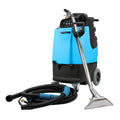
Mytee 1000DX-200 Speedster Portable Extractor, 10 gal., 220 PSI
$2,421
An unheated 10 gallon machine with 130 inches of water lift for flushing and recovering a whole room.

Map the spill
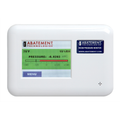
FLIR MR77 5-in-1 Moisture Meter with METERLiNK Technology
$789
A pinless sensor plus a pin probe for checking how far wet carpet and pad spread.
Step 1: Blot a fresh spot, do not rub
If the accident just happened, press clean towels on it and stand on them to pull the liquid up. Replace the towels until they come up nearly dry. Rubbing spreads the urine sideways and pushes it deeper into the backing.
Step 2: Find the full extent
The wet patch you can see is rarely the whole spill. Turn the lights off and sweep a UV flashlight over the carpet: dried urine often glows, which shows spots you have never seen. Other residues can glow too, so confirm each spot by smell or with the meter before you treat it.
Then check how deep it went. A moisture meter shows where carpet and pad are still wet. The Teledyne FLIR MR77 at $789 pairs a pinless sensor with a remote pin probe and a temperature and humidity sensor. On a thick carpet the pinless sensor may not reach the pad from the top of the pile (Teledyne FLIR lists its maximum pinless depth as 0.75 inches), so lift a corner and read the pad with the pin probe. Compare readings in the marked area with a dry part of the room and mark where they climb. A meter finds moisture, not urine: on an old, dried spill a normal reading does not clear the pad, so lift a corner and smell it too. For more on meter types, see pin vs pinless moisture meters.

Step 3: Decide spot, pad or subfloor
| What you find | What it means | What to do |
|---|---|---|
| One small, recent spot; the carpet is damp at the surface only | Urine has not reached the pad | Blot, treat and rinse with a spotter |
| A larger or older spot; the pad reads wet or the smell is strong when you lift a corner | Urine is in the backing and pad | Treat the area, then flush it and extract with a subsurface tool on an extractor; replace the pad if it stays wet or smells after drying |
| Repeat accidents in one place, or a pad that is soaked through | Urine may have reached the subfloor | Pull the carpet back, replace the pad and treat the subfloor before the carpet goes down again |
Step 4: Treat it as deep as it went
Apply the treatment so that it reaches the same depth the urine did. A light mist on the surface only treats the surface. Use enough product to wet the area you marked, in the amount the label gives for urine and let it dwell for the time the label states. Take it a little past the edges you marked, because urine spreads wider in the pad than on the surface.
Read the label for two things. First, the dilution and dwell time. Second, whether it tolerates hot water, because some products are not meant to be mixed or rinsed hot. Check what comes next too: some labels say to extract after the dwell, others say to leave the product in to dry. If the label does not say, check with the maker before you pour it into a heated machine.
We do not sell treatment chemicals, so use the one you trust and follow its label exactly. A masking spray only covers the smell, so never use one in place of flushing.
Step 5: Flush and extract
This is the step that removes the smell. Flushing means putting clean water into the carpet and pulling it back out, so the treated urine goes with it. Pass the wand slowly so the vacuum does the work. Keep going until the water you can see coming back through the wand or the vacuum hose looks clear. The recovery tank holds everything you pulled up, so it never runs clear.
When the urine reached the pad, a carpet wand is the wrong tool for the flush. It works from the top of the pile, and spraying from the top without pulling back through the pad pushes the urine into dry pad. Pros use a subsurface extraction tool instead: a flat, sealed plate that connects to the extractor's vacuum hose. Wet the marked area with rinse water, set the plate on it and stand on it, so the vacuum pulls through the carpet and the pad below. We do not carry one, so check that the tool's hose fitting matches your machine.
Lift and pressure matter here. The Mytee 1000DX-200 Speedster has a 220 PSI pump, 130 inches of water lift and 200 CFM of airflow, with 10 gallon solution and recovery tanks and a single 50 ft cord drawing 20 A at 115 V. Before a home job, check that the outlet's circuit can carry 20 A with nothing else running on it. It is unheated and weighs 104 lb.

For a single spot, a spotter is easier to carry. The Sandia Super Spotter runs a 55 PSI pump with 3 gallon solution and recovery tanks, a 4 inch upholstery tool and 7 ft solution hoses. The clear tool kit is $734 and the stainless tool kit is $786.


Flush a spot
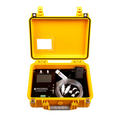
Sandia Super Spotter Spot Extractor Kit - 50-3000/50-3001
From $734
A 3 gallon spotter for single accidents, stairs and upholstery.
New to extractors? See how to use a carpet cleaning machine.
Step 6: Dry it fast
Run air across the floor as soon as extraction is done. The Sandia Gen-Air 3-Speed Air Mover at $285 moves a rated 1,500, 1,900 or 2,400 CFM across its three speeds and draws 4.5 A on a 20 ft cord. Two draw 9 A together (our calculation: 2 x 4.5 A), so keep them off the circuit the extractor is using; the extractor alone draws 20 A. Aim them across the treated area and move them as the carpet dries.


Dry the floor
Sandia Gen-Air 3-Speed Air Mover with 1/2 HP and 2400 CFM - 90-0000
$285
Three speeds up to a rated 2,400 CFM at 4.5 A for drying the treated area.
Check the pad with the meter again after a few hours. If it still reads high, keep drying. Our guides on how long carpet takes to dry and drying wet carpet after a leak cover the timing. See the air movers and moisture meters collections.
Step 7: Recheck and replace what will not clear
Come back the next day and smell the area, ideally on a warm, humid day, when a leftover source shows up. If it is gone, you are done. If it returns, the urine is probably still in the pad or subfloor. Cut back the carpet, treat the subfloor and let it dry fully. If you seal it, use a primer whose label covers odor sealing. Then lay new pad and re-stretch or replace the carpet.
Odor and color are separate problems. The Carpet and Rug Institute's bulletin on pet urine says urine can affect carpet dyes, and that when spots are found long after the accident, the dyes and fibers may be permanently damaged. Flushing removes the odor source, but it cannot put the color back. A spot that is still discolored once it is clean and dry needs a carpet repair, such as a patch.
Common mistakes
| Mistake | Why it fails |
|---|---|
| Spraying a fragrance over the spot | It covers the smell and leaves the urine in the pad |
| Treating only the visible stain | The spill usually reaches further than the stain does |
| Using laundry or automatic dishwashing detergent | The Carpet and Rug Institute's pet urine bulletin warns against both on carpet |
| Mixing two treatment products | Combine products only when both labels allow it |
For the stain side of the job, see how to remove carpet stains like a pro. For picking a larger machine, browse our carpet extractors.
Frequently asked questions
How do I use an enzyme cleaner on pet urine?
Follow its label. Apply enough to wet the whole area the urine reached and let it dwell for the time the label gives. Check the label for water temperature and for what comes next. If it says to extract, flush and extract once the dwell is up. If it says to leave the product in to dry, flush and extract the area first and apply the enzyme last.
Does vinegar work on dog urine?
On a fresh spot it can be part of a home method. The Carpet and Rug Institute's bulletin on pet urine gives a mild nonbleach detergent solution, then one cup of white vinegar to two cups of water, blotted dry. It warns against laundry or automatic dishwashing detergent. Vinegar does not reach urine that has soaked into the pad, so an old smell still needs flushing and extraction.
What is the best carpet cleaner for pet urine?
Match the machine to the depth. A spotter such as the Sandia Super Spotter handles single fresh accidents. A portable with strong water lift, such as the Mytee 1000DX-200 Speedster, run with a subsurface tool, handles urine in the pad. For the chemistry, choose an enzyme or oxidizing product whose label covers urine on your carpet's fiber.
Does a rental machine work on pet urine?
For a fresh spot, usually yes. Once urine has soaked into the pad, no wand, rented or pro, pulls it back out from the top of the pile. That takes a subsurface extraction tool on an extractor, or lifting the carpet and replacing the pad.
Can I clean cat urine the same way?
The steps are the same: find the full extent, treat it as deep as it went, flush, extract and dry. Check your product's label for pet urine use.
Flush it out, do not mask it
Related guides
- How to Get Rid of Carpet Odor: Find the Source, Extract It and Dry the Pad Fast
- How to Remove Carpet Stains Like a Pro: Spotting Chart and Extraction Steps
- How to Use a Carpet Cleaning Machine: The Pro Extraction Steps, Passes and Settings
- Best Commercial Carpet Extractors: Portable, Heated and High-PSI Picks by Job Size