How we made this guide: picks, prices and specs come from our catalog and the makers' published specs, owner quotes come from customer reviews on our product pages and the guide was drafted with AI help, then checked and edited by Trevor Hall.
Lead abatement is work designed to permanently eliminate lead-based paint hazards, through removal, enclosure, encapsulation or replacing the painted component, and it is done by certified abatement firms and workers. Lead-safe paint removal, in the sense most contractors mean it, is different: renovation, repair and painting that disturbs lead paint in pre-1978 homes and child-occupied facilities falls under the EPA Renovation, Repair and Painting (RRP) rule and its lead-safe work practices. Both jobs end with HEPA cleanup, and the core tools in our range run from the Novatek 3.3 gal HEPA backpack vacuum at $2,125 to the HEPA-AIRE H2KM negative air machine at $1,070.
Quick answer
Abatement is a hazard-elimination job for certified abatement professionals. RRP is a set of work rules for a certified firm and a certified renovator doing ordinary renovation in older buildings. Both end in careful cleanup, but they are checked differently: an RRP job ends with cleaning verification by the certified renovator, while an abatement job ends with clearance testing, dust-wipe samples taken by a certified inspector or risk assessor and compared with the EPA's dust-lead clearance levels. HEPA vacuums, negative air and containment earn their cost in that cleanup. Browse HEPA vacuums, negative air machines, mobile containment and decontamination showers. This post is equipment and rules background, not legal advice: check your state program, because many states run their own rules.
Which one is your job?
The split comes down to purpose. Abatement exists to remove or permanently cover a lead hazard. RRP exists to keep a renovation from making a new one. If you are replacing a window in a 1960 house, you are doing a renovation, and the RRP rule applies. If an owner or agency hires a firm specifically to eliminate the lead paint hazard, that is abatement, and it is handled under the EPA's separate abatement certification requirements or the equivalent state program.
The table below sorts typical tasks. Treat it as a map, not a ruling. Whether a job needs a certified abatement firm can depend on your state and on who is paying for the work.
| Task | Abatement or RRP | Who does it | Containment | Cleanup equipment |
|---|---|---|---|---|
| Replacing windows in a pre-1978 home | RRP | Certified firm, certified renovator on site | Work-area containment | HEPA vacuum, damp wiping, cleaning verification |
| Scraping and repainting a pre-1978 room | RRP | Certified firm, certified renovator on site | Work-area containment | HEPA vacuum, damp wiping, cleaning verification |
| Hired to eliminate a lead paint hazard | Abatement | Certified abatement firm, supervisor and workers | Set by the abatement plan and state rules | HEPA vacuum, often negative air; clearance testing by a certified inspector or risk assessor |
| Encapsulating or enclosing lead paint as a permanent control | Abatement | Certified abatement firm, supervisor and workers | Set by the abatement plan and state rules | HEPA vacuum, often negative air; clearance testing by a certified inspector or risk assessor |
| Replacing a painted component as a hazard control | Abatement | Certified abatement firm, supervisor and workers | Set by the abatement plan and state rules | HEPA vacuum, often negative air; clearance testing by a certified inspector or risk assessor |
What the RRP rule requires
The EPA says firms that do this work are required to be certified, and that their employees must be trained in lead-safe practices, either as certified renovators or on the job under one. Before work starts in pre-1978 homes and child-occupied facilities, the firm distributes the EPA's lead hazard information pamphlet and documents that it did so. Under the EPA's recordkeeping section, job records are kept for three years.
The work practices themselves, per the EPA's work practices page and 40 CFR 745.85, include the following:
- Work-area containment so no dust or debris leaves the work area: inside, taped-down plastic sheeting on the floor 6 feet beyond the surfaces being worked on, and outside, sheeting on the ground 10 feet beyond them, or farther where needed.
- Open-flame burning or torching of painted surfaces is prohibited.
- Machines that remove paint through high speed operation are allowed only with shrouds or containment and a HEPA vacuum attachment at the point of dust generation.
- A heat gun is permitted on painted surfaces only below 1,100 degrees Fahrenheit.
- Cleanup that collects paint chips and debris without dispersing them, then HEPA vacuuming of the remaining surfaces and damp wiping or mopping.
- Cleaning verification: a certified renovator inspects the work area. Inside, once it looks clean, the renovator wipes window sills, floors and countertops and compares the cloths with the EPA's cleaning verification card. Outside, the visual inspection is the check.
The rule exempts minor repair and maintenance that disturbs 6 square feet or less of painted surface per room inside, or 20 square feet or less outside, but not window replacement, demolition of painted surfaces or any job that uses a prohibited practice. State programs can be stricter. Read the EPA's pages for your job before you bid it.
Methods you will hear about
Each method trades dust risk, speed and cost, and each one changes how much cleanup follows.
Wet scraping
Misting the paint before scraping keeps chips and dust from going airborne, so it is a common choice for small areas. The cleanup afterward still needs a HEPA vacuum, because chips and fine dust settle on floors and sills.
Chemical strippers
Strippers lift paint without sanding, which cuts dust, but the softened paint still has to be scraped off and collected, and some strippers are caustic or solvent-based. Read the label and safety data sheet for ventilation and respirator needs, and follow your state rules for waste.
Heat guns
The rule allows a heat gun on painted surfaces only below 1,100 degrees Fahrenheit. Open-flame burning or torching is prohibited outright.
HEPA-shrouded power tools
Sanders, grinders and similar tools are allowed only when shrouded and connected to a HEPA vacuum at the point where dust is made. The vacuum has to keep up with the tool, which is where airflow and lift specs come in.
Protecting the crew
The RRP rule protects the building and the people in it. OSHA's lead standard for construction, 1926.62, protects the workers. It lists manual scraping, manual sanding and heat gun use on lead paint among the tasks where, until the employer's exposure assessment shows otherwise, workers must get interim protection: respirators, protective clothing, change areas, hand washing facilities, blood lead testing and training. OSHA's limit is 50 micrograms of lead per cubic meter of air, averaged over 8 hours.
Enclosure, encapsulation and replacement
These are abatement methods because they aim to control the hazard for the long term rather than just get through a repair. Replacing a painted component removes the lead paint from the building, but the removal itself still needs containment and cleanup.
Clearance testing ends an abatement job
Under the EPA's abatement rules, post-abatement clearance is done only by a certified inspector or risk assessor, who takes dust-wipe samples for a lab to compare with the EPA's dust-lead clearance levels. A 2024 EPA rule lowered those levels to 5 micrograms per square foot for floors, 40 for window sills and 100 for window troughs; check your state program for the levels it applies. An RRP job uses the renovator's cleaning verification card instead, unless the contract or another law calls for clearance testing.
Why cleanup equipment matters most
Lead dust is fine, so it does not stay in one spot. It settles onto floors, sills and every flat surface in the work area, which is why the rule asks for HEPA vacuuming and damp wiping rather than sweeping. OSHA's lead standard for construction work, 1926.62, says that when vacuuming is chosen for housekeeping the vacuums shall be equipped with HEPA filters, and that compressed air shall not be used to remove lead from any surface unless it is used with a ventilation system designed to capture the dust.
The RRP rule gives the test a buyer should apply. It defines a HEPA vacuum as a vacuum cleaner designed with a HEPA filter as the last filtration stage, a filter capable of capturing particles of 0.3 microns with 99.97% efficiency, and designed so that all the air drawn into the machine is expelled through the HEPA filter with none of it leaking past. So ask whether the whole machine is built that way, not just whether a HEPA filter fits it. For what the ratings mean, see our post on what a HEPA filter is. No machine on this page is approved, certified or compliant under the RRP rule or any abatement program. The rule governs the firm and the work practices, and the equipment is a tool for meeting them.
HEPA vacuums for lead cleanup
Two HEPA vacuums from our range that suit lead cleanup are below. Our HEPA vacuums collection also has lower-priced backpack and canister models. Both Novatek models list four stages of filtration ending in a tested and certified HEPA filter, and both come in air-powered and electric versions.

Floor HEPA vacuum
Novatek 15 Gal HEPA Floor Vacuum, Air or Electric
$2,335
Bulk HEPA cleanup: electric on 120 V with up to 25 ft of hose, or air for compressor sites with up to 75 ft.
The Novatek 15 gal HEPA floor vacuum has a 15 gal collection bag, 110 CFM and 110 inches of static lift on the electric version, or 170 CFM and 160 inches on the air version. The electric model is $2,335 and the air model is $3,050. The air model uses 50 cfm at 90 psi. It comes with 10 ft of 1.5 inch crush-proof hose. Novatek's manual lists the box contents as the canister and wheels, two pre-filters, five disposable bags, a collection bag, the hose and the manual, so plan on floor and surface tools. If the job has carpet, the RRP rule says the HEPA vacuum must be equipped with a beater bar when vacuuming carpets and rugs. The manual says the vacuums were specifically designed to clean up hazardous material such as lead-based paint and asbestos, and tells owners to use only Novatek filters and bags. It lists a 180-day limited warranty on Novatek tools.
Skip it if you only need stair and sill work, where the backpack below is easier to carry. The air version also needs a compressor sized for 50 cfm at 90 psi.

Lower-priced HEPA backpack
Mosquito HEPA Construction Backpack Vacuum 6 Quart
From $520
A 4.4 lb 6 quart backpack with a HEPA filtration system, for stairs and sills.
The Mosquito HEPA Construction Backpack Vacuum 6 Quart starts at $520. It lists 129 CFM, a lift figure of 115, 10.7 amps and a weight of 4.4 lb. Skip it if you need a large bag for bulk debris.

Backpack HEPA vacuum
Novatek 3.3 Gal HEPA Backpack Vacuum, Air or Electric
$2,125
Stairs, window openings and overhead work, in electric or air versions.
The Novatek 3.3 gal HEPA backpack vacuum lists the same 110 CFM and 170 CFM figures as the floor model, with a 3 gal collection bag and a 6 ft hose. The electric version is $2,125 and draws 11 amps at 120 V. The air version is $2,695. The air model supplies a T fitting for a shrouded tool, so size the compressor for the vacuum plus the tool.
Skip it if you need a large bag for bulk debris, or if you are cleaning large floors for hours at a stretch.
Negative air for the work area

Negative air machine
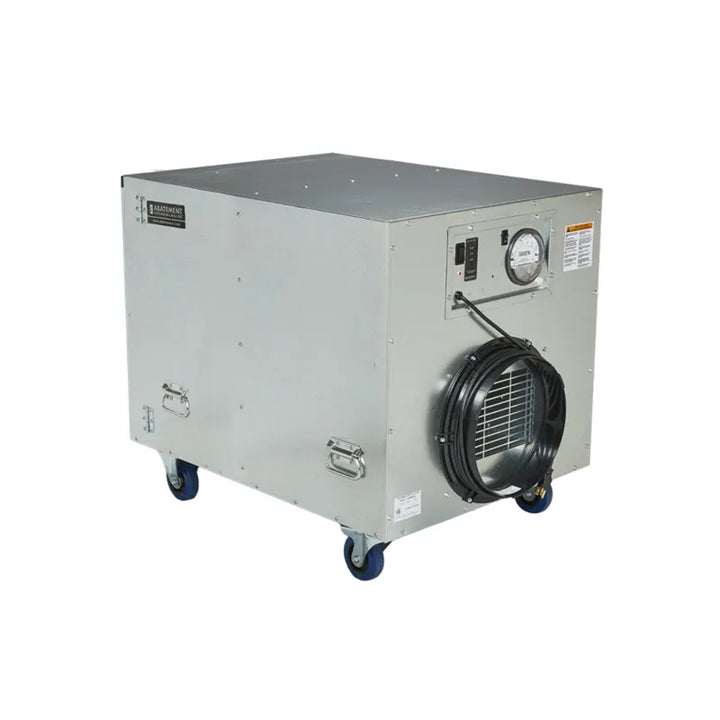
Abatement Technologies HEPA-AIRE Series Negative Air Machine H2KM
$1,070
Two-speed HEPA negative air machine for larger work areas.
The Abatement Technologies HEPA-AIRE H2KM is $1,070 and is one of our best-selling air machines. Abatement Technologies lists 2,000 CFM on high and 1,300 CFM on low, and a HEPA filter rated at 99.97% at 0.3 microns. It runs on 115 to 120 V on a 15 amp circuit and weighs 124 lb with the 6 inch HEPA filter. Airflow figures like these are the maker's rating, so do not treat them as a room-size promise. Our negative air machine range covers other sizes.
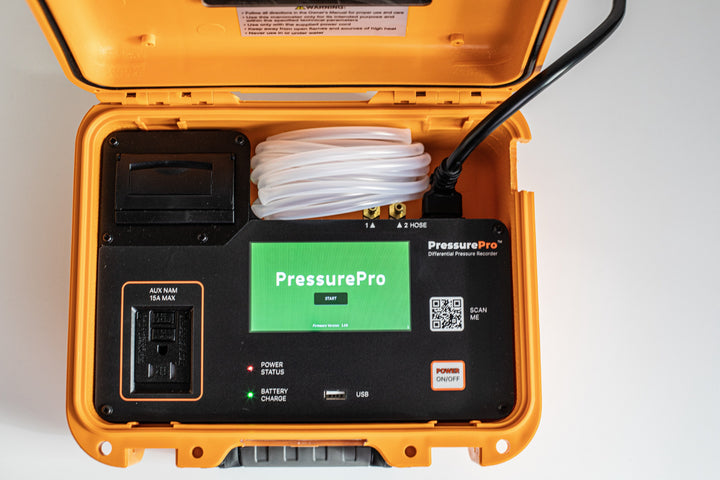
Negative air is a containment tool: it holds the work area at lower pressure than the rooms around it so air leaks in rather than out. It does not replace work-area containment, HEPA vacuuming or wipe cleaning. To do that, the machine's exhaust is ducted out of the work area, usually to outdoors, and a pressure monitor such as the Abatement Technologies RPM-RT1 shows whether the area is staying negative. The RRP rule itself does not call for negative air; abatement plans and some state rules do.
Skip it if the job is a single small room where a smaller unit does the job, and remember that at 124 lb it needs a trolley or two people on stairs.
Containment for above-ceiling work

Mobile containment
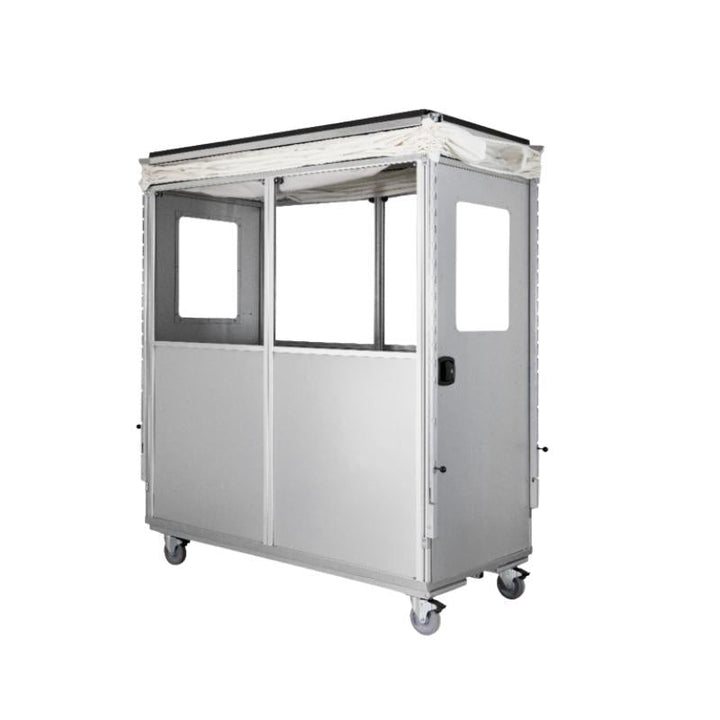
Abatement Technologies AIRE GUARDIAN Series Mobile Containment Cube AG3000MCCK
$4,300
A rolling containment cube for above-ceiling access, with HEPA vacuum ports.
The AIRE GUARDIAN AG3000MCCK is $4,300. Abatement Technologies lists an aircraft-grade aluminum frame, a reinforced PVC enclosure, 300 to 900 CFM, a pharmaceutical-grade HC1836-H14 HEPA filter and a port that supports up to three HEPA vacuum hoses. Abatement Technologies describes it as a mobile containment cube for above-ceiling access that adjusts to ceilings from 8 to 10 feet and opens through large top zippers. It measures 20 x 20.5 x 50.5 inches and rolls on four casters with foot brakes. See all mobile containment units we carry.
Skip it if your lead work is on walls, windows, trim or floors rather than above a ceiling, where plastic sheeting and a HEPA vacuum do the job.
A decontamination shower on site

Decontamination shower
Abatement Technologies EASY UP Collapsible Decontamination Shower S4000EU
$826
Collapsible shower that one person can set up in minutes.
OSHA's lead standard says an employer shall provide clean change areas for employees whose airborne exposure to lead is above the permissible exposure limit, and shower facilities where feasible for those employees, and that where showers are available employees shower at the end of the work shift. The EASY UP S4000EU is $826. It measures 30 inches on each side, stands 81 inches tall assembled, weighs 41 lb and folds into a carrying case. Other options are in our decontamination showers collection.
Skip it if your jobs never reach the exposure level where the standard asks for showers, or if the site already has a suitable shower.
What equipment suits which job
| Equipment | Best use on a lead job | Price |
|---|---|---|
| Novatek 15 gal HEPA floor vacuum | Bulk cleanup and shrouded-tool dust collection | from $2,335 |
| Mosquito HEPA Construction Backpack 6 Quart | Lower-priced HEPA cleanup of stairs and sills | from $520 |
| Novatek 3.3 gal HEPA backpack vacuum | Stairs, sills and overhead cleanup | from $2,125 |
| HEPA-AIRE H2KM | Negative air for a work area | $1,070 |
| AIRE GUARDIAN AG3000MCCK | Above-ceiling access containment | $4,300 |
| EASY UP S4000EU | Decontamination on site | $826 |
At today's prices, an RRP renovator can equip HEPA cleanup for anywhere from about $500 to just over $3,000, depending on the vacuum. An abatement crew adding the H2KM negative air machine, the electric Novatek 15 gal floor vacuum and the EASY UP shower spends a little over $4,000 before containment supplies.
Frequently asked questions
How do they remove lead paint?
Professionals use methods such as wet scraping, chemical strippers, heat guns below 1,100 degrees Fahrenheit and shrouded power tools with a HEPA vacuum attached. Abatement can also mean enclosing or encapsulating the paint or replacing the painted component. Open-flame burning or torching is prohibited.
How long does lead dust stay in the air?
Fine lead dust settles onto floors, sills and other flat surfaces and stays there until it is cleaned up, and dry sweeping can lift it back into the air. That is why the RRP rule ends every job with HEPA vacuuming, wet wiping and mopping, then cleaning verification, and why OSHA's lead standard allows sweeping only where vacuuming has been tried and found not to be effective.
What does a lead abatement contractor do?
A certified abatement contractor carries out work designed to permanently eliminate lead-based paint hazards. That can include removing lead paint and dust, enclosing or encapsulating paint, replacing painted components or covering lead-contaminated soil, with containment, cleanup and clearance testing around the work. Your state may add its own licensing and clearance rules.
Can your body dispose of lead?
This is a medical question, so talk to a doctor or see the CDC's pages on lead. We cannot give medical advice.
When is lead abatement required?
Usually when a law or an order calls for it: a health department order after a child's elevated blood lead test, some federally assisted housing work under HUD's Lead Safe Housing Rule, or a state or local lead law. An owner can also hire a certified firm to abate voluntarily. Ask your state lead program or a certified firm. Ordinary renovation in an older home is usually an RRP matter, not abatement.
What happens if you accidentally sand lead paint?
Stop, keep people and pets out of the area and close it off so the dust does not spread. Clean up with a HEPA vacuum and wet wiping, not sweeping, and ask your state lead program or a certified risk assessor about dust testing. Health questions go to a doctor.
Equip a lead-safe job