How we made this guide: picks, prices and specs come from our catalog and the makers' published specs, owner quotes come from customer reviews on our product pages and the guide was drafted with AI help, then checked and edited by Trevor Hall.
ICRA stands for Infection Control Risk Assessment: the documented process a healthcare facility's team completes before construction or maintenance to match the type of work with the risk to nearby patients and set the precautions for the job. We carry the containment side, from carts such as the Abatement AIRE GUARDIAN AG5000 at $6,780 to anterooms, negative air machines and pressure recorders. (This page covers healthcare construction, not the Indian credit rating agency ICRA.)
Quick answer
The team picks the construction activity type (A to D) and the highest-risk patient group the work affects, then reads the class of precautions off the matrix: I to V on ASHE's ICRA 2.0, I to IV on the older APIC-based matrix. The class sets the barriers, filtration, pressure and cleanup. Browse our mobile containment range or the negative air machines that pair with it.
What ICRA means and who does it
An ICRA is a risk assessment and a permit in one process. Before a ceiling tile is lifted or a wall is opened in a hospital, clinic or nursing home, the facility's infection prevention staff, facilities managers and the contractor sit down and ask what the work will release, who is nearby and what must stand between the two. The answer is written down, signed and posted at the work area.
The contractor does not choose the class alone. The facility owns the assessment, and the contractor then builds and maintains the precautions it lists. The CDC's 2003 Guidelines for Environmental Infection Control in Health-Care Facilities include the ICRA. The matrices on most forms come from APIC's older four-class version or the American Society for Health Care Engineering's ICRA 2.0 (2022, five classes). Read the current form your facility uses before you price a job.
How the ICRA matrix works
The matrix has two inputs and one output.
- Construction activity type, A to D, from inspection and non-invasive work (A) up to major demolition and large construction (D).
- Patient risk group, from low risk up to the highest-risk patients, such as those with severely weakened immune systems. The highest group affected by the work sets the row.
- Precaution class. The older APIC-based matrix, still used on some hospital forms, has Classes I to IV. ASHE's ICRA 2.0 (2022) has Classes I to V and moves several cells up, so the same job can land a class higher on a newer form.
| Patient risk group (ICRA 2.0 examples) | Type A | Type B | Type C | Type D |
|---|---|---|---|---|
| Low: offices and public hallways off clinical units | I | II | II | III |
| Medium: waiting areas, cafeterias and materials management | I | II | III | IV |
| High: patient rooms, acute care units, the emergency department and labs | I | III | IV | V |
| Highest: ICUs, transplant and oncology units, operating rooms and the clean side of sterile processing | III | IV | V | V |
Class of precautions by activity type and patient risk group, from ASHE's ICRA 2.0 (2022). If Type C work in a medium-risk area or Type D work in a low-risk area cannot be sealed off from patient care, ASHE adds the Class IV negative air exhaust.
On ICRA 2.0, lifting one ceiling tile to look (Type A) in an office area is Class I, but the same lift in an ICU or oncology unit is Class III. Work above the ceiling (Type B) is Class III in a patient care area and Class IV in the highest-risk group, and major demolition (Type D) there is Class V. Facilities may adjust the matrix, so take the class from your facility's own form.
ICRA 2.0 also has the team check the units above, below, beside, behind and in front of the work, then uses the higher risk group if those areas are more sensitive.
What each class calls for on site
This table summarizes the minimum precautions in ASHE's ICRA 2.0 (2022), in our words. Facilities can add to them, so plan equipment from it and take the requirements from your facility's form.
| Class | What ICRA 2.0 lists (summary) | Equipment that fits |
|---|---|---|
| I | Non-invasive work that makes no dust and does not block patient care. Replace any displaced ceiling tile before leaving. | Normal cleaning tools; no containment |
| II | Limited-dust facilities and engineering work under the facility's standing precautions. ASHE says Class II must never be used for construction or renovation. | The facility's own procedures and a HEPA vacuum |
| III | Active dust control: hand-held HEPA vacuums, poly containment or a closed room door. Isolate the return and supply air diffusers, seal doors with tape that leaves no residue, keep a contained area neutral to negative, carry debris in hard-lidded containers and lay an adhesive mat at the entrance. | Mobile containment cart or poly enclosure, HEPA vacuum |
| IV | Critical barriers to NFPA 241 that reach the ceiling, or the deck above when tiles are out, with every penetration sealed. A containment unit with HEPA-filtered exhaust can serve a small area it fully contains. The whole area stays negative and a device outside the containment monitors the pressure continually. Workers wear shoe covers and leave with clean clothing. | Containment cart or cube with a negative air machine, pressure monitor |
| V | Everything in Class IV, plus an anteroom at the entrance big enough for equipment staging, cart cleaning and workers, plus disposable coveralls worn throughout. | Barriers or modular containment, anteroom, negative air machine, pressure recorder |
ICRA 2.0 also raises the class when the work meets sewage, mold, asbestos, gray water or black water: Class IV in low and medium-risk areas and Class V in high and highest-risk areas. On the older four-class APIC-based matrix, the anteroom and shoe covers come in at Class IV.
ICRA barriers, walls and panels
An ICRA wall is the barrier that separates the work area from occupied space. Two kinds are common. A hard barrier is built from drywall, plywood or panel systems and suits longer, dustier jobs. A soft barrier is poly sheeting, fixed firmly at the floor and ceiling so it cannot move, with gaps sealed by tape that leaves no residue. For Class IV and V, ICRA 2.0 calls for critical barriers that meet NFPA 241 and reach the ceiling, or the deck above when ceiling tiles are out, with every penetration sealed to its fire rating.
A mobile containment unit replaces a built wall for small jobs such as one ceiling cavity. It wraps the work spot in a sealed enclosure on wheels, so you can move it to the next tile instead of framing a room.
What the permit at the work area records
Most ICRA forms end in a permit that is posted at the entrance to the work area. It names the project, the activity type, the patient risk group, the resulting class and the person who approved it. It then lists the precautions as a checklist (barrier type, air handling isolation, filtration, entry procedure and cleanup), with how and how often each control is checked.
Treat the checklist as a contract. Anything that no longer matches the permit, such as a torn barrier or a negative air machine that is switched off, is fixed before work continues. When the job ends, the area is cleaned and, for Class IV and V and Class III Type C work, inspected by an infection preventionist or designee and an engineering representative before precautions come down. Negative air keeps running after the dusty work ends and until the barrier is removed.
ICRA 2.0 requires a permit and approval for Class III Type C work and for all Class IV and V work, and its permit tells crews to stop work and get new approval if the scope changes.
Common ICRA mistakes on small jobs
- Treating a small ceiling job as no job at all. ICRA 2.0 lists work above the ceiling, such as running cable or getting into a chase, as Type B, which is Class III in patient care areas and Class IV in the highest-risk group.
- Skipping the pressure check. A negative air machine that runs without a gauge only gives you a guess.
- Exhausting to the wrong place. For Class IV and V, ICRA 2.0 sends HEPA exhaust outdoors; air may go out unfiltered only when it discharges 25 feet or more from entrances, air intakes and windows. Any exhaust kept indoors must pass HEPA filtration checked by particle measurement, and none may go into shared or recirculating HVAC or bathroom exhaust. Confirm the duct path with the facility before you start.
- Pulling the barrier before cleanup. Removing the wall first spreads the dust.
- Reusing last year's class. Each job needs its own assessment.
Mobile containment carts
The AG5000 is our best-selling containment cart, and it weighs 230 lb. Abatement Technologies lists a collapsed footprint of 32 by 66.5 by 20 inches and a maximum accessible ceiling height of 10 feet. The enclosure is white fire-retardant nylon on an anodized aluminum frame. ICRA 2.0 accepts a containment unit with HEPA-filtered exhaust for Class IV work in a small area the unit fully contains, such as one open ceiling bay.

Best-selling cart
Abatement Technologies AIRE GUARDIAN Series Mobile Containment Dust Cart AG5000
$6,780
Collapsible cart for ceiling and wall cavity work; the maker's video shows setup.
The AG8000 lists a 10 ft 2 in maximum ceiling height, 2 inches more than the AG5000, with a 900 lb load rating. It ships with a 16 ft, 3-section fiberglass extension ladder.

Ladder included
Abatement Technologies AIRE GUARDIAN Series Mobile Containment Cart AG8000
$9,190
Ships with a 16 ft extension ladder; ceilings up to 10 ft 2 in.
The ICMOBKC kit pairs a cube and caddy cart with a PRED750 air scrubber, so the air scrubber comes in the same purchase. Its enclosure is reinforced PVC with a listed ceiling range of 8 to 10 feet.

Cart plus scrubber
Abatement Technologies ICRA Kit w/Caddy and Air Scrubber ICMOBKC
$5,800
Cube, caddy cart and a PRED750 scrubber in one purchase.
Anterooms and modular containment
HEPACART lists its ECU4 mobile containment bundle for ICRA levels I to V. It comes in five kits that differ in price and parts. For example, the Isolation pack at $5,739 has the frame, platform, tow cart and disposable envelopes, while the System kit at $6,335 drops the envelopes and includes an OA600N Plus negative air machine instead. The ECU4 envelope is rip-stop poly flame-rated to ASTM E 84. The MPP, CMCS and All-in kits also include the Sidewall Flange, which zips on to turn the ECU4 into an anteroom (pictured).


Containment with negative air
ECU4 Mobile Containment Bundle with Mobile Platform and Tow Cart
$6,335
Pick the kit that matches what you already own; the complete kit costs more.
The AnteRoom 48 rolls to a doorway and seals with a magnetic gasket, forming a vestibule that people pass through. It fits 48 inch doors natively, with reducers and extenders for doors from 36 to 68 inches. HEPACART publishes it for ICRA levels I to V when used with a negative air machine, which is sold separately. Hardware options are a lock, a lever handle or a keypad and the pressure display is a gauge or a digital monitor.

Doorway anteroom
AnteRoom 48 Mobile Isolation Anteroom
$6,744
Analog gauge version shown; digital monitor and keypad options cost more.
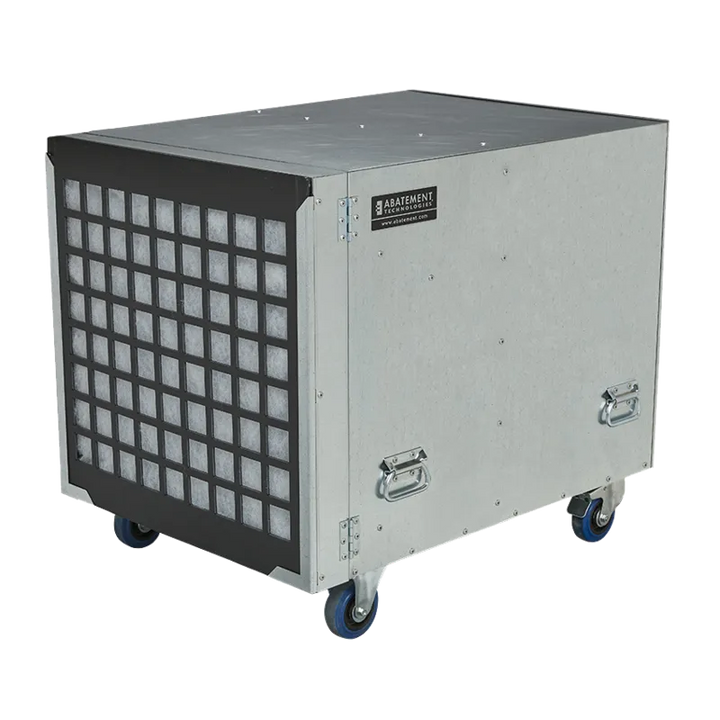
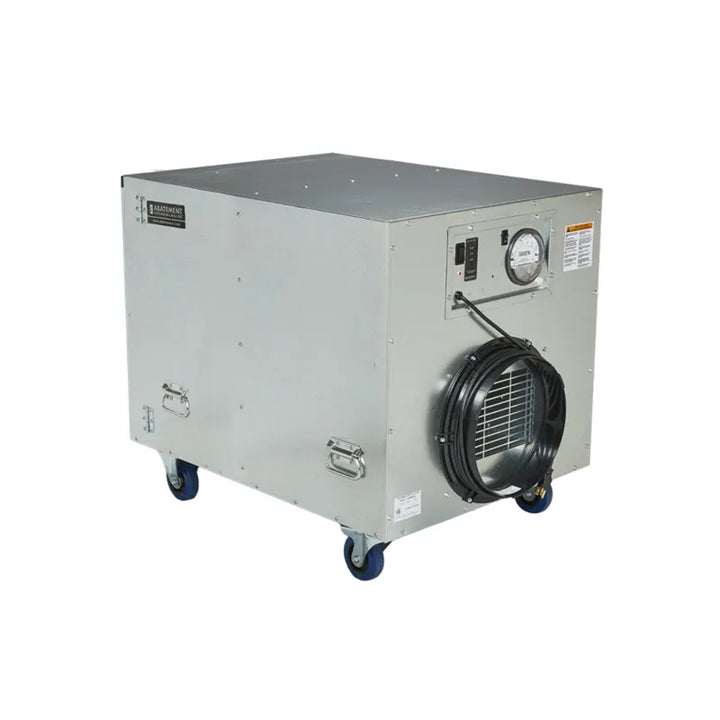
For the machine that holds the pressure, see our negative air machines, the Abatement Technologies containment line and our dust containment carts. What a negative pressure room is and dust control in construction cover the pressure side and the sealing steps in more depth.
Proving the pressure with a record
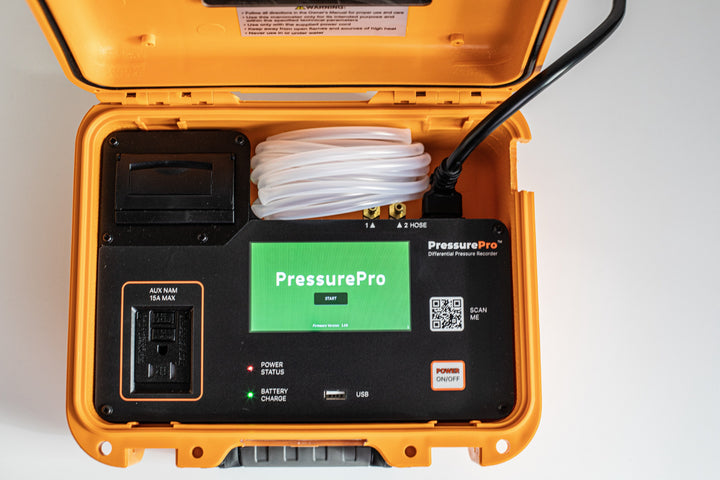
ICRA 2.0 calls for a device outside the containment that monitors negative pressure continually in Classes IV and V, and recommends one with a visual pressure indicator. A recorder adds printed proof that the pressure held. The PressurePro M1w saves a dated reading every 30 minutes by default while pressure stays in range, speeds up to a reading every 2 minutes once an alarm trips, and can print the log on its built-in thermal printer. Its range is +0.250 to -0.250 inches WC. A switched outlet can run one negative air machine up to 2,000 CFM.


Pressure record
PressurePro M1w Wi-Fi Differential Pressure Recorder with Printer
$1,649
Wi-Fi recorder with printer for logging containment pressure.
Frequently asked questions
What is an ICRA barrier?
It is the physical separation between the work area and occupied space, such as a built wall, poly sheeting or a mobile containment enclosure. The assessment's class decides how complete and how sealed it must be.
What do ICRA and PCRA mean?
ICRA is the infection control risk assessment. PCRA is the pre-construction risk assessment that Joint Commission standard EC.02.06.05 requires. It covers air quality, infection control, utilities, noise, vibration and other hazards of the work, so the ICRA is usually one part of it.
Is ICRA a rating or a certification?
In healthcare construction it is neither. It is a process and a permit completed for each project. The unrelated ICRA credit rating agency in India has nothing to do with it.
Who decides the ICRA class?
The facility's team, usually led by infection prevention with facilities management, decides it before work starts. The contractor builds and keeps the precautions. Follow your facility's own ICRA policy and form.
Contain the work area