How we made this guide: picks, prices and specs come from our catalog and the makers' published specs, owner quotes come from customer reviews on our product pages and the guide was drafted with AI help, then checked and edited by Trevor Hall.
A room pressure monitor measures the tiny pressure difference between a room and the space next to it, in pascals or inches of water column and sounds an alarm when the room stops holding its set point. For containment work, our top seller among air scrubbers and containment gear is the Abatement Technologies RPM-RT1 at $1,210, a small wall-mounted monitor. The one that prints a job record is the PressurePro M1 at $1,549.
Hospitals use fixed wall units for isolation rooms. Contractors use monitors and recorders on ICRA work zones and abatement containments.
What a differential pressure monitor measures
The monitor does not read the pressure of the room. It reads the difference between two points: a sensing tube inside the room and a reference, usually the space next to it. If the room reads lower than the reference, the room is negative and air leaks in through gaps instead of out. If it reads higher, the room is positive.
To calculate the pressure in a room, subtract the reference pressure from the room pressure. A reading of -0.02 in WC means the room sits 0.02 inches of water column below the space beside it.
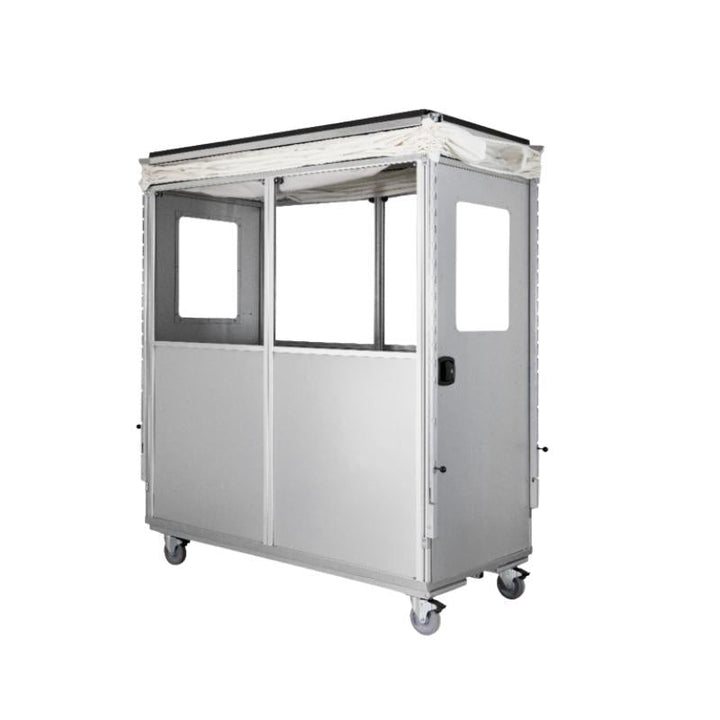
The device that checks this is a manometer or a differential pressure monitor. A simple manometer shows a number. A monitor adds alarms, and a recorder adds a log of readings over the whole job. One of our mobile containment carts, the AIRE GUARDIAN AG8000PAS-RPM, ships with both a PAS750 air scrubber and an RPM-RT1 monitor.
Pascals, inches of water column and psi
Containment pressures are small. 1 in WC equals about 249 Pa (our calculation), and every figure below uses it.
| Inches of water column | Pascals (our calculation) | Where it shows up |
|---|---|---|
| 0.01 in WC | about 2.5 Pa | CDC isolation room figure |
| 0.02 in WC | about 5 Pa | OSHA asbestos enclosure minimum |
| 0.04 in WC | about 10 Pa | RPM-RT1 alarm set point limit |
| 0.10 in WC | about 25 Pa | RPM-RT1 and PPM3-S range edge |
| 0.250 in WC | about 62 Pa | PressurePro M1 range edge |
How much psi is in a room? Atmospheric pressure is about 14.7 psi at sea level, nearly the same inside and outside. The differential is far smaller. Using 1 in WC as about 0.036 psi, a 0.02 in WC difference is roughly 0.0007 psi, our calculation. That is why monitors use inches of water column or pascals, not psi.
Set points: what the CDC and OSHA state
Two US sources give a number for this work. We quote only what each says.
- The CDC's 2003 environmental infection control guideline for healthcare settings recommends continuous negative air pressure of 2.5 Pa (0.01 inch water gauge) in an airborne infection isolation room, relative to the corridor. It also advises checking pressure on a regular schedule, preferably daily, using a manometer or smoke tube at the door or a permanent visual indicator, and keeping a record of the results (recommendation C.IV.A.1, cdc.gov).
- OSHA's asbestos construction standard, 29 CFR 1926.1101, requires a negative pressure enclosure used for Class I work to hold a minimum of -0.02 column inches of water pressure differential relative to outside, shown by manometric measurement. Its non-mandatory Appendix F says pressure differentials typically range from 0.02 to 0.10 inches of water gauge, depending on conditions. It also lists pressure monitoring devices with alarms and strip chart recorders attached to each system (osha.gov, 1926.1101 Appendix F).
Whether a job meets a standard depends on the containment, the airflow and the written plan, not on the monitor alone. For the room-side picture, see what a negative pressure room is and what ICRA is.
Monitors and recorders we carry
| Model | Price | Range | Alarms | Log | Power |
|---|---|---|---|---|---|
| Abatement Technologies RPM-RT1 | $1,210 | +/-0.10 in WC (+/-25 Pa) | Visual and audible, set points to +/-0.04 in WC | 12,000 events, USB flash drive | 9 to 24 V AC or DC |
| Abatement Technologies PPM3-S | $1,400 | +/-25 Pa (+/-0.1 in) | Visual and audio | CSV logs over USB | Up to 12 hours on battery |
| PressurePro M1 | $1,549 | +/-0.250 in WC | Programmable, audible and visual | 16MB, built-in printer | 120 VAC, about 3 hours on battery |
| PressurePro M1w | $1,649 | +/-0.250 in WC | Programmable, audible and visual | 16MB, built-in printer | 120 VAC, prints on AC power; adds built-in Wi-Fi |

Wall-style monitor
Abatement Technologies Single Room Pressure Monitor RPM-RT1
$1,210
A 3.5 inch color screen, 12,000 logged events and an alarm rated 85 dB at 4 inches, for rooms that need watching around the clock.
The RPM-RT1 is the simplest way to put a number on a room. The spec rows list a color-coded display (green, yellow and red), a choice of inches of water column or pascals and a 9 to 24 V AC or DC supply. No power supply appears on its included list, so plan the source. It weighs 0.5 lb. Skip it if you need a printed record on site or an alarm set point deeper than -0.04 in WC.

Portable case
Abatement Technologies Portable Differential Pressure Monitor PPM3-S
$1,400
A touch screen in a protective case with a clear window, up to 12 hours on battery and CSV logs.
The PPM3-S reads -25 Pa to +25 Pa across a containment area and the space beside it. It is the cased portable of the four. Its CSV logs open in a spreadsheet. Skip it if the job needs readings beyond +/-25 Pa.
Logging and printouts as job records
Alarms tell you a problem is happening. A log shows what happened while nobody was watching. The PressurePro M1 logs every 30 minutes while the reading is in range and every 2 minutes in alarm, both adjustable. The spec rows list more than 2 years of logs in 16MB. The CDC guideline also says to review the pressure records after a construction project (C.II.I.1, cdc.gov). A log is that record.

Recorder with printer
PressurePro M1 Differential Pressure Recorder with Printer
$1,549
A 4.3 inch touchscreen, a built-in thermal printer and a NIST-traceable certificate of accuracy.

The M1's default alarm window runs from -0.020 in WC (Alarm 1, the upper limit) to -0.040 in WC (Alarm 2, the lower limit). PressurePro's owner's manual suggests -0.020 and -0.060 in WC for asbestos or lead abatement. A built-in switched outlet can cycle one negative air machine rated up to 2,000 CFM, turning it on at -0.022 in WC and off at -0.040 in WC by default. That outlet works on AC power only and is rated 15 A max. PressurePro's manual says to plug only a negative air machine into it, set it to low or medium speed at first and exhaust it outside through layflat ducting at least 5 ft long.

The warranty is 1 year limited, and PressurePro's manual says the registration card must be returned to activate it (the spec row says within 30 days). Skip it if you only need a quick check.
The PressurePro M1 and the M1w share the measuring range and printer. The M1w adds built-in Wi-Fi and a 2 year limited warranty, so choose it when someone off site needs to watch the reading. PressurePro's manual lists 10 ft of tubing, 4 rolls of thermal paper and the NIST certificate in the box, and says to use only PressurePro thermal paper. Refill printer paper and a replacement printer are sold separately.
Tube placement and zeroing
- Set the monitor outside the containment, where it can be read without entering. PressurePro's owner's manual says to place the unit outside the containment area.
- Fasten the end of the sensing tube firmly inside the containment, away from the entrance and the negative air machines, and leave the other port open to the space you are comparing against.
- Keep the tubing free of kinks and abrupt bends. The manual gives 70 ft of 5mm ID tube as the maximum, and the M1 ships with 10 ft.
- Zeroing: PressurePro's manual says the M1 needs no calibration between jobs because it corrects zero drift itself. For a manual zero, let it warm up 30 minutes and disconnect the tubing from both inlet nozzles first.
- Set the alarm limits before the machines start, then check the display once the room settles. PressurePro's manual suggests annual NIST calibration verification, and the M1 ships with a NIST-traceable certificate.
When the alarm sounds
| Sign | Likely cause | Check |
|---|---|---|
| Reading drifts toward zero after a door opens | Door or zipper left open | Close it and watch the reading recover |
| Slow loss over days | Machine pre-filter or HEPA filter loading | Check the machine's filter indicator |
| Sudden loss | Torn poly or a pulled seam | Walk the barrier |
| Erratic or flat reading | Kinked or pinched tube, which PressurePro's manual warns against | Check the run of tubing |
The M1 logs every 2 minutes while in alarm, so the record shows how long the loss lasted.
How to choose between them
If a client only asks whether the room held, a monitor with an alarm and a USB log is enough, and the RPM-RT1 or the PPM3-S fits. If the job file needs paper with time-stamped readings, a recorder with a printer fits better. The RPM-RT1 mounts to a wall, the PPM3-S travels room to room on its battery and the M1 prints on AC power.
Last, check the range against the job. A range of +/-0.10 in WC covers the figures in the table above, including the OSHA minimum and typical design values. Alarms are a separate limit. The RPM-RT1's alarm set points adjust only from -0.04 to +0.04 in WC (-10 to +10 Pa), so a job plan that needs an alarm deeper than -0.04 in WC fits the PressurePro M1, whose programmable limits PressurePro's owner's manual sets at -0.020 and -0.060 in WC for asbestos or lead abatement. The M1 reads out to +/-0.250 in WC.
Monitor, cart or machine
A monitor does not move air. You still need a negative air machine or a scrubber, and the difference between them is covered in air scrubber vs negative air machine. For setting up the machine itself, see how to set up a negative air machine. For ceiling access work, the AIRE GUARDIAN AG8000PAS-RPM cart ships with a PAS750 air scrubber and an RPM-RT1 monitor.

Cart with monitor
Abatement Technologies AIRE GUARDIAN Series Mobile Containment Cart with PAS and RPM AG8000PAS-RPM
$11,090
Locking casters, a 900 lb load rating and a ladder, with a PAS750 and an RPM-RT1 included.
Browse the full range under Abatement Technologies. For showers and anterooms on the same job, see decontamination showers.
Frequently asked questions
How do you calculate pressure in a room?
Subtract the reference pressure from the room pressure. A negative result means the room is lower than the space beside it. A monitor does that subtraction continuously.
Which device is used to check pressure?
A manometer or a differential pressure monitor. The monitor adds alarms, and a recorder adds a printed or exported log.
How much psi is in a room?
About 14.7 psi at sea level, nearly the same as outside. The difference a monitor reads is tiny: 0.02 in WC is roughly 0.0007 psi, our calculation.
What is a good differential pressure reading?
It depends on the source. The CDC states 2.5 Pa (0.01 inch water gauge) for an isolation room and OSHA states a minimum of -0.02 in WC for a negative pressure enclosure on Class I asbestos work. Follow the one your job plan names.
Prove the containment held
Related guides
- What Is a Negative Pressure Room? How It Works, Pressure Targets and Monitoring
- What Is ICRA? Infection Control Risk Assessment Classes, Barriers and Containment
- Air Scrubber vs Negative Air Machine: Same Box, Different Setup (and When You Need Each)
- Decontamination Showers and Decon Units for Asbestos and Mold Work