How we made this guide: picks, prices and specs come from our catalog and the makers' published specs, owner quotes come from customer reviews on our product pages and the guide was drafted with AI help, then checked and edited by Trevor Hall.
Crawl space mold remediation comes down to four jobs in a fixed order: fix the water source, put the space under negative air, physically remove or clean the growth, then seal the space and hold humidity down. The three lead pieces of gear are the AlorAir Sentinel HD55 crawl space dehumidifier at $587.48, the AlorAir CleanShield HEPA 550 air scrubber at $497 and the Sandia HEPA Raven backpack vacuum at $571.
Together those three come to about $1,700 at today's prices. Larger or divided spaces move you up to the ducted AlorAir Sentinel HDi90 at $1,147.11 or the Abatement Technologies PAS750 air scrubber at $1,139. Mold is removed by cleaning and removal work, not by a machine: the gear below controls air, dust and moisture while you do that work.
Quick answer
Stop the water first, or the mold returns. Then seal the work area, run a HEPA air scrubber ducted outdoors as negative air, HEPA vacuum and scrub the growth, replace wood that is damaged and finish with a low-cabinet dehumidifier in a sealed crawl space. Browse crawl space dehumidifiers, HEPA air scrubbers and HEPA vacuums.
Why a crawl space changes the gear you pick
A crawl space is a bad place to use full-size equipment. Headroom is short, the hatch is small and you work on your knees or belly with a cord trailing behind you. Four constraints decide what is worth buying.
- Cabinet height. The Sentinel HD55 is 13.3 inches tall and the XPOWER Viking BD-65 is 14 inches, so both sit low. The Sentinel HDi90 is 17.7 inches tall.
- Weight through the hatch. The HD55 weighs 44 lb, the BD-65 55.1 lb and the HDi90 70.5 lb (AlorAir's spec sheet), and the PAS750 air scrubber weighs 33.5 lb. A backpack vacuum of about 10 lb rides on your back instead of dragging behind you through the hatch.
- Hatch size. Measure the opening first. Abatement Technologies lists the PAS750 at 23.75 by 18 by 17.5 inches, and the CleanShield is 20.87 by 24.8 by 14.96 inches.
- Where the water goes. A gravity drain needs a downhill path to a drain point or the outside. If the crawl space has no downhill path, you need a pump built in or added.
Power matters too. Every electric machine here runs on 115 or 120 V. The AlorAir dehumidifiers list a grounded 3-prong GFCI outlet on a 15 A circuit, and the CleanShield lists a 23 ft power cord. Plan cord runs before you start, because an extension cord through a polyethylene seal is a tripping hazard.
Signs of mold in a crawl space
Look for fuzzy or spotty growth on joists, subfloor and insulation facing, in white, gray, green or black. White crystals on block or concrete walls that crumble to powder and dissolve in water are usually efflorescence, a mineral salt left by water moving through masonry, not mold, though both mean the space is wet. A musty or mildew smell in the crawl space or the rooms above usually means the space stays damp and something is growing. Push a screwdriver into dark or soft-looking wood: wood that gives easily is rotting and needs replacing, not just cleaning.
The remediation sequence, step by step
This is the order a contractor follows. It is general practice, not a code: follow your local rules, any written protocol for the job and your own training. We do not give legal or medical advice, and large or toxic-looking jobs belong with a licensed remediator.
1. Find and fix the moisture source
Mold needs moisture, so a cleanup without a fix is temporary. Look for plumbing leaks, gutters and downspouts that dump water at the foundation, open vents that let humid air in and bare soil. Moisture on the surfaces tells you where to look. A musty smell tells you moisture is present; it does not tell you what species is growing.
2. Set up containment and negative air
Seal the work area with polyethylene sheeting so dust does not drift into the house above. Shut off any furnace or air handler that sits in or draws air from the crawl space, and seal its returns and registers inside the work area so the system cannot pull dust into the house. Then run a HEPA air scrubber with its exhaust ducted outdoors, so the work area sits at slightly lower pressure than the house above. The CleanShield HEPA 550 lists a 16 inch inlet and an 8 inch outlet, both ductable. The PAS750 lists a 10 inch exhaust outlet. A HEPA filter captures particles; it does not clean surfaces or fix a leak. For the basics, see what a HEPA filter is and how it is rated.
3. Clean or remove the growth
Remove what you cannot clean. Wet or rotted insulation and badly damaged wood come out and go into bags. Sound framing is HEPA vacuumed first, then scrubbed or abraded to take off the growth, then HEPA vacuumed again. A HEPA backpack vacuum lets you do this without dragging a canister through the hatch. Wear the respirator, gloves, eye protection and coveralls your protocol calls for.
4. Dry the space
Start drying as soon as the source is fixed: wet wood is hard to clean and growth stays active while it stays wet. Run the dehumidifier inside the containment during the cleanup and keep it running after. Check the framing with a moisture meter and the air with a hygrometer.
5. Seal the crawl space
A dehumidifier cannot keep up with a vented crawl space over bare soil. AlorAir's HD55 manual says the area should be sealed with a vapor barrier and, in a crawl space, all vents sealed. XPOWER's BD-65 manual says to run its dehumidifier in an enclosed area. Cover the soil with a vapor barrier, close the vents and seal gaps before you count on the dehumidifier. Some protocols also apply an antimicrobial or an encapsulant to cleaned framing. Use any such product strictly as its label directs, and understand that it does not replace removal. We do not recommend any product here as a treatment.
6. Hold the humidity down
The EPA's brief guide to mold says to keep indoor relative humidity below 60 percent, ideally between 30 and 50 percent. Put a hygrometer in the crawl space and hold the dehumidifier to that range. How a dehumidifier works explains the refrigerant coil that does the drying.
Crawl space mold equipment compared
| Pick | Job | Price | Key rating | Weight |
|---|---|---|---|---|
| AlorAir Sentinel HD55 | Dehumidifier, typical crawl space | from $587.48 | 53 pints/day at AHAM; up to 1,200 sq ft as rated | 44 lb |
| AlorAir Sentinel HDi90 | Dehumidifier, large or divided space | $1,147.11 | 90 pints/day at AHAM; up to 2,600 sq ft as rated | 70.5 lb |
| XPOWER Viking BD-65 | Dehumidifier, crawl space or attic | $879 | 60 pints/day at AHAM; 1,300 sq ft coverage | 55.1 lb |
| Abatement Technologies PAS750 | Air scrubber, negative air | $1,139 | Up to 750 CFM; HEPA certified to 99.97% at 0.3 micron | 33.5 lb |
| AlorAir CleanShield HEPA 550 | Air scrubber, negative air | $497 | 270 to 550 CFM; HEPA up to 99.95% of particles 0.3 micron and larger | 39.6 lb |
| Novatek 3.3 gal HEPA backpack | HEPA vacuum, air or electric | from $2,125 | 110 CFM electric; 170 CFM air | |
| Sandia HEPA Raven 10 qt | HEPA vacuum, corded electric | $571 | 150 CFM; 10 quart bag | 10.5 lb |
Pints per day in the table are the makers' AHAM figures only, so the three dehumidifiers compare fairly. AlorAir also rates the HD55 at 113 pints per day and the HDi90 at 198 at saturation (90°F, 90% RH). Those saturation figures describe much hotter, wetter air than most crawl spaces and should never be set beside an AHAM number. A cool crawl space also removes less than the AHAM figure: AlorAir lists the HDi90 at 47.71 pints a day at 60°F and 60% RH, and XPOWER's manual lists the BD-65 at 36.8 pints at 65°F and 60% RH. Those two were rated at different temperatures, so do not rank one against the other.
How we picked
We did not test these machines. Picks come from the makers' spec sheets and manuals plus what a crawl space demands: low cabinet height, manageable weight, a drain that works without a floor drain and an air scrubber that can be ducted. None of the seven has an owner review on our product pages yet, so there are no owner quotes here.
AlorAir Sentinel HD55: for a typical crawl space

Typical crawl space
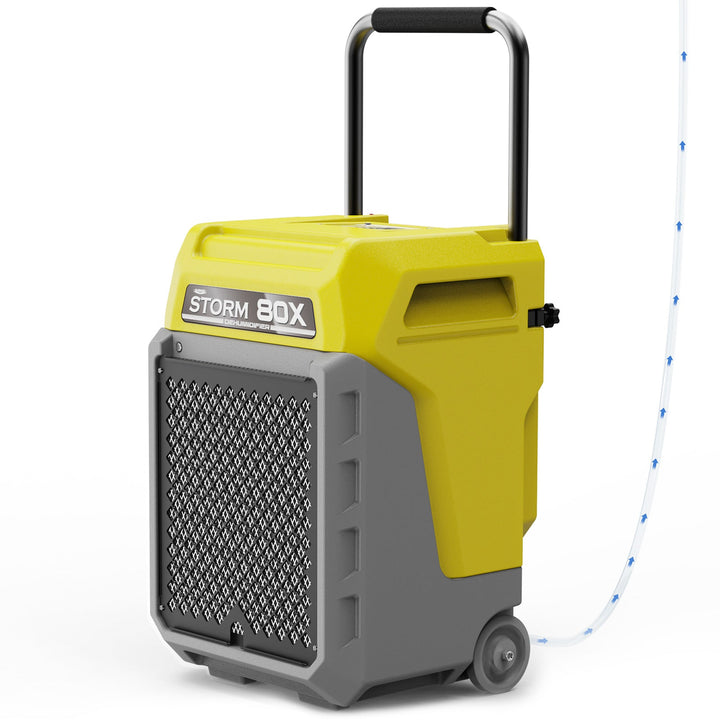
AlorAir Sentinel HD55 53-Pint Crawl Space Dehumidifier
From $587.48
A low blue steel cabinet rated at 53 pints a day at AHAM.
The HD55 is the dehumidifier to start with for an ordinary crawl space. AlorAir rates it at 53 pints a day at AHAM conditions (80°F, 60% RH), 120 CFM of airflow, up to 1,200 sq ft of coverage and 4.0 A on a 115 V supply. The standard unit is $587.48 and the WiFi version is $628.66.
It operates from 33.8°F to 104°F, so it keeps running in a cool crawl space. The humidity setpoint runs from 36% to 90%, plus a continuous mode. The cabinet is 19.2 by 12.2 by 13.3 inches. Drainage is by gravity, with A5 and A6 terminals for an external condensate pump, and a 6 inch supply collar takes a duct up to 6 ft long. AlorAir's HD55 manual lists a 1 year parts and labor warranty, plus 3 years parts and labor and 5 years parts on the refrigeration system.
Pros
- Low, compact cabinet at 44 lb
- Runs down to 33.8°F
- Terminals for an external condensate pump
Cons
- Gravity drain only, no built-in pump
- MERV-1 filter is a basic panel
- 1,200 sq ft is a maker rating, not a promise for wet soil
Skip it if the crawl space is large, divided into rooms by footings or has no downhill path for the drain line.
AlorAir Sentinel HDi90 Duct-able: for large or divided spaces

Large or divided space
AlorAir Sentinel HDi90 Duct-able 90-Pint Crawl Space Dehumidifier with Pump
$1,147.11
A built-in pump and ducting for areas the unit cannot see.
The HDi90 is rated at 90 pints a day at AHAM conditions and up to 2,600 sq ft as the maker rates coverage. It draws 5.56 A at 115 V and lists 210 CFM of airflow. AlorAir lists it at less than 58 dBA, against less than 52 dBA for the HD55.
Two features suit crawl spaces. The built-in condensate pump has a manual drain button and a 19.6 ft drain hose, so water can travel up and out when there is no downhill route. The 6 inch supply adapter comes standard and lets you duct the dry air to a section the unit cannot reach, and a 12 inch return collar is optional.

Pros
- Built-in pump with a 19.6 ft hose
- 6 inch ducting for divided spaces
- 90 pints a day at AHAM
Cons
- 17.7 inch cabinet is taller than the HD55
- Costs about twice the HD55
- Heaviest of the three dehumidifiers at 70.5 lb, per AlorAir's spec sheet
Skip it if your crawl space is one open rectangle under 1,200 sq ft and drains downhill. The HD55 is enough there.
XPOWER Viking BD-65: stainless cabinet with gravity or pump drain

Gravity or pump drain
XPOWER VIKING Commercial Grade Dehumidifier for Crawlspace, Basement, Attic, Garage BD-65
$879
A stainless steel cabinet with either gravity drain or a built-in pump.
XPOWER's manual rates the BD-65 at 60 pints a day at 80°F and 60% RH (AHAM conditions) and 36.8 pints at 65°F and 60% RH. It lists 180 CFM, 520 W, an 18.4 ft cord, coverage of 1,300 sq ft and an ETL/CETL safety listing. The housing is stainless steel and the machine weighs 55.1 lb at 17.8 by 13.1 by 14.0 inches, per XPOWER's manual.
XPOWER's manual shows both a gravity drain outlet and a pump drain outlet on the BD-65, with a 20 ft drain hose, plus automatic defrost and R32 refrigerant. At AHAM, 60 pints is a little more than the HD55's 53 and well under the HDi90's 90. XPOWER's manual lists a 1 year limited warranty.

Pros
- Pump or gravity drain on the same unit
- Stainless steel housing
- Cord is 18.4 ft long
Cons
- At 55.1 lb, heavier than the HD55's 44 lb
- 14 inches tall, a little taller than the HD55
Skip it if cabinet height and weight through a small hatch are your tightest limits. The HD55 is lighter and lower.
Abatement Technologies PAS750: air scrubber for negative air

Negative air, contractor grade
Abatement Technologies HEPA-AIRE Series Portable Air Scrubber PAS750
$1,139
750 CFM peak airflow in a 33.5 lb anodized aluminum cabinet.
The PAS750 is the contractor-grade air scrubber on this list. Abatement Technologies rates airflow as variable up to 750 CFM, and the HEPA filter as certified to 99.97% efficiency at 0.3 micron. It draws 1.9 amps or less on 120 VAC, and Abatement Technologies says up to five units can be daisy-chained on one 15 A circuit. It is NRTL-certified to UL and CSA standards.
The cabinet is anodized aluminum with a 1 inch Fiber-Trapper pre-filter and a 2 inch pleated pre-filter ahead of the HEPA, plus an optional 2 inch Vapor-Lock carbon filter. It stacks up to three units, carries by top handles and has a 10 inch exhaust outlet that you can duct to the outside. The noise range is 62 to 67 dBA. Abatement Technologies lists it at 33.5 lb and 23.75 by 18 by 17.5 inches.
Pros
- Light at 33.5 lb with top carrying handles
- Low amp draw
- 10 inch exhaust for ducting
Cons
- Highest price of the two air scrubbers
- Carbon filter is an extra
Skip it if you only need to keep dust down on a small job. The CleanShield costs less.
AlorAir CleanShield HEPA 550: air scrubber on a budget

Entry-level negative air
AlorAir CleanShield HEPA 550 Air Scrubber with 3-Stage Filtration
$497
Variable 270 to 550 CFM with a three-stage filter.
The CleanShield is the lower-priced way to get negative air. AlorAir rates the airflow at 270 to 550 CFM on a variable speed knob and the HEPA at "up to 99.95% of particles 0.3 µm and larger". Air passes a MERV-10 pre-filter first, then one combined HEPA and carbon element. It draws 2.5 A at 115 V and has a 23 ft cord, a 12 A circuit breaker and a GFCI duplex outlet that daisy chains up to three units.
Both ports are ductable: a 16 inch inlet and an 8 inch outlet, with a static pressure rating of 2.8 inches of water. AlorAir lists coverage up to 800 sq ft (5,500 cu ft), and it weighs 39.6 lb in a rotomolded polyethylene housing.
Pros
- Lower-priced HEPA air scrubber of the two on this list
- Ductable 8 inch outlet
- Outlet to chain additional units
Cons
- Heavier than the PAS750 at 39.6 lb
- HEPA rated up to 99.95% at 0.3 micron, against 99.97% certified on the PAS750
Skip it if your protocol or client specifies a HEPA filter certified to 99.97% at 0.3 micron. Use the PAS750 instead.
Novatek 3.3 gal HEPA backpack vacuum: air or electric

HEPA vacuum, on your back
Novatek 3.3 Gal HEPA Backpack Vacuum, Air or Electric
From $2,125
Choose air power or a 2 HP electric motor.
The Novatek comes as an air model at $2,695 and an electric model at $2,125. The air model moves 170 CFM with 160 inches of water lift on 50 cfm at 90 psi, and takes up to 75 ft of 1.5 inch hose. The electric model moves 110 CFM with 110 inches of lift on 11 amps from a 2 HP bypass motor and takes up to 25 ft of hose.
The air version needs no electricity at all, which is useful when you want the cords out of a damp space. It does need a compressor sized for the vacuum plus any shrouded tool. Filtration is four stages ending in a tested and certified HEPA filter, with a 3 gallon collection bag.
Pros
- Air version has no electrical supply in the crawl space
- Four-stage filtration ending in HEPA
- Long hose runs on the air model
Cons
- Highest price on this list
- The air model needs a compressor
Skip it if you only clean small areas occasionally. The Sandia costs far less.
Sandia HEPA Raven 10 qt: corded backpack vacuum

Light HEPA backpack
Sandia HEPA Raven 10-Quart Backpack Vacuum With 5 Pc. Standard Tool Kit - 20-3001
$571
A 10.5 lb corded backpack with a five-piece tool kit.
Sandia's sell sheet lists the HEPA Raven at 10.5 lb and 23 inches tall, with 10 quarts of capacity, 150 CFM, a 1.5 HP one-stage motor, 11.5 amps, 1,340 W and 67 dB. It ships with a five-piece standard tool kit. Sandia's sell sheet gives no HEPA efficiency figure. It lists a lifetime warranty on the body, 5 years on the motor and electrical parts and 90 days on tools and accessories.

Pros
- 10.5 lb on your back
- Tool kit included
- Under $600
Cons
- Corded, so you manage an extension cord
- No HEPA percentage published by Sandia
Skip it if your protocol calls for a vacuum with a tested and certified HEPA filter. The Novatek lists one.
Setup tips for tight crawl spaces
- Stage everything at the hatch. Hoses, bags and spare filters stay outside so you crawl in once.
- Duct the air scrubber exhaust outdoors, then check that the containment sheeting bows slightly inward, a sign the space is under negative pressure. A pressure monitor gives you a reading to record.
- AlorAir's HD55 manual calls for at least 1 inch of fall per 10 ft of drain line with no loops or dips. Where it cannot slope, use the HDi90's pump or an external condensate pump.
- Raise the dehumidifier on blocks or pavers rather than setting it on the vapor barrier, as AlorAir's manual says, so the gravity drain can flow. Clear filters before starting. See dehumidifier maintenance for filter and coil care.
- Read humidity with a separate hygrometer rather than trusting the unit's display alone.
For a similar job overhead, see attic mold remediation. For a finished space under the house, basement mold remediation covers the same moisture rules. If the dehumidifier is the part you are still choosing, browse mold remediation dehumidifiers.
Frequently asked questions
How do you clean mold out of a crawl space?
Fix the moisture source, seal the work area and run a HEPA air scrubber as negative air. Then HEPA vacuum and scrub or abrade the growth, replace damaged wood, dry the space and hold humidity down. The steps above give the order.
Can you remediate crawl space mold yourself?
The EPA's brief guide to mold puts the line for a homeowner job at a moldy patch under about 10 square feet, around 3 ft on a side. Larger areas, rotted framing or health worries are reasons to hire a licensed remediator, and local rules may require one.
How serious is mold in a crawl space?
Serious enough to fix promptly. The moisture that feeds it rots joists and subfloor over time, and air from a crawl space moves up into the house. Small surface growth on sound wood is a cleaning job; soft wood, sagging floors or growth across most of the space call for a contractor.
How much does it cost to remediate mold in a crawl space?
We sell equipment, not remediation labor, so we cannot quote a job price. For equipment, the three lead picks come to about $1,700 at today's prices, and a ducted dehumidifier or the PAS750 moves that up. What moves a contractor's price is the square footage, how much wood and insulation must be replaced, and whether the job includes a vapor barrier and dehumidifier.
Can you put DampRid in a crawl space?
You can, but a moisture absorber holds a fixed amount of water and then needs replacing. A refrigerant dehumidifier such as the HD55, rated at 53 pints a day at AHAM, runs continuously and drains out. For a whole crawl space, a dehumidifier is the usual tool.
Is dish soap enough to clean a crawl space?
Soap cleans; it is not sold as a mold killer. The EPA's brief guide to mold says to scrub mold off hard surfaces with detergent and water and dry completely, and it does not recommend bleach as a routine practice. On crawl space framing, HEPA vacuuming and scrubbing or sanding do the work, and the wood then has to be dried.
What time of year is worst for crawl space mold?
In a vented crawl space, summer is usually worst: warm, humid outdoor air comes in through the vents and meets cooler soil, framing and ducts, where moisture condenses. Check with a hygrometer all year. If readings stay above the EPA's 60 percent ceiling, the space is a candidate for a dehumidifier whatever the season.
Keep the crawl space dry after the cleanup