
How we made this guide: picks, prices and specs come from our catalog and the makers' published specs, owner quotes come from customer reviews on our product pages and every guide is checked and edited by Trevor Hall.
A desiccant dehumidifier holds moisture on a drying wheel and drives it off with heated air, so it keeps working in cold spaces where a refrigerant coil would frost. A refrigerant (compressor) dehumidifier condenses water on a cold coil and is the leaner choice in warm, humid air.
Ebac lists its desiccant units down to -4°F, from the DD200 at $3,667, while the refrigerant picks here list a floor of 33°F to 33.8°F and start near $899.11.
Quick verdict
Pick a desiccant unit if the space drops toward freezing (an unheated garage, a cold warehouse, a boat shed or a cold basement) or if the job needs air drier than a refrigerant coil can make it, as in storage, cold stores and deep drying. Pick a refrigerant unit if the space stays warm, well above the unit's listed floor and you want the most water removed per kilowatt hour. The listed floor (33°F on the CD60, 33.8°F on the Storm Pro) is the coldest air the unit will run in, not where it makes its rated pints: the Storm Pro's 85 pints are rated at 80°F and 60% RH. The price gap is large: our desiccant dehumidifiers start in the high $3,000s, while our refrigerant dehumidifiers start under $500.
What a desiccant dehumidifier is
A desiccant dehumidifier uses a material that holds water vapor, such as silica gel, instead of a cold coil. Room air passes over the material, which takes up the moisture and sends warm, dry air back out. The wheel keeps turning, and a second, heated airstream passes through one section of it to drive the water off so the wheel can work again. That wet, hot stream leaves the machine through a duct, which is why the units we carry are listed as ductable and show no water tank.

Per Ebac's DD200 manual, the hot wet-air exhaust has to leave the room being dried, through a short duct that falls away from the machine, and 0.5 m (about 20 in.) of clear space is needed around the inlets and outlets. Ebac's brochures list a 4 in. wet-air duct on the DD400 and a 6 in. one on the DD700.
A refrigerant unit works the way an air conditioner does. A fan pulls air across an evaporator coil that is colder than the dew point of the air, water condenses on the coil and runs to a tank, a drain or a pump and the air is reheated slightly on the way out. Our guide to how a dehumidifier works covers both designs, including LGR, in more detail. For the refrigerant side in depth, see what LGR dehumidifiers are and browse our LGR dehumidifiers.

Side-by-side comparison
| Point | Desiccant (Ebac DD units) | Refrigerant (Ebac CD60 and AlorAir Storm Pro) |
|---|---|---|
| How it removes water | Adsorbs moisture on a drying wheel, then dries the wheel with heated air | Condenses water on a cold evaporator coil |
| Lowest operating temperature as listed | -4°F (DD200, DD400, DD700) | 33°F (CD60) and 33.8°F (Storm Pro) |
| Power as listed | 800 W (DD200), 1,800 W (DD400), 7,500 W (DD700) | 880 W (CD60, Ebac's spec sheet); about 644 W for the Storm Pro (5.6 A x 115 V, our calculation) |
| Rated pints per day and condition | 36 (DD200), 71.5 (DD400) and 231 (DD700, High Extraction setting), at 27°C (about 81°F) and 60% RH per Ebac's manual and brochures | 85 at AHAM (80°F, 60% RH) and 180 at saturation (Storm Pro); 56 typical, no condition given (CD60) |
| Electrical supply | 115 V single-phase (DD200), 220 V single-phase at 8 A (DD400) and 220 V or 460 V three-phase, hardwired (DD700) | 110 V at 7 A (CD60); 115 V at 5.6 A on a grounded GFI outlet (Storm Pro) |
| Weight | 37.5 lb (DD200), 59.5 lb (DD400) and 170 lb (DD700) | 80 lb (CD60) and 99.2 lb (Storm Pro) |
| Noise as listed | 67 dB (DD200, DD400 and DD700) | 57 dBA (CD60) and 58 dBA or less (Storm Pro) |
| Warranty | 1-year limited (DD200, DD400 and DD700) | 1-year unconditional plus 3 years on the compressor (CD60); 12-month limited (Storm Pro) |
| Where the water goes | Out through the duct; no tank or pump on the DD400 and DD700 listings | Tank, drain or built-in pump; CD60 and Storm Pro both have a pump |
| Ducting | Listed as ductable (DD400, DD700) | Storm Pro takes a 6" discharge duct |
| Heat added to the room | Dry air comes out warmer than it went in (Ebac's DD200 manual), which helps in a cold space; the hot, wet reactivation air is ducted outside | Air comes out slightly warmer: Ebac's CD60 spec sheet says about 2°C (3.6°F) |
| Price in our range | About $3,700 to $46,000 across 12 desiccant units | Under $500 for small crawl-space units to over $10,000 for the largest Ebac CD units; most commercial units $500 to $1,700, and $2,200 for the CD60 |
What they share
Both types lower the moisture in the air, both are rated in pints per day and both need an electrical circuit that matches the nameplate. Both can drain by gravity or pump on some models, and both need regular filter care, which our guide to dehumidifier maintenance walks through. Neither type is a mold treatment. Mold is dealt with by remediation, and a dehumidifier is one part of the drying that follows. Neither is an air cleaner either: see dehumidifier vs air purifier for the difference.
Difference 1: operating temperature
Temperature is the main reason to choose a desiccant unit. A refrigerant coil runs colder than the air passing over it, and when the air is already near freezing the coil can collect frost, which is why refrigerant makers list a lower limit. Ebac lists 33°F to 95°F for the CD60 and AlorAir lists 33.8°F to 105°F for the Storm Pro. Ebac lists -4°F as the lowest operating temperature for its DD200, DD400 and DD700. Ebac's DD400 and DD700 brochures say desiccant units do best in cooler climates, and that because they make no liquid water in the machine they keep working below freezing.
The second reason is very dry air. The same brochures point desiccant units at storage, deep drying and low-humidity jobs, and the DD700 brochure lists dry air leaving at 18% RH on its High Extraction setting and 8% on Deep Drying. If your space stays well above the refrigerant floor and does not need that dry an air, a refrigerant unit is usually the better fit. If it can sit near or below the floor, the desiccant wheel is the type that keeps going.

Smallest desiccant
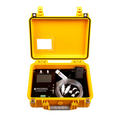
Ebac DD200 40 Pint Desiccant Dehumidifier 10502SS-US
$3,667
A 37.5 lb stainless steel unit on a standard 115 V circuit, listed at 800 W and 7.5 A, for a room up to 400 sq. ft.
Difference 2: power and running cost
Power is where the two types separate in favor of refrigerant. This is our calculation from the listed watts, which gives the most a unit can draw in a day (watts x 24 hours / 1,000 = kWh):
| Unit | Listed power | Most it can draw per day (our calculation) |
|---|---|---|
| Ebac DD200 | 800 W | 19.2 kWh |
| Ebac DD400 | 1,800 W | 43.2 kWh |
| Ebac DD700 | 7,500 W | 180 kWh |
| Ebac CD60 | 880 W (Ebac's spec sheet) | 21.1 kWh |
| AlorAir Storm Pro | About 644 W (5.6 A x 115 V) | 15.5 kWh |
AlorAir publishes an efficiency of 2.88 L/kWh for the Storm Pro, which works out to about 6 pints per kWh (our calculation, 1 pint = 0.4732 L).
Ebac does state a condition in its own documents. The DD200 owner's manual rates the DD200 at 36 pints a day at 27°C (about 81°F) and 60% RH, and Ebac's brochures rate the DD400 at 71.5 pints and the DD700 at 231 pints (High Extraction setting) at the same point. That is nearly the 80°F, 60% RH air behind the Storm Pro's 85 AHAM pints. The test methods are not identical, so read this as a rough guide. Our calculation (pints per day / kWh per day): the DD200 gives about 1.9 pints per kWh, the DD400 about 1.7 and the DD700 about 1.3, against about 6 for the Storm Pro. In warm air a refrigerant unit removes three to nearly five times the water per kWh. In air near freezing the refrigerant unit's pints fall away and that advantage goes with them. For a worked cost per day at your electric rate, use our guide to what a dehumidifier costs to run.

Top seller of these five
Ebac DD400 Commercial Desiccant Dehumidifier 10500SS-US
$4,867 · 5.0 from 1 review
71.5 pints a day at 27°C and 60% RH (Ebac's brochure), 1,800 W on a 220 V single-phase supply, ductable and listed down to -4°F. The most-bought machine of the five here.
Difference 3: where the water goes
A refrigerant unit collects liquid water, so it needs a tank, a drain line or a pump. The Ebac CD60 lists an internal condensate pump, and the AlorAir Storm Pro lists a built-in pump with a vertical rise up to 15 ft. A desiccant unit puts the moisture into a warm airstream instead. The DD400 and DD700 listings show no internal pump or continuous drain, the DD700 lists no water container and both are listed as ductable. In practice that means the desiccant unit's duct run and exhaust point are part of the setup, in the same way a drain line is for a refrigerant one.

Refrigerant pick
Ebac CD60 Industrial Dehumidifier with 56 pints Capacity 10264FR-US
$2,200
56 pints a day (Ebac's spec sheet calls it typical extraction and gives no condition), 360 CFM, 880 W on 110 V, 33°F to 95°F with hot gas defrost and an internal pump, in an 80 lb steel unit.
Difference 4: size, weight and price
Desiccant units are priced for work where refrigerant fails. Ebac's DD200 owner's manual rates it at 36 pints a day at 27°C (about 81°F) and 60% RH, for $3,667; the 40 in its product name has no stated condition. In nearly the same air, 80°F and 60% RH, AlorAir rates the Storm Pro at 85 pints a day, for under $1,000. The Storm Pro's 180 pints is a saturation figure (90°F, 90% RH), so set desiccant pints only against the 85. At the top of the range the DD700 is listed at 231 pints a day, 883 CFM and 7,500 W, at $13,000 for the 220 V version or $13,267 for 460 V.
Small desiccant units are the light ones. The DD200 weighs 37.5 lb and the DD400 59.5 lb, against 80 lb for the CD60 and 99.2 lb for the Storm Pro; the DD700 is 170 lb. They are louder, though: 67 dB on all three DD units against 57 dBA for the CD60 and 58 dBA or less for the Storm Pro.

Largest desiccant
Ebac DD700 Industrial Desiccant Dehumidifier
$13,000
231 pints a day at 27°C (about 81°F) and 60% RH on its High Extraction setting, per Ebac's brochure; 883 CFM; hardwired three-phase at 220 V (20 A) or 460 V (10 A), priced apart.

Refrigerant for warm, wet jobs
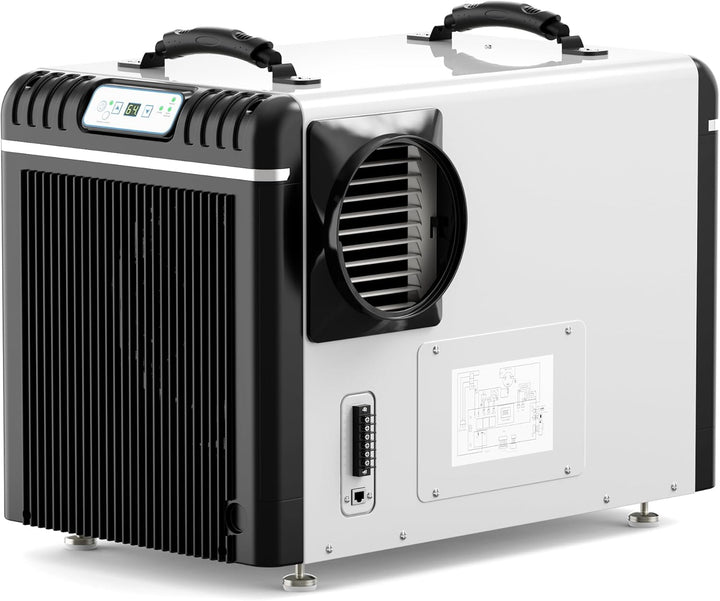
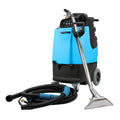
AlorAir Storm Pro 85-Pint Commercial Dehumidifier with Pump
$979.99
85 pints a day at AHAM and 180 at saturation, 210 CFM on 5.6 A, a built-in pump and a 6 inch duct connection; the blue version is priced lower than green, red or yellow.
Pros
- Desiccant: keeps working at the temperatures where a refrigerant coil would frost, listed down to -4°F on the Ebac DD units.
- Refrigerant: lower purchase price and a clear efficiency figure (2.88 L/kWh on the Storm Pro).
Cons
- Desiccant: higher purchase price, more power per pint in warm air and a duct run to plan.
- Refrigerant: a listed lower limit of 33°F to 33.8°F, so it is the wrong tool for a space that stays near freezing.
Choosing between the two
Start with the coldest temperature the space reaches, because that decides the type before price does. Then size the machine to the room and check the circuit: the DD200 runs on a standard 115 V outlet, the DD400 needs a 220 V single-phase supply at 8 A, and the DD700 is hardwired to a three-phase supply at 220 V or 460 V (Ebac's DD700 brochure), which most homes and small shops do not have. The CD60 (7 A) and the Storm Pro (5.6 A) both plug into 115 V; AlorAir's listing asks for a grounded GFI outlet on a 15 A time-delay breaker, so a small job rarely needs an electrician. Last, plan the water path, a pump or drain for refrigerant and a duct run for desiccant, before the machine arrives on site.
Watch how they work
Ebac's UK channel has a short explainer on how its dehumidifiers work. It covers Ebac's home range, but the coil and airflow basics are the same.
Best dehumidifier for a cold basement
A cold basement is the case people most often ask about, and the answer depends on how cold it gets. A heated basement is refrigerant work. An unheated one that sits in the 30s or 40s °F for weeks will still run a refrigerant unit (the CD60 lists 33°F and uses hot gas defrost, per Ebac's CD60 spec sheet; the Storm Pro lists 33.8°F), but it will remove well under its rated pints. A basement that stays that cold all winter, or drops toward freezing, is where the Ebac DD200 and DD400, listed to -4°F, earn their price. The DD200 suits a room up to 400 sq. ft. on a normal outlet; the DD400 lists a suggested room size of 1,200 sq. ft. but needs a 220 to 240 V supply.
Size the machine first, then pick the type. Our guide to what size dehumidifier you need covers pints per day and the AHAM versus saturation difference, and reading a psychrometric chart explains the grains-per-pound and dew point numbers that restorers use to judge drying. For warehouse and garage buying advice, see our best commercial dehumidifiers picks, and for water-damage work see dehumidifiers for water damage.
Verdict by job
| Job | Better type | Pick |
|---|---|---|
| Unheated garage or shed in winter | Desiccant | Ebac DD200 or DD400 |
| Cold warehouse or marine space | Desiccant | Ebac DD400 or DD700, by room size |
| Storage, cold store or deep drying to a low RH | Desiccant | Ebac DD400 or DD700 |
| Heated basement or office | Refrigerant | Ebac CD60 |
| Warm, wet water-damage job | Refrigerant | AlorAir Storm Pro |
| Space that swings between cold and warm | Depends on the coldest night | Match to the lowest temperature the space reaches |
For the full range, browse the Ebac dehumidifiers collection, which holds both the desiccant and the refrigerant Ebac models.
Frequently asked questions
What are the disadvantages of a desiccant dehumidifier?
The main ones are price and power. The units we carry start in the high $3,000s. The three DD units in this guide draw 800 W to 7,500 W as listed, and the larger DD900 and DD1200 Plus list 9,800 W and 11,800 W. They also need a duct run, and a refrigerant unit is the leaner choice in warm, humid air.
What is the difference between a desiccant and a compressor dehumidifier?
A desiccant unit takes moisture onto a drying wheel and dries the wheel with heated air. A compressor (refrigerant) unit condenses water on a cold coil. The practical difference is temperature: the Ebac DD units list -4°F, while the refrigerant units here list a floor of 33°F to 33.8°F.
Which type of dehumidifier is better, refrigerant or desiccant?
Neither is better everywhere. Refrigerant suits warm, humid spaces and costs less to buy and, in warm air, to run. Desiccant suits spaces that get close to or below freezing. Match the type to the coldest temperature the space reaches.
Where does the water go in a desiccant dehumidifier?
On a ducted commercial unit like the Ebac DD range, the water leaves as moisture in hot reactivation air. Ebac's DD200 manual has that exhaust vented outside the room. Small plug-in home desiccant units are built differently and collect the water in a tank.
How much electricity does a desiccant dehumidifier use?
As listed, the DD200 is 800 W, the DD400 is 1,800 W and the DD700 is 7,500 W. Running flat out for 24 hours that is 19.2, 43.2 and 180 kWh, our calculation. Multiply by your electric rate for the cost per day.
Is a desiccant dehumidifier the same as a moisture absorber?
No. A moisture absorber is a tub or pack of desiccant that soaks up water until it is full and then has to be replaced or dried out. It has no fan and no heater. A desiccant dehumidifier pushes air through its wheel and dries the wheel continuously with a heater, so it keeps working for as long as it runs. An absorber suits a closet; a basement or warehouse needs a machine.
Match the dehumidifier to the temperature
Related guides
- Best Commercial Dehumidifiers: Warehouse, Job-Site and Garage Picks
- How Does a Dehumidifier Work? Refrigerant, LGR and Desiccant Explained
- What Size Dehumidifier Do I Need? Pints per Day, AHAM vs Saturation and a Sizing Chart
- How to Read a Psychrometric Chart for Water Damage: GPP, Dew Point, Grain Depression