How we made this guide: picks, prices and specs come from our catalog and the makers' published specs, owner quotes come from customer reviews on our product pages and the guide was drafted with AI help, then checked and edited by Trevor Hall.
Yes, a dehumidifier is what removes the water after a leak or flood, and for most jobs the pick is an LGR unit such as the AlorAir Storm LGR 1250 at $1,377, with the Abatement Technologies AQUATRAP AT250RS at $2,400 for fewer, larger machines and the Ebac DD300 desiccant at $4,147 for cold spaces. Fans and heat only move moisture from wet materials into the air; the dehumidifier takes it out.
The seven units here run from under $900 to over $4,000, and the Dapper Supply 190-pint at $895 is the entry-level option for warm, lightly wet rooms. How many you need comes from the cubic feet of the wet space and the class of water damage, and the method is further down.
Quick answer
Light, clean-water jobs can use a conventional refrigerant unit. Most structural drying uses LGR units. Cold spaces and dense materials are where desiccant units come in. To size the job, divide the cubic feet by the IICRC chart factor, then divide the pints per day that gives you by each machine's AHAM rating and round up. Browse every flood restoration dehumidifier we carry, the LGR dehumidifiers or the desiccant dehumidifiers.
Why water damage changes which dehumidifier you buy
A water damage dehumidifier has a harder job than a basement one: it pulls out the moisture that wet drywall, framing, carpet pad and subfloor give up while air movers push dry air across them.
Four things decide the choice. Temperature comes first, because refrigerant units are built for a working range and desiccant units keep going in cold rooms. Abatement's AT250RS manual shows how much: 147 pints a day at 81°F and 60% RH, but 69 pints at 50°F and 70% RH. Abatement calls 68°F to 84°F favorable for drying. Capacity comes second, and it only means something with its test condition attached. Third is drainage: a restoration job runs for days, so a pump or a hose to a drain beats emptying a tank. Fourth is power, because machines and air movers share a few circuits.
Each machine below is listed with its pints per day and the condition the maker gives. AHAM figures are measured at 80°F and 60% relative humidity; saturation figures at 90°F and 90% always read higher, so compare like with like. For the physics behind each type, see our explainer on how a dehumidifier works and the older LGR dehumidifier explainer.
LGR vs conventional vs desiccant
| Type | How it removes water | Where it fits | IICRC chart factor, Class 1 to 4 |
|---|---|---|---|
| Conventional refrigerant | Cools air over a coil so water condenses | Light jobs and warmer rooms. The Ebac HM150 is a conventional (non-LGR) unit | 100, 40, 30 and N/A for Class 4 |
| Low grain refrigerant (LGR) | Refrigerant unit that pre-cools incoming air before the coil, so it keeps pulling water when the air is already fairly dry | Most structural drying | 100, 50, 40 and 40 |
| Desiccant | Passes air over a drying material instead of a cold coil | Cold spaces and dense materials. The Ebac DD300 lists -4°F as its lowest operating temperature | Sized by air changes per hour: 1, 2, 3 and 3 |
A larger chart factor means less rated capacity is needed. In Classes 2 and 3 the IICRC chart lets you count on less AHAM capacity from an LGR unit than from a conventional one, and it gives conventional units no Class 4 factor at all.
The seven units compared
| Pick | Type | Rated pints a day (maker's condition) | Drainage | Amps | Weight | Price |
|---|---|---|---|---|---|---|
| AlorAir Storm LGR 1250 | LGR | 125 at AHAM | Built-in pump | 8.1 A | 79.2 lb | $1,377 |
| XPOWER XD-125Li | LGR | 125 at AHAM, 220 at saturation | Auto purge pump | 7.9 A | 88.2 lb | $3,079 |
| AlorAir Sentinel SLGR 1400X | LGR (AlorAir SLGR) | 140 at AHAM, 275 at saturation | Gravity hose | 5.4 A | 124.3 lb | $1,699 |
| Abatement AQUATRAP AT250RS | LGR | 147 at AHAM, 266 at saturation | Built-in pump | 12 A | 100 lb | $2,400 |
| Ebac HM150 | Conventional | 105 typical, 203 maximum (no AHAM rating) | Internal pump | 8 A | 95 lb | $3,667 |
| Dapper Supply 190-pint | Refrigerant (not listed as LGR) | 94.5 at AHAM, 190 at saturation | Pump or 2 gal tank | 9.5 A | 99.21 lb | $895 |
| Ebac DD300 | Desiccant | 69 at 81°F and 60% RH | Wet-air duct to outside | 12.4 A | 44 lb | $4,147 |
How we picked these seven
We did not run these machines ourselves. The seven come from the makers' published ratings and manuals, cover all three types and run from under $900 to over $4,000. None has an owner review on its product page yet, so there are no owner quotes and no durability claims.
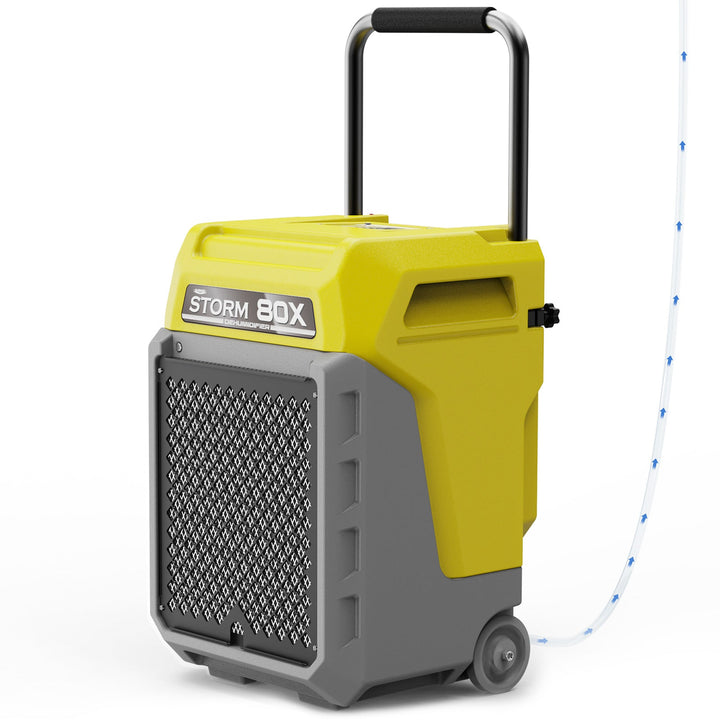
Best overall for most jobs: AlorAir Storm LGR 1250

Best overall
AlorAir Storm LGR 1250 125-Pint Commercial Dehumidifier with Pump
$1,377
A 125-pint AHAM LGR unit with a built-in pump at a mid-range price.
The Storm LGR 1250 removes 125 pints a day at AHAM conditions with a 300 CFM airflow, and AlorAir rates it for spaces up to 3,000 ft². It draws 8.1 A and runs on a grounded GFCI outlet on a 15 A circuit. A built-in condensate pump lets the hose run to a drain with the outlet no higher than 15 feet, and the operating range is 33.8°F to 110°F.
It comes in three colors at one price: blue and green standard LGR 1250 units and a red LGR 1250X that adds WiFi control through the AlorAir app, which suits a crew that wants to check a job without walking back in.
Pros
- 125 pints a day at AHAM, with a MERV-8 filter listed
- Built-in pump, so no tank to empty
- Lighter than the other LGR units here at 79.2 lb
Cons
- Two units cannot share one 15 A circuit (2 x 8.1 A = 16.2 A, our calculation)
- Lower rated airflow than the XPOWER (300 vs 420 CFM)
Skip it if the job is a large Class 3 or Class 4 space where you want fewer machines on fewer circuits.
Best for long hose and cord runs: XPOWER XD-125Li

Best for long runs
$3,079
Same 125-pint AHAM rating with a 40 ft drain hose, a 25 ft cord and Bluetooth.
The XD-125Li carries the same 125-pint AHAM rating as the Storm and adds a saturation rating of 220 pints a day and a 420 CFM rated airflow. It draws 7.9 A, comes with a 25 ft power cord and a 40 ft drain hose, and has an auto purge pump.
Bluetooth links the app to a phone near the unit; to check a job from off site, the WiFi Storm LGR 1250X is the version to look at.

At $3,079 it costs more than twice what the Storm does for the same AHAM figure.
Pros
- 125 pints at AHAM and 220 at saturation
- 40 ft drain hose and 25 ft cord included
Cons
- Priced well above the Storm for the same AHAM rating
- 88.2 lb, heavier than the Storm
Skip it if your drain and outlet sit close to the wet room.
Best for large spaces: AlorAir Sentinel SLGR 1400X

Best for big spaces
AlorAir Sentinel SLGR 1400X 140-Pint Commercial Dehumidifier
$1,699
140 pints at AHAM and 440 CFM on just 5.4 A.
The Sentinel SLGR 1400X is rated at 140 pints a day at AHAM and up to 275 pints at saturation, with 440 CFM of airflow on 5.4 A. It uses washable MERV-10 and MERV-8 filters. The low amperage is what stands out: it draws less than the Storm for more rated water removal, though AlorAir lists a dedicated 15 A circuit with GFCI protection.
It drains by gravity through a 6.6 ft hose, so the drain must sit below the outlet. An external pump is sold separately. At 124.3 lb it is the heaviest unit here, so plan the carry up stairs.
Pros
- 5.4 A draw is the lowest of the LGR units listed
Cons
- No built-in pump, only gravity drainage
- 124.3 lb is the heaviest of the seven
Skip it if the drain is above the unit or you will move it between floors often. At $1,699 it costs more than the Storm for 15 more AHAM pints.
Best for capacity per machine: Abatement Technologies AQUATRAP AT250RS

Best for capacity
Abatement Technologies AQUATRAP Series LGR Dehumidifier AT250RS
$2,400
147 pints at AHAM from a 100 lb restoration unit with a soft-start compressor.
The AT250RS lists 147 pints a day at AHAM and 266 pints at saturation, the highest AHAM figure among the seven. It runs on 115 V, and Abatement's manual lists 12 A, 413 CFM of rated airflow, a centrifugal condensate pump that purges automatically, a 32 ft drain hose and a 9.84 ft cord. It weighs 100 lb and works from 34°F to 100°F.

The 12 A draw is the practical limit. A 15 A circuit carries one of them with little left over, so plan the circuits first on a multi-unit job. At $2,400 it costs more than the Storm and Sentinel, and it is the pick when fewer, larger machines make the layout easier.
Pros
- Soft-start compressor and sensor-controlled defrost
- Stackable cabinet
Cons
- 12 A is the highest draw among the LGR units
- Short 9.84 ft cord; the manual allows only grounded extension cords rated for the load
Skip it if your power is tight, since the Sentinel offers more water removal per amp.
Best conventional unit for flood jobs: Ebac HM150

Best conventional
Ebac HM150 Flood Restoration Dehumidifier
$3,667
540 CFM and an internal pump, built for flood jobs, with no AHAM rating.
The Ebac HM150 is a conventional refrigerant unit, not an LGR. Ebac's brochure lists typical extraction of 105 pints a day and a maximum of 203, with no AHAM rating, plus 540 CFM of airflow and 8 A; the unit weighs 95 lb. It has an internal condensate pump that lifts up to 3 m (about 10 ft), automatic defrost and auto-restart. It runs from 33°F to 95°F.
Because Ebac gives no AHAM rating, the HM150 cannot go into the IICRC formula beside the other units; Ebac's own guide figure is an effective volume of 10,600 cubic feet. It sells in two versions, with and without a humidistat, at $3,667 either way.
Pros
- Internal condensate pump and auto-restart
Cons
- No AHAM rating, so it cannot be sized with the IICRC formula
Skip it if you need an AHAM rating to size the job with the IICRC chart; Ebac does not publish one for the HM150.
Best entry-level unit: Dapper Supply 190-pint

Best entry-level
Dapper Supply 190-Pint Commercial Dehumidifier, Built-In Pump, 15000 Sq Ft Coverage
$895
Entry-level price and a big pump lift, but the AHAM rating is 94.5 pints.
The Dapper Supply unit is the entry-level pick here at $895, and its headline 190 pints is a saturation rating. The AHAM rating at 80°F and 60% relative humidity is 94.5 pints a day, which is the number to use when you size a job. Dapper lists coverage up to 15,000 sq ft and 700 CFM of airflow, and a built-in pump that lifts water 16.4 ft. That coverage figure is for holding humidity in a dry building. For drying a wet one, the IICRC chart gives 94.5 AHAM pints about 3,800 cubic feet of Class 2 loss at the conventional factor of 40, roughly a 470 sq ft room with 8 ft ceilings (our calculation).

It draws 9.5 A at 115 V and weighs 99.21 lb. Its operating range starts at 41°F, a higher floor than the Ebac, AlorAir and Abatement units. Treat it as a unit for warm, lightly wet spaces rather than a cold structure.
Pros
- Built-in pump with a 16.4 ft lift
Cons
- 94.5 pints at AHAM is the lowest AHAM figure here
- Operating range starts at 41°F
Skip it if the space is cold or the water damage is deep, where the other units give you more AHAM capacity.
Best for cold spaces and dense materials: Ebac DD300 desiccant

Best desiccant
Ebac DD300 70 Pint High-Grade Stainless Steel Desiccant Dehumidifier 10501SS-US
$4,147
A 44 lb desiccant unit that lists operation down to -4°F.
Ebac's manual rates the DD300 at 69 pints a day at 81°F (27°C) and 60% RH, close to AHAM conditions but not labeled AHAM, with 136 CFM of dry (process) airflow. It draws 12.4 A on a 10 ft cord, weighs 44 lb and runs down to -4°F. It has no condensate to drain: the manual says the wet air outlet must be ducted to outside the room being dried.
Ebac's capacity chart plots lower output in colder process air, so -4°F is where it still runs, not where it gives 69 pints. At $4,147 it costs more than any refrigerant unit above. The reason to buy it is the temperature range and the ducting, not the pints.
Pros
- Lists operation down to -4°F
Cons
- Highest price of the seven
- Needs a wet-air duct to outside the room, and draws 12.4 A
Skip it if the building is warm and a refrigerant unit can do the work.
How many dehumidifiers do you need
The IICRC publishes an Initial Dehumidification Recommendation chart with factors and formulas for sizing dehumidifiers on water losses. For refrigerant units, the chart works like this: divide the cubic feet of the wet space by the chart factor for your class and unit type, which gives the total pints per day needed. Then divide by each machine's AHAM rating and round up. For desiccant units, multiply cubic feet by air changes per hour, divide by 60 and divide the result by each machine's CFM rating.
The classes of water damage are explained in our table of the S500 categories and classes. This is the initial equipment guide, not a drying plan; readings take over from there. The examples below are our calculation from the IICRC factors and the AHAM ratings on our product pages. Makers' coverage areas, such as 3,000 ft² for the Storm or 15,000 sq ft for the Dapper, describe humidity control in a dry building, not drying a wet one, so size water losses with the chart.
| Example | Space | Chart factor | Pints per day needed | Units |
|---|---|---|---|---|
| 1. Class 2 bedroom and hall, LGR | 20 x 30 x 8 ft = 4,800 cu ft | 50 | 4,800 / 50 = 96 | 96 / 125 = 0.77, so 1 Storm LGR 1250 |
| 2. Class 3 basement, LGR | 30 x 40 x 8 ft = 9,600 cu ft | 40 | 9,600 / 40 = 240 | 240 / 125 = 1.92, so 2 Storm units; 240 / 140 = 1.71, so 2 Sentinels |
| 3. Class 4 slab and cabinets, LGR | 25 x 30 x 9 ft = 6,750 cu ft | 40 | 6,750 / 40 = 169 (rounded up) | 169 / 147 = 1.15, so 2 AT250RS |
| 3b. Same space, desiccant | 6,750 cu ft at 3 air changes per hour | 3 ACH | 6,750 x 3 / 60 = 337.5 CFM | 337.5 / 136 = 2.48, so 3 DD300 |
Three DD300s also mean three circuits at 12.4 A each and three wet-air ducts to outside, and roughly $12,000 in machines against about $5,000 for two AT250RS units at today's prices.
Always round up: 1.92 units means two machines. Sized for a hypothetical 125-pint AHAM conventional unit at the Class 3 factor of 30, the same basement needs 320 pints a day, so three machines. That is the chart's way of saying an LGR unit does more of the work once materials are wet.
Add up the amps of every dehumidifier and air mover on each circuit before you plug in. Our guide to sizing a dehumidifier covers the AHAM versus saturation difference in more depth.
Set up and run the dehumidifier
Close the wet room off from the rest of the building so the machine works on that air only. Put the dehumidifier in the room, not in a dry hallway. Leave clear space around the intake and exhaust.
Run the drain before you power up. A pump unit such as the Storm, XPOWER, AT250RS, Ebac HM150 or Dapper can push condensate to a sink or outdoors through a hose, while the Sentinel drains by gravity and needs a drain below its outlet. The DD300 makes no liquid water: Ebac's manual says its warm, moist reactivation air must be ducted to outside the room being dried.
Air movers do the evaporating, and the dehumidifier does the removing. Our air mover range sits beside the dehumidifiers, and our guides to drying wet carpet and drying hardwood floors after water damage show the same pairing on real materials.

How long to run the dehumidifier and fans
Run them until the materials read dry, not for a fixed number of days. Restorers compare wet readings against a dry reference reading from the same kind of unaffected material in the same building. Our moisture meter readings chart shows what normal readings look like for drywall, wood and concrete.
Check the machines daily. Humidity and meter readings should be falling; if they stall, add equipment or check the doors and drain.
Video: the Storm LGR 1250
Frequently asked questions
Does a dehumidifier help with water damage?
Yes. Air movers and heat move water out of wet materials into the air, and the dehumidifier removes that water so the air can take up more. It does not replace extracting standing water.
Will a dehumidifier stop mold after water damage?
It helps by drying the structure quickly, but it is not mold treatment. If you find growth, the job moves to mold remediation.
How long should a dehumidifier run after water damage?
Until the materials reach the drying goal on a moisture meter, measured against a dry reference reading of the same material. Time depends on the materials, the class of loss and the machine count.
How many dehumidifiers do I need for water damage?
Divide the cubic feet by the IICRC chart factor for your class and unit type, then divide by each machine's AHAM rating and round up. A 9,600 cubic foot Class 3 basement with LGR units needs 240 pints a day at AHAM, which is two 125-pint units (our calculation).
Is it safe to run a dehumidifier 24 hours a day?
Restoration units are built to run for days. Check the amps against the circuit, keep the filters clean and follow the manual for the model. A GFCI outlet is required on units such as the Storm LGR 1250.
How often should I dump the water from my dehumidifier?
You should not need to. The Dapper unit has a 2-gallon tank for cases where you cannot drain. The Storm LGR 1250, XPOWER XD-125Li, AT250RS and Ebac HM150 all have pumps. The Ebac DD300 vents its moisture as warm air through a duct instead of making water.
Is the water from a dehumidifier safe?
Do not drink it; drain it to a sink, floor drain or outdoors. For contaminated losses, see our guide to Category 3 water damage.
What is the best dehumidifier for water damage?
For most jobs, an LGR unit with a pump, such as the AlorAir Storm LGR 1250 at $1,377. Choose the AT250RS for the highest AHAM figure of these seven, and the Ebac DD300 desiccant unit if the space is cold.
Dry the structure faster
Related guides
- What Size Dehumidifier Do I Need? Pints per Day, AHAM vs Saturation and a Sizing Chart
- Category 3 Water Damage, Explained: The IICRC S500 Categories and Classes in One Table
- How to Read a Psychrometric Chart for Water Damage: GPP, Dew Point, Grain Depression
- What Is a Desiccant Dehumidifier? Desiccant vs Refrigerant and When to Use Each