
How we made this guide: picks, prices and specs come from our catalog and the makers' published specs, owner quotes come from customer reviews on our product pages and every guide is checked and edited by Trevor Hall.
For a heated or mild garage, the best pick is the Ebac WM80-D at $2,653: it runs down to 33°F, drains through an internal pump and can stand on the floor or hang on a wall. The budget pick here is the AlorAir Sentinel Pro 55X at $599.99.
A garage that sits near freezing all winter needs a different kind of machine. The Ebac DD200 at $3,667 is a desiccant unit that Ebac's brochure rates down to -4°F. Refrigerant units like the WM80-D list a lowest operating temperature of 33°F or 37.4°F, so a freezing garage is outside what they are built for. The seven picks here run from about $600 to about $3,700.
Quick answer
Match the machine to the coldest week of your winter, then to your drain. Mild garage with a floor drain or a pump: a refrigerant unit. Garage near freezing: a desiccant dehumidifier. Large shop: a bigger refrigerant dehumidifier. Browse everything in our garage dehumidifier range.
Why a garage changes the choice
Most dehumidifier advice is written for a basement or a living room. A garage is a harder room. It is often unheated, the door leaks air, the slab is concrete and the temperature swings from summer heat to winter cold. Four things decide the machine: how cold the garage gets, where the water goes, how much dust the filter sees and whether you have floor space to spare.
Temperature comes first because every refrigerant dehumidifier lists a lowest operating temperature. Below it the coil can frost faster than the unit can clear it. Ebac's WM80-D manual, for example, describes a defrost cycle that occurs when the surrounding air is under 15°C (59°F), at intervals of no more than an hour and lasting no more than 5 minutes. Cold air also holds less moisture, so the same machine pulls less water out of a cold room than the printed pint figure suggests.
That last point matters when you read a spec sheet. AHAM pints per day are rated at 80°F and 60% relative humidity, which is warmer than most garages in winter. Treat the AHAM figure as a ceiling for comparing machines, not a forecast for your slab in January. The refrigerant makers here publish no pint figure at garage temperatures. Ebac's DD200 manual charts that unit's capacity from 14°F to 86°F (-10°C to 30°C), and it changes with both temperature and humidity.
Which machine fits which garage
This table matches the four common garage types to a plan. The lowest operating temperatures are the numbers each maker lists. Where a garage drops below that number, a refrigerant unit is the wrong tool.
| Garage type | What to plan for | Drain plan | Picks |
|---|---|---|---|
| Attached, heated | Stays well above freezing; humidity from the slab and damp cars | Floor drain, or a unit with a pump | Ebac WM80-D, AlorAir Sentinel Pro 55X |
| Attached, unheated | Cold snaps; shares a wall with the house | Pump to a sink or hose to a floor drain | Ebac WM80-D, Ebac DD200 if it nears freezing |
| Detached, unheated | Coldest air and the longest cold stretches | No drain, but a wet-air duct to outdoors | Ebac DD200 |
| Workshop or large garage | Big air volume, dust, a long hose run | Gravity hose to a drain or a purge pump with a long hose | AlorAir Sentinel SLGR 1400X, XPOWER XD-85L2 |
Garage dehumidifiers compared
| Pick | Type | Price | Pints per day | Lowest temp | Drain | Power draw | Weight |
|---|---|---|---|---|---|---|---|
| Ebac WM80-D | Refrigerant | $2,653 | 62 (Ebac figure) | 33°F | Internal pump, 25.5 ft hose | 8 A | 81.5 lb |
| AlorAir Sentinel Pro 55X | Refrigerant | $599.99 | 55 AHAM, 120 saturation | 37.4°F | Built-in pump, 19.6 ft hose | 3.5 A | 45 lb |
| Ebac DD200 | Desiccant | $3,667 | 36 at 80.6°F, 60% RH (Ebac brochure) | -4°F | No drain; 2.75 in wet-air duct to outdoors | 7.5 A | 37.5 lb |
| AlorAir Sentinel SLGR 1400X | Refrigerant | $1,699 | 140 AHAM, 275 saturation | 33°F | Gravity, 6.6 ft hose | 5.4 A | 124.3 lb |
| XPOWER XD-85L2 | LGR | $2,148 | 85 AHAM, 145 saturation | 33°F | Purge pump, 40 ft hose | 6.7 A | 70.5 lb |
| Ebac RM40 | Refrigerant | from $1,400 | 24 (Ebac figure) | 33°F | Pump on the RM40P only | 340 W | 42 lb |
| Ebac Triton | Refrigerant | $2,200 | 52 (Ebac figure) | 33°F | Internal pump, 25.5 ft hose | 470 W | 75 lb |
Ebac's figures are not AHAM ratings. The WM80-D, RM40 and Triton figures are printed with no test condition, and the DD200 brochure rates it at 36 pints per day at 27°C (80.6°F) and 60% RH. So never set an Ebac number against an AlorAir or XPOWER AHAM number. For more on that, see our guide to what size dehumidifier you need.
How we picked
We started from the catalog data on each listing: the maker's lowest operating temperature, pints per day with the condition the maker states, drain method, filter, cord and amps. Then we read the maker's manuals and brochures where we hold a copy. We did not test these machines. Coverage figures are each maker's own claim, and you should size by the maker's figure and your own hygrometer reading.
Best overall for a mild garage: Ebac WM80-D

Best overall
Ebac WM80-D Commercial Dehumidifier with Digital Humidity Control 11284GL-US
$2,653
A garage that stays above freezing and has a sink, drain or a spot to run a hose.
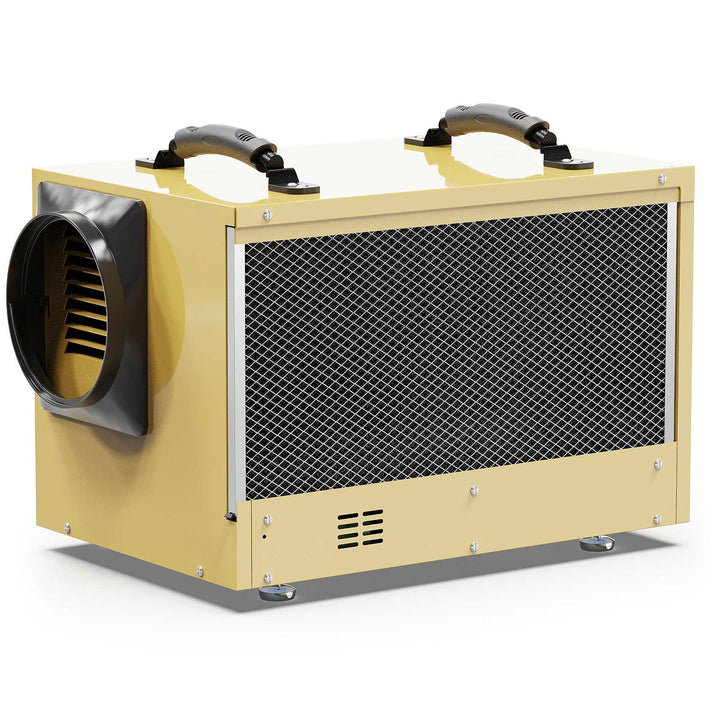
The WM80-D is a refrigerant unit, and Ebac's brochure lists garages among the WM80's uses. The brochure lists 62 pints per day with no test condition, 160 CFM and a 33°F to 105°F operating range. A hot gas defrost system is part of the design, which is what you want when the air cools. The condensate pump is internal, with a 25.5 ft drain hose, so water can go up and out to a sink without a floor drain. The filter is a washable slide-out type. It draws 8 A at 58 dB and weighs 81.5 lb.
Ebac's manual says the unit is free standing or wall mountable, with a bracket and mounting instructions. Where floor space is tight that helps, and our wall mounted dehumidifiers are the place to compare it with other options. Ebac lists a manufacturer-suggested room size of 1,500 sq ft, The warranty is 1 year unconditional, with 3 years on the compressor, condenser and evaporator. It is one of our best-selling dehumidifiers.
Pros
- 33°F lowest operating temperature with hot gas defrost
- Internal pump and 25.5 ft hose
- Free standing or wall mountable
Cons
- 81.5 lb, heavy to move alone
- The highest price of the refrigerant picks
Skip it if your garage regularly sits near or below freezing, or if you only need a small machine for a one-car space and a budget matters more than the pump and wall mount.
Best budget pick: AlorAir Sentinel Pro 55X


Best budget pick
AlorAir Sentinel Pro 55X 55-Pint Commercial Dehumidifier with Pump
$599.99
A heated or mild one- or two-car garage with an outlet on a GFCI circuit.
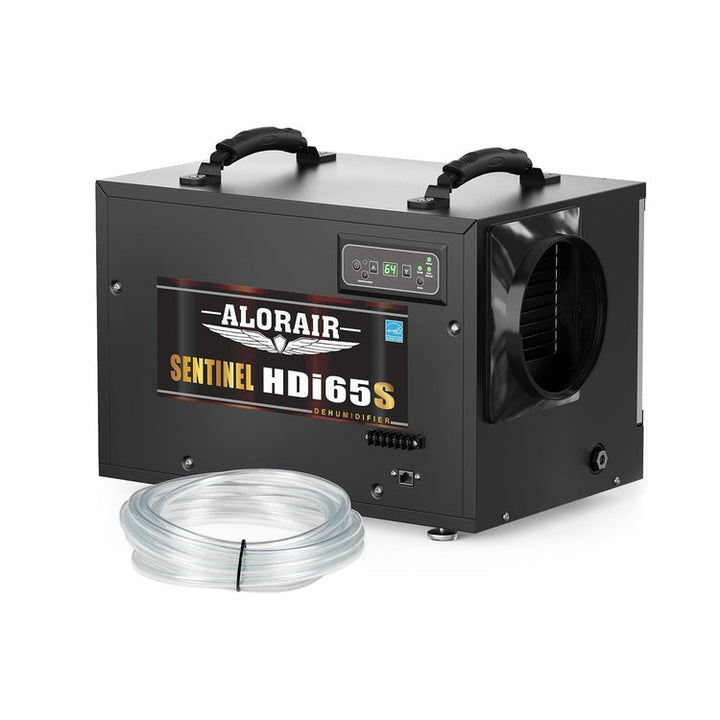
AlorAir rates the Sentinel Pro 55X at 55 pints per day at AHAM conditions (80°F, 60% RH) and 120 pints at saturation (90°F, 90% RH), with 187 CFM and coverage up to 1,500 sq ft. It lists an operating range of 37.4°F to 100.4°F, so it is the least cold-tolerant refrigerant unit in this post. Plan it for a garage that stays above that line.
The drain is a built-in pump with a 19.6 ft hose, or a 6.5 ft gravity hose. The filter is a washable MERV-1. It draws 3.5 A (408 W) and AlorAir calls for a grounded GFCI outlet on a 15 A circuit, so check that the garage outlet is GFCI-protected. At 45 lb on four wheels and 52 dBA, it is the easiest of the refrigerant picks to roll in and out.
Pros
- Entry-level price among the seven picks
- Built-in pump with a 19.6 ft hose
- 3.5 A draw, 45 lb and on wheels
Cons
- 37.4°F lowest operating temperature
- MERV-1 filter is a basic washable screen
Skip it if your garage drops below 37.4°F for weeks at a time, or if you want a wall-mount option.
Best for a garage near freezing: Ebac DD200


Best for near-freezing garages
Ebac DD200 40 Pint Desiccant Dehumidifier 10502SS-US
$3,667
A detached or unheated garage where winter air sits close to or below freezing.
This is the machine for the cold end of the range. Ebac's brochure lists a minimum operating temperature of -4°F and a maximum of 104°F. It also says desiccant units do not produce water, so they work down to sub-zero temperatures.
A desiccant unit passes air over a rotating silica gel wheel. The wheel releases the moisture into a second, heated air stream that Ebac says is exhausted outside the area being dried. Ebac's manual says that wet air must be ducted outside the room being dried, through a short duct that slopes down and away from the machine, so condensation cannot run back inside. Plan a wall or window outlet for the 2.75 in wet-air duct. There is no condensate drain to plumb. Ebac's brochure rates it at 36 pints per day at 27°C (80.6°F) and 60% RH, with 115 CFM of dry air, 7.5 A on a 10 ft cord, 67 dB and 37.5 lb. Ebac suggests a room size of 400 sq ft, which suits a one-car garage rather than a large shop. For how the two types differ, see our guide to desiccant vs refrigerant dehumidifiers.
One safety line from the DD200 manual: do not use the unit in an environment containing flammable fumes. Garages hold fuel, solvents and paint, so keep the machine away from them and read the manual for any other restriction before you put it down.
Pros
- Rated to -4°F in Ebac's brochure
- No condensate drain; one short wet-air duct instead
- 37.5 lb and a 10 ft cord
Cons
- The highest price in this post
- 67 dB, the loudest listed here
- Small coverage figure for a large shop
Skip it if your garage stays above freezing, because a refrigerant unit at a lower price will do the same job. See the full desiccant dehumidifier range for larger Ebac models.
Best for a big shop: AlorAir Sentinel SLGR 1400X


Best for a large shop
AlorAir Sentinel SLGR 1400X 140-Pint Commercial Dehumidifier
$1,699
A big heated shop or multi-bay garage with a floor drain or sink nearby.
The SLGR 1400X is rated at 140 pints per day at AHAM and 275 at saturation, with 440 CFM. AlorAir lists coverage up to 3,800 sq ft and an operating range of 33°F to 102°F. Two washable filters sit in the cabinet: MERV-10 at the top and MERV-8 at the back, which is more filtration than most picks on this list. In a dusty shop, check and clean them on a schedule; our guide to dehumidifier maintenance shows how.
It drains by gravity through a 6.6 ft hose, and an external pump is sold separately, so the hose must run downhill to a floor drain or sink. It draws 5.4 A on a 19.6 ft cord and AlorAir calls for a dedicated 15 A circuit with GFCI protection. That matters in a garage where a freezer or compressor shares the line. It weighs 124.3 lb, so plan a spot where it can stay.
Pros
- 140 pints AHAM, 440 CFM and 3,800 sq ft coverage
- MERV-10 and MERV-8 washable filters
- 33°F lowest operating temperature
Cons
- Gravity drain only; the pump is an extra
- 124.3 lb
- Needs a dedicated 15 A GFCI circuit
Skip it if you have a one- or two-car garage. It is a lot of machine for the space, and our best commercial dehumidifiers guide covers where this size fits.
Best with a long hose: XPOWER XD-85L2


Best with a long hose
$2,148
A shop where the nearest drain is far from where the machine has to sit.
The XD-85L2 is an LGR unit with an automatic purge pump and a 40 ft drain hose, the longest hose in this post. XPOWER lists 85 pints per day at AHAM (80°F, 60% RH), up to 145 at saturation (90°F, 90% RH), 180 CFM and an operating range of 33°F to 105°F. It draws 6.7 A on a 10 ft cord, weighs 70.5 lb and carries ETL / CETL certification marks.
The housing is roto-molded polyethylene and up to three units can be stacked, which is handy if you store it between jobs. It comes in blue or red at one price. For a deeper look at pumps and gravity drains, see our guide to dehumidifiers with a built-in pump.
Pros
- 40 ft hose and an automatic purge pump
- 33°F to 105°F operating range
- Wheels, handle and stackable housing
Cons
- 70.5 lb is still a lift without a wheeled dolly
- Priced well above the AlorAir units of similar pint rating
Skip it if you want a wall-mount unit, or if the garage is small enough that a 40 ft hose is wasted.
Compact pick: Ebac RM40


Compact pick
Ebac RM40 Series Compact Dehumidifier
$1,400
A small, cold-tolerant machine for a single-car garage or storage bay.
The RM40 lists 24 pints per day, 170 CFM, 340 W and a 33°F to 95°F range at 47 dB, the quietest listing in this post. It weighs 42 lb and Ebac suggests a room size of 208 sq ft. The RM40P variant adds a pump that moves condensate up to 10 ft away, and it costs more, which is why the price above reads "from". Without the pump, you will use the gravity drain.
Pros
- 47 dB and 42 lb
- Pump available on the RM40P
Cons
- 24 pints and 208 sq ft suggest a small space only
- 95°F top temperature is lower than the others
Skip it if the garage is more than a single bay or you need to push through a lot of water fast.
Compact restoration pick: Ebac Triton


Heavy-duty compact
Ebac Triton Professional Series Industrial Dehumidifier 11393GR-US
$2,200
A workshop that wants a wheeled unit with a long cord and an internal pump.
The Triton lists 52 pints per day, 282 CFM, 470 W and a 33°F lowest operating temperature. It carries an internal condensate pump with a 25.5 ft drain hose, a 25 ft power cord and wheels. Ebac lists room coverage up to 800 sq ft at 57 dB and 75 lb. Ebac backs it for 1 year, with 3 years on the main refrigeration parts.
Pros
- 25 ft cord and 25.5 ft drain hose
- Internal pump and wheels
- 470 W draw
Cons
- 75 lb, and priced well above the RM40
Skip it if the garage is mild and small, because the WM80-D or the Sentinel Pro 55X cover the same ground with a wall mount or a lower price.
Setup tips for a garage
- Measure first. Put a hygrometer on a shelf away from the door for a few days and write down the readings. That reading answers whether you need a machine. Our guide to crawl space humidity levels and the basement humidity target post cover the same humidity numbers.
- Close the overhead door. A dehumidifier cannot dry the outdoors. Keep the door and any side door shut while it runs.
- Place it centrally with clearance. Leave space around the intake and outlet as the manual states. The WM80-D manual lists minimum clearances from walls and ceilings. The DD200 manual asks for 0.5 m (about 20 in) of clear space around the inlet and outlet.
- Plan the drain before you buy. Floor drain, sink, pump or long hose. The hose must slope downhill for a gravity drain. For a desiccant unit, plan the wet-air duct to outdoors instead.
- Keep it away from fuel and solvents. The DD200 manual warns against flammable fumes; read your machine's manual for its own warnings.
- Clean the filter. Dust loads a filter faster than a basement does. See dehumidifier maintenance.
- Read the hygrometer again. Compare it with the first readings to see whether the machine is keeping up.
If the unit stops collecting water in winter, our guide on a dehumidifier not collecting water covers frozen coils. To estimate running cost for a long season, see how much it costs to run a dehumidifier. For the science behind each type, how a dehumidifier works explains it.
Frequently asked questions
Does my garage need a dehumidifier?
A hygrometer reading answers it. Leave one in the garage for several days and look at the readings, not the smell or the look of the room. If they stay high, a dehumidifier is worth considering. You can use one in a garage with the right type and drain plan. A dehumidifier lowers the humidity. It does not fix a roof or door leak.
How do you get rid of humidity in a garage?
Close the overhead door and any side door, fix leaks that let water in, then run a dehumidifier sized for the space. Check the lowest operating temperature on the spec sheet and keep the machine away from flammable fumes.
What size dehumidifier do you need for a garage?
Start from the maker's room size and the water you need to remove, then check the pint rating with its test condition. In this post, AlorAir and XPOWER rate their units from 55 to 140 pints per day at AHAM conditions, while Ebac's compact RM40 lists 24 pints with no test condition and suits about 208 sq ft. Our sizing guide has the chart.
What is the best dehumidifier for a garage in winter?
If the garage stays above freezing, a refrigerant unit like the Ebac WM80-D, which lists 33°F. If it nears freezing, the Ebac DD200, which Ebac's brochure rates to -4°F.
Is it okay to run a dehumidifier in a garage in winter?
Yes, if the garage stays above the machine's lowest operating temperature: 33°F for most refrigerant picks here, 37.4°F for the Sentinel Pro 55X. Below that, use a desiccant unit such as the Ebac DD200, which Ebac rates to -4°F.
Is DampRid as good as a dehumidifier?
No. Moisture-absorbing tubs such as DampRid hold a fixed amount of moisture, then they are full and need replacing. A plugged-in dehumidifier with a drain removes water continuously. They suit a closet or small cabinet, not a whole garage.
Where can I find an industrial dehumidifier for sale?
Start with our garage dehumidifiers and the wider refrigerant dehumidifier range. Our best commercial dehumidifiers guide narrows it down.
Where should I put a dehumidifier in my car?
Do not put one in the car. Dry the closed garage where the car is parked and the room reading will fall.
Where not to place a dehumidifier?
Not next to fuel, solvents or paint. Never with its intake or outlet blocked. Ebac's DD200 manual specifically says not to use the unit around flammable fumes, and not to cover or obstruct airflow from the grilles.
Dry the garage, not just the air
Related guides
- What Is a Desiccant Dehumidifier? Desiccant vs Refrigerant and When to Use Each
- What Size Dehumidifier Do I Need? Pints per Day, AHAM vs Saturation and a Sizing Chart
- Dehumidifier Not Collecting Water? Causes and Fixes (Including Frozen Coils)
- Crawl Space Humidity: What Level Is Normal and How to Control It