
How we made this guide: picks, prices and specs come from our catalog and the makers' published specs, owner quotes come from customer reviews on our product pages and every guide is checked and edited by Trevor Hall.
A dehumidifier that runs but collects no water is usually in air that is already dry, in air too cold for its coil or on an airflow path starved by a dirty filter or an iced coil. Less often the setpoint is above the room's humidity, the water is leaving through a pump hose nobody is watching, or the refrigerant circuit has a fault that only a certified technician can fix.
Quick answer
Measure before you touch anything. Read temperature and humidity at the inlet and the outlet with a meter such as the FLIR EM54 at $261.99. A machine that is pulling water cools the air at the coil and returns it warmer and drier. If the air is already near your target, the machine is doing its job and the bucket stays empty. Time: 15 minutes. Difficulty: easy until the coil never gets cold, which is a technician job.
This guide is written for owners of commercial, crawl space and restoration dehumidifiers: job-site units with pumps, long drain hoses and humidistats. Small home units follow the same logic, and a short note for them is in the notes by machine type. For what is happening inside the box, read how a dehumidifier works. For filters, coils and drain line care, see dehumidifier maintenance.
What you need
You need three things: a way to read the air, a way to see the coil and a way to follow the water. A hygro-thermometer is the minimum. A meter that also reads dew point and airflow is better, because dew point is the cleanest test of whether a machine is removing water.

Measure the air
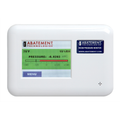
FLIR EM54 HVAC Environmental Meter for Air Velocity Flow Temperature and Humidity Measurements
$261.99
Reads air temperature, relative humidity, dew point, wet bulb (calculated) and air velocity, so one tool covers the inlet and outlet check.
The EM54 is listed with a relative humidity range of 5% to 98% (accuracy ±3.5%), a dew point range of -30 to 60°C (±3°C), an operating range of 32 to 122°F and a limited 3-year warranty. Its vane probe reads air velocity from 0.4 to 30 m/s, which helps when you suspect airflow rather than the coil.

Also bring a flashlight, a screwdriver for the filter grille or cover, and a bucket or a clear section of drain hose so you can see water move. If the coil needs cleaning, the maintenance steps are in the maintenance guide.
Watch a maker's video first
AlorAir's own video shows the Storm Ultra, a commercial LGR-style unit with a built-in pump, so you can see where the filter, the display and the drain line sit before you start.
Step 1: Check whether the air has anything left to give
Read the room with the unit running. A dehumidifier only collects water while the air is above its target humidity and warm enough for the coil to work. Three things stop collection that are not faults.
- The unit is in fan-only mode or just restarted. Many compressors wait a few minutes before starting, and Ebac's CD100 manual says to rest it at least three minutes after a power cut.
- The room has reached the setpoint. The AlorAir Storm Ultra, for example, has a humidity setpoint from 25% to 80% in 5% steps plus a continuous mode. At the setpoint the unit cycles down and the bucket or hose goes quiet. That is the answer to whether a dehumidifier ever stops collecting water: yes, once the room is dry enough for the setting.
- The air is cold. Cold air holds little moisture, so there is less to take out. Every unit also has a lowest operating temperature. The Storm Ultra lists 33.8°F to 105°F, the Ebac CD100 lists a lowest operating temperature of 33°F, and below those figures a refrigerant machine is outside its rating.
If the room reads above your setpoint and above the machine's lowest temperature, move on. If it reads below, raise the target or choose a machine built for the space (see the last sections).
Step 2: Measure the inlet and the outlet
Hold the meter in the air entering the machine, wait for the reading to settle, then repeat at the outlet grille. Write down temperature, relative humidity and dew point at both.
Ebac's CD100 owner's manual describes what to expect. Air passes the cold coil, where it is cooled below its dew point and loses moisture, then passes the hot condenser and is discharged at a higher temperature but a lower relative humidity than it entered. So a healthy machine shows a warmer outlet and a lower outlet humidity.
Use dew point as the deciding number. Relative humidity at the outlet falls partly because the air was reheated, so a low outlet reading alone does not prove water came out. Dew point drops only when moisture is removed. This is our reasoning from the physics, not a maker figure. If the outlet dew point is lower than the inlet dew point, the machine is removing water and the water is going somewhere. Use the same meter at both points and let each reading settle. The EM54 lists dew point accuracy of ±3°C (about ±5°F), so a gap of only a few degrees is inconclusive: repeat the readings. Do not read during a defrost cycle (on the CD100 about 3 minutes in every 50 per Ebac's manual), when the coil is warming on purpose. If the gap is clear, go to the drain steps. If the two match, the coil is not doing its job. If you want to turn the readings into grains per pound, how to read a psychrometric chart shows the method and a named chart to calculate from.
Step 3: Check the airflow
Restricted airflow is a common reason a good coil collects little, and a frequent cause of ice: Ebac's CD100 manual lists insufficient air flow first under little or no water extraction. Check these in order:
- Inlet and outlet clear. The CD100 manual says both grilles need clear space and must not be obstructed. Do not push the unit against a wall or a stack of boxes.
- Filter. The Storm Ultra uses a pre-filter and a MERV-8 filter. A loaded filter cuts airflow, so clean or replace it.
- Coils. For coil dirt, Ebac's CD100 manual allows compressed air or a vacuum, kept about 6 inches from the fins so they are not bent, and it says never to steam clean refrigeration coils. Unplug the machine first.
- Fan. The manual lists a loose fan on the shaft, a burnt-out fan motor and loose wiring as causes of little or no airflow.
If you own a meter with a vane probe, a before-and-after air velocity reading at the outlet shows whether the cleaning worked.
Step 4: Look at the coil
With the machine unplugged, look at the evaporator coil through the grille or with the cover off, following the maker's instructions. What you see tells you which branch of the problem you are in.
- Evenly frosted or wet coil: the circuit is working. Ebac's CD100 manual describes a check where, after about 20 minutes with the humidistat at maximum, the coil is evenly coated in frost. Above 25°C (77°F) the coil may be covered in water droplets instead.
- Thick ice that blocks the fins: an airflow, temperature or defrost problem. See the next section.
- Partial frosting with frost on the thin capillary tubes: the CD100 manual says this indicates loss of refrigerant gas or a low charge. That is a technician job.
- Dry, warm coil that never gets cold: the compressor or refrigerant circuit is not working.


A unit with a documented defrost test
Ebac CD100 Commercial Dehumidifier 1133560
$3,333
The owner's manual lists its airflow, lowest operating temperature and a coil check you can repeat. Listed at 700 CFM and a 97 pint capacity (condition not stated).
Frozen coils: why they happen and how to thaw one
A frozen coil collects almost nothing, because ice insulates the fins and blocks air. In cool rooms a compressor dehumidifier's coil drops below freezing and frosts, which is why commercial units have a defrost cycle. The trouble starts when the defrost cannot keep up or when something starves the coil of warm air.
What the makers' documents and our listings say:
- Ebac's CD100 manual describes a hot gas defrost system controlled by an electronic timer. In its test, the unit enters defrost after about 50 minutes and the cycle lasts about 3 minutes.
- Ebac's WM80-D manual says that when the unit runs in an ambient below 15°C (about 59°F), a defrost cycle should occur at intervals of no more than every hour and last no more than 5 minutes.
- The Storm Ultra listing names an auto defrost and an operating range down to 33.8°F.
Defrost types differ by model. Some units use hot gas and some reverse the cycle, so check your own model's manual before you assume how yours clears ice.
Common causes of ice
- A dirty filter or dirty coil that restricts airflow.
- Blocked inlet or outlet grilles.
- A room colder than the machine's rated range.
- A weak or loose fan.
- Low refrigerant, which shows as partial frosting that does not clear.
How to thaw it safely
- Switch the unit off and unplug it. Leave it to stand with the fan side clear until the ice melts and drains.
- Do not apply direct heat to the coil. The CD100 manual says that under no circumstances should direct heat be applied to the evaporator coil to remove ice, because of the high pressures in the refrigeration circuit.
- Clean the filter and coils, and clear the grilles.
- If the machine was switched off at the mains, wait. The CD100 manual says to let it rest at least three minutes before restarting, or the compressor can blow fuses.
- Restart and watch for ice. If it returns in a room that is warm enough, the cause is not the room. Stop and call a technician.
For basements that sit near the lower end of these ranges, read the ideal basement humidity level and consider a unit rated for the temperature you really have.
Step 5: Follow the water
If the inlet-to-outlet check showed the coil is pulling water, the water may be going somewhere you are not looking.
Pump and hose
Many job-site units drain through a pump. The Storm Ultra has a built-in condensate pump with a vertical rise of up to 15 feet. The XPOWER XD-130Li has an auto purge pump and a 40 ft drain hose. If the hose is kinked, frozen, pinched under a door or looped too high, the machine holds water inside and may shut off or flood.
Ebac's CD100 manual covers gravity drainage: the hose must at no point be raised higher than the outlet pipe, or the unit floods. It can be fitted with an optional pump that discharges up to 30 feet away. Its troubleshooting table lists a faulty pump, a sticking float switch and a blocked drain tray as causes of water flooding inside the machine.
Walk the whole hose from the machine to the drain. A bucket under the end of the hose lets you check that water is arriving. Our guide to dehumidifiers with a built-in pump covers how pumps differ.


A unit that shows what it is doing
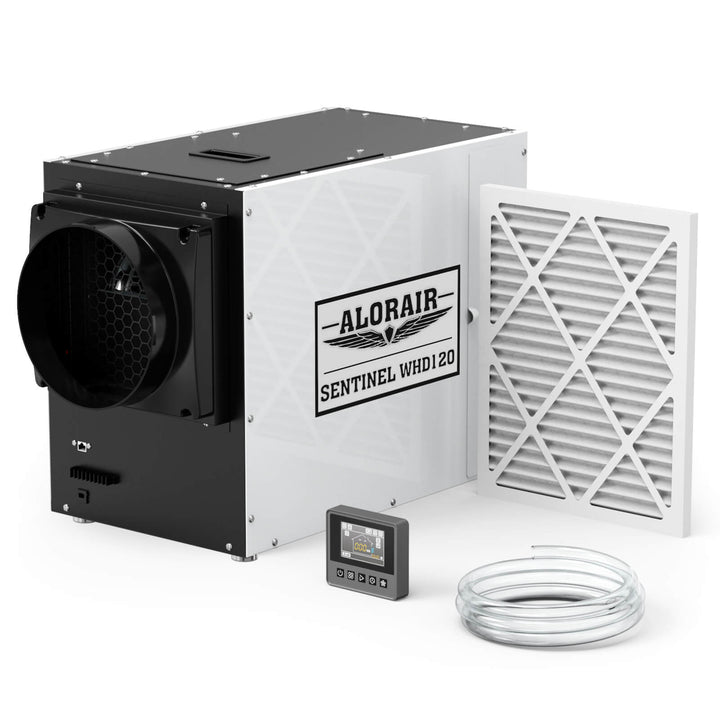
$3,079
Its listing describes a display of inlet and exhaust temperature and humidity, a quick inlet-to-outlet check (a dew point meter is still the firmer test). Listed at 125 pints/day (AHAM) and 220 (saturation), 420 CFM.
Humidistat and setpoint
Dials differ. On the Ebac CD100 a higher humidistat setting makes the machine run longer and dry harder: Ebac's CD100 owner's manual suggests about 50% on its dial for factories and warehouses and about 100% for basements or de-flooding. On units with a digital RH setpoint, such as the Storm Ultra (25% to 80%), a lower number means drier. If a drying job has finished, the setpoint may simply have been reached. If it is not, check that the setpoint is below the room's reading, or the unit has no reason to run.
Troubleshooting table
The rows below come from the makers' manuals. Check the manual for your model before opening a unit.
| Symptom | Likely cause | Check | Fix | What the manual says |
|---|---|---|---|---|
| Runs, bucket or hose empty | Room at or below the setpoint | Room RH against the setting | Lower the setpoint if the room needs more drying | CD100: turn the dial up (drier) for worse conditions; digital units: set a lower RH |
| Runs, bucket or hose empty | Air too cold | Room temperature against the lowest operating temperature | Warm the space or use a desiccant unit | CD100 lists 33°F as its lowest operating temperature |
| Little or no water | Insufficient airflow | Filter, grilles, coils, fan | Clean or replace the filter, clear grilles, clean coils | CD100: little or no water extraction can be insufficient air flow, a compressor fault or loss of refrigerant gas |
| Little or no airflow | Loose fan, burnt-out fan motor, dirty coils, loose wiring | Fan on its shaft, coils, wiring | Tighten or replace the fan, clean the coils, check the wiring diagram | CD100 troubleshooting table |
| Ice on the coil | Restricted airflow or a cold room | Filter, grilles, room temperature | Switch off, let it thaw, fix the airflow. No direct heat | CD100: never apply direct heat to remove ice |
| Little or no defrost when required | Faulty timer or faulty bypass timer | Defrost does not occur in a cool room | Contact the maker's service center | CD100 troubleshooting table |
| Partial frost, frosted capillary tubes | Low refrigerant charge | Run 20 minutes at maximum humidistat and look at the coil | Certified technician | CD100: partial frosting indicates loss of refrigerant gas or a low charge |
| Water inside the machine or on the floor | Faulty pump, sticking float switch or blocked drain tray | Drain tray, float, pump | Remove the obstruction or replace the pump | CD100 troubleshooting table |
| Desiccant unit: little dehumidification | Clogged filter, no regeneration heat, reduced airflow, rotor not turning, air leakage | Filters, heater, ducts, rotor drive belt | Clean or replace filters, check ducts, check the belt | Ebac's DD400 manual troubleshooting table |
When refrigerant is the problem
If the coil never gets cold, or frost shows only in patches, the fault is in the sealed system. Ebac's manual says that if refrigerant is lost, a refrigeration technician must correct the fault and the maker's service center should be contacted first. EPA's Section 608 program requires certification for technicians who maintain, service or repair equipment that could release refrigerant. Do not open the circuit yourself.
Weigh a sealed-system repair quote against the price of a new machine. For more on the decision, see best commercial dehumidifiers.
Notes by machine type
Refrigerant units: LGR and conventional
These use a cold coil, and everything above applies. LGR dehumidifiers are built for low-grain drying on restoration jobs. The XPOWER XD-130Li lists 125 pints a day on the AHAM basis (80°F, 60% RH) and 220 on the saturation basis (90°F, 90% RH), with 420 CFM and 8.2 A. Do not compare an AHAM number with a saturation number. For the sizing math, see what size dehumidifier do I need. Browse refrigerant dehumidifiers or the wider dehumidifier collection.

A pump unit with app control
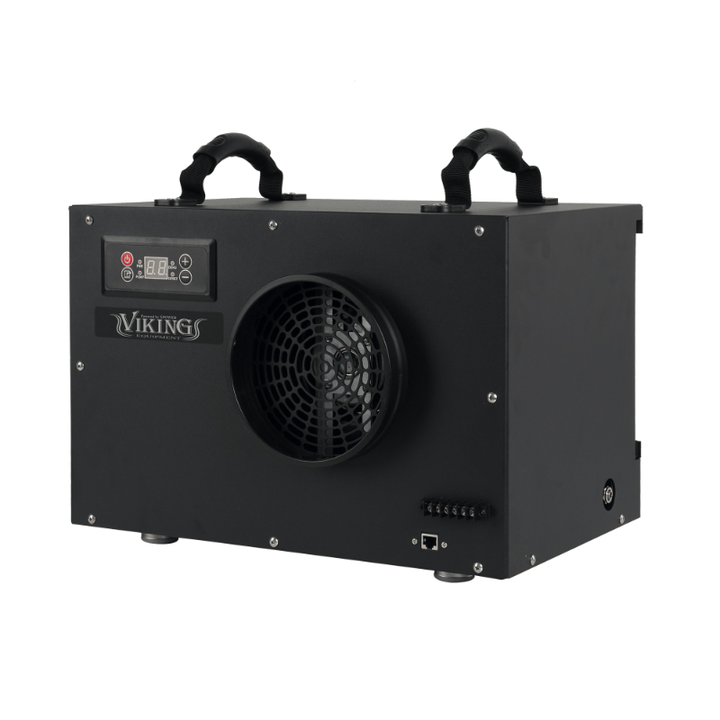
AlorAir Storm Ultra 90-Pint WiFi Commercial Dehumidifier with Pump
$1,199
Built-in pump, 5.6 A, 18 ft cord, 210 CFM. Listed at 90 pints/day (AHAM) and 190 (saturation); operating range 33.8°F to 105°F. Pump lifts up to 15 ft vertically.
Desiccant units: cold spaces
A desiccant unit does not use a cold coil, so it cannot freeze one. It also fills no bucket. A rotor holds moisture from the process air and heated reactivation air carries it out. Ebac's DD400-P brochure says the hot, wet regeneration air is exhausted outside the area being dried, through a 4 in wet-air duct. It lists an operating range of -4°F to 104°F (-20°C to 40°C). So a desiccant machine that collects no water is working normally, and the moisture leaves through the duct.


For cold spaces
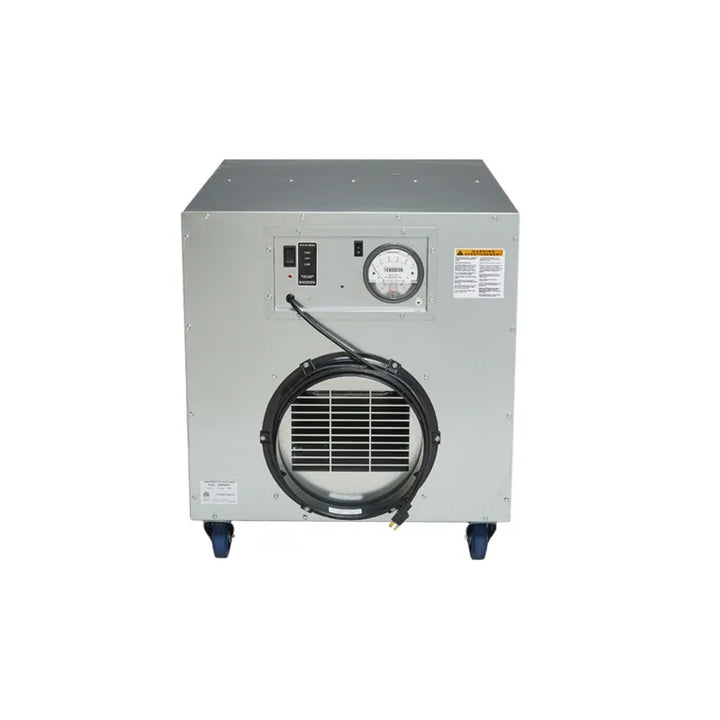
Ebac DD400-P Portable Commercial Desiccant Dehumidifier 10640RG-US
$5,236
Listed with a lowest operating temperature of -4°F, 197 CFM, 71.5 pints per day at 27°C (80.6°F) and 60% RH per Ebac's DD400-P brochure, 68 lb. Ebac's DD400-P brochure lists 220 V, single phase, 8 A, so it needs a 220 to 240 V outlet, not a standard 120 V one. Check the plug before the job.
Ebac's manual for the related DD400 model asks for filters to be checked at least once a month and says never to run the unit without them. It has an overheat protector with a manual reset if the ambient exceeds 40°C. Read desiccant vs refrigerant dehumidifiers to decide between the two types, and see desiccant dehumidifiers if a cold space is your problem.
Small home units
The same checks apply: room humidity against the setting, then the filter, the coil and the water path. The water path is the bucket being seated and not full, or the drain hose being clear. Check the manual for the model, because lowest operating temperatures vary.
Common mistakes
- Running a refrigerant unit in a room below its rated temperature and calling it faulty.
- Setting the humidistat above the room's reading and wondering why it never runs.
- Applying heat to remove ice.
- Restarting straight after cutting the power.
- Leaving a kinked or high-looped hose, so water backs up.
- Comparing pints per day from different conditions.
- Opening the sealed circuit without a certified technician.
When the real fix is a different machine
If the space is cold, a refrigerant unit will ice or idle and a desiccant is the better tool. If the job is restoration drying where you need low humidity in warm and cool conditions, an LGR unit is built for it. Browse LGR dehumidifiers and see dehumidifiers for water damage for how many you need. If the space is a garage, the best dehumidifier for a garage covers cold, dusty rooms. For running costs once it works, read how much it costs to run a dehumidifier.
Frequently asked questions
Why is my dehumidifier running but not collecting water?
Usually the air is already at the setpoint, the air is too cold or airflow is restricted by a dirty filter, a dirty coil or ice. Less often the water goes down a pump hose or the refrigerant circuit has a fault. Measure the inlet and outlet dew point to tell which.
Will my dehumidifier ever stop collecting water?
Yes. Once the room reaches the humidistat setting, the unit cycles down and stops collecting. That is normal, not a fault.
Can a dehumidifier work without collecting water?
Yes. A desiccant dehumidifier sends the moisture out as warm, moist air through a duct, so it fills no bucket and has no drain. A refrigerant unit that is working always produces condensate somewhere, a bucket, a hose or a pump.
What usually goes wrong with a dehumidifier?
The common ones are a dirty filter or coil, blocked airflow, ice on the coil, a kinked drain hose and a failed pump or float switch. The CD100 and DD400 manuals list these in their troubleshooting tables. Refrigerant loss and compressor faults are the ones that need a technician.
How do I reset a dehumidifier?
Switch it off, unplug it, wait at least three minutes (Ebac's CD100 manual), then restart and check the setpoint. A desiccant DD400 has a red manual-reset overheat button inside, per Ebac's DD400 manual.
Why is my humidifier running but no water?
A humidifier is a different appliance that adds moisture to the air, so it works from a water tank. If your problem is a dehumidifier, use this guide. If it is a humidifier, check the maker's manual.
How much water should a dehumidifier collect in 24 hours?
It depends on the air. A rating is a ceiling at stated conditions, such as 90 pints a day at AHAM (80°F, 60% RH) for the Storm Ultra. A drier or cooler room gives less. See the sizing guide for how conditions change the figure.
When the fix is a different machine
Related guides
- Dehumidifier Maintenance: How to Clean the Filter, Coils, Pump and Drain Line
- How Does a Dehumidifier Work? Refrigerant, LGR and Desiccant Explained
- What Is a Desiccant Dehumidifier? Desiccant vs Refrigerant and When to Use Each
- Best Dehumidifier for a Garage: Picks for Cold, Dusty and Unheated Garages