
How we made this guide: picks, prices and specs come from our catalog and the makers' published specs, owner quotes come from customer reviews on our product pages and every guide is checked and edited by Trevor Hall.
The EPA's mold and moisture guide for homes says to keep indoor relative humidity below 60 percent if possible, ideally 30 to 50 percent. Most crawl space targets start from that range. One number is not enough, though. What matters is whether the air touching the joists, ducts and ground cover stays above its dew point, and how much moisture the framing wood itself holds.
Quick answer
Aim to keep the crawl space air below 60 percent and ideally near 50 percent (AlorAir's HD55 manual suggests a typical setpoint of 50 to 55 percent), check it with a logger across a week of weather, then spot-check joists with a pin meter. If readings stay high, pick the fix that matches the cause: seal and dehumidify, add a powered vent fan where it suits or repair a water source first. A handheld hygro-thermometer with a NIST certificate, the Extech 445580-NIST, costs $172.49 and a crawl space dehumidifier in our range starts under $500.
What your humidity reading means
Readings are taken in the air, not in the wood, so treat them as a prompt to look closer. The bands below use the EPA's home guidance as the anchor and the actions are ours.
| Reading | How it compares with the EPA guidance | What to do |
|---|---|---|
| Under 30% | Below the EPA's ideal range | Check the sensor against a second meter before you act |
| 30 to 50% | Inside the EPA's ideal range | Keep logging; watch for summer peaks |
| 50 to 60% | Under the EPA's upper limit | Acceptable, but see if the weekly high climbs past 60 |
| 60 to 70% | Above the EPA's limit of 60 percent | Look for open vents, bare soil and damp spots; plan a dehumidifier |
| 70 to 90% | Well above the guidance | Find the water source first, then seal and dehumidify |
| Over 90% | Close to saturated air | Look for liquid water, plumbing leaks or standing water before buying equipment |
Is 60 percent too high for a crawl space?
It sits right at the EPA's stated upper limit for homes, so a crawl space that reads 60 percent on average has no margin left. A reading that only touches 60 on the wettest days is different from one that sits there for weeks. Look at the weekly log, not a single visit.
Why the number alone is not enough
Relative humidity changes with temperature, so the same moisture in the air reads high in a cool space and low in a warm one. The figure that tells you whether water will condense is the dew point: the temperature at which the air is fully saturated. If a joist, duct or pipe is colder than the air's dew point, moisture collects on it even when the room reading looks moderate.
The examples below use the Magnus approximation. These figures are our calculation, not a measurement. The psychrometric chart guide shows how to read the same values off a chart.
| Air temperature | Relative humidity | Dew point (our calculation) |
|---|---|---|
| 80°F | 70% | about 69°F |
| 75°F | 80% | about 68°F |
| 75°F | 60% | about 60°F |
| 70°F | 50% | about 50°F |
| 50°F | 80% | about 44°F |
Summer vs winter in a crawl space
A vented crawl space takes on whatever the outdoor air is doing. That is why the same space can read fine in January and poorly in August.
| Season | What the air does | What to watch |
|---|---|---|
| Humid summer, vented space | Outdoor air at 80°F and 70% RH has a dew point near 69°F (our calculation). Any surface cooler than that, such as a cold duct or pipe, can collect condensation. | Weekly peaks in the logger, sweating on ducts, damp insulation |
| Mild spring and fall | Warm, damp days followed by cool nights can drop joists, ducts and pipes below the air's dew point overnight. | Daily swings between the morning and afternoon readings |
| Winter | Cold outdoor air carries little moisture. At 50°F and 80% RH its dew point is about 44°F (our calculation). | A reading that stays high in winter points your search toward liquid water sources rather than humid outside air |
The full comparison of open, closed and sealed layouts is in our venting guide. In short, a vent that lets in 80°F air with a dew point near 69°F adds moisture to any duct, pipe or joist cooler than 69°F; compare your own summer logs before you decide.
How and where to measure
A single reading on a dry afternoon tells you little. Use a recording meter and a second instrument to cross-check it.
- Place a data logger near the middle of the crawl space, a short way above the ground cover and away from a dehumidifier's exhaust.
- Log across at least a week that includes warm, humid weather if you can.
- Walk the space with a handheld hygro-thermometer and compare it to the logger at a few spots.
- Spot-check joists and the sill with a pin meter, since air readings do not show what the wood holds.

Logger
Extech SD700 Barometric Pressure Humidity Temperature Data Logger
$340.99
Logs RH, temperature and barometric pressure to an SD card in Excel format, at intervals you set from 5 to 600 seconds.
The Extech SD700 lists a temperature range of 32 to 122°F. If your crawl space falls below freezing in winter, the unit is outside its listed range, so run it in the warmer part of the year or move it to a protected spot.

Handheld check
Extech 445580-NIST Mini Hygro-Thermometer 14 to 122°F
$172.49
A pen-style hygro-thermometer for spot checks; 10% to 90% RH and 14 to 122°F, with a NIST certificate.
Checking the wood
Damp air does wet framing over time. By the Wood Handbook's equilibrium moisture content table, wood kept near 70°F settles at about 16 percent moisture content at 80 percent RH and about 20 percent at 90 percent RH. The USDA Forest Products Laboratory's Wood Handbook says serious decay occurs only when wood moisture content is above the fiber saturation point, which averages about 30 percent. It also notes that fully air-dried wood usually does not exceed 20 percent, which gives a reasonable margin of safety. Read pin meter figures against the species and temperature corrections in the meter's own manual. Our moisture meter readings chart and the pin vs pinless guide cover those details.


Moisture meter with camera
FLIR MR277 Moisture Meter with MSX Infrared Camera and Hygrometer for Building Inspections
$1,609
Combines pin and pinless moisture checks with a 160 x 120 thermal camera and a hygrometer. One of our best-selling moisture meters.
Browse every moisture meter we carry or the full Extech range for loggers and hygro-thermometers.
Fix it: which option fits
Match the fix to the cause you found. Doing the dehumidifier step before a water source is repaired means the unit fights a leak.
| What you found | Fix | Notes |
|---|---|---|
| Liquid water, a plumbing leak or poor drainage | Repair the water source first | Dry the area before any humidity work; see crawl space mold remediation if growth is present |
| Bare soil, open vents and humid summer readings | Seal the space and dehumidify | Ground cover, closed vents and a dehumidifier sized to the floor area; see crawl space encapsulation |
| Moderate readings, no standing water, a space that vents well | A powered vent fan where it suits | Compare your summer dew point before relying on outdoor air; browse crawl space ventilation fans |
| Readings high only after storms | Check grading, gutters and downspouts | Then re-log for a week |
The building code option
Section R408.3 of the International Residential Code allows an unvented crawl space to go without ventilation openings if it meets a list of conditions. One condition is a continuous Class I vapor retarder over bare earth, lapped 6 inches at the joints and sealed or taped. Another is a moisture control method, and dehumidification is one choice. The 2021 and 2024 editions tie the dehumidifier size to the manufacturer's specifications. Some older adopted codes set a rate instead. The 2018 Virginia Residential Code names 70 pints a day per 1,000 square feet of crawl space floor and states no test condition. Adoption and local amendments differ, so ask your building department which edition it enforces. This is not legal advice. Our crawl space encapsulation guide lists the other code options.
Whichever wording applies, compare machines at the same test condition, since a pint figure at one condition is not the same as at another. Our dehumidifier sizing guide explains AHAM and saturation ratings, and how a dehumidifier works covers the machines.
Dehumidifiers for the sealed crawl space
Once the space is sealed, a dehumidifier holds the target. The two below are crawl space models in our range; our crawl space dehumidifier picks compare more of them by size, height and drainage.

Crawl space dehumidifier
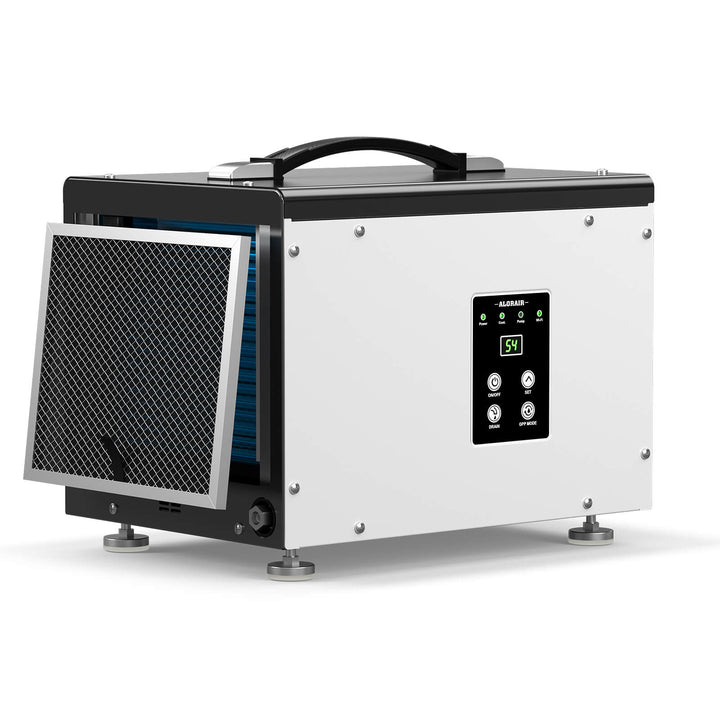
AlorAir Sentinel HD55 53-Pint Crawl Space Dehumidifier
From $587.48
53 pints a day at AHAM and 113 at saturation; Standard and WiFi versions are priced apart.
Starting at $587.48, the AlorAir Sentinel HD55 is listed at 53 pints a day under the AHAM test (80°F, 60% RH) and 113 pints a day at saturation (90°F, 90% RH). It lists 120 CFM, a 4.0 A draw on a grounded GFCI 15 A circuit, a 44 lb body and coverage up to 1,200 square feet as AlorAir lists it. The listed operating range is 33.8 to 104°F. AlorAir's manual gives a setpoint range of 35% to 90%, and a continuous mode runs the unit regardless of the setpoint.
AlorAir's manual says to seal the space with a vapor barrier and seal the vents if the unit goes in a crawl space. It also says not to set the unit directly on the barrier, so use blocks or a paver. For the setpoint, the manual says typically 50 to 55 percent. Our crawl space dehumidifier installation guide covers placement and drainage.
The HD55 drains by gravity, so the drain line must run downhill. The HD55/HD55S manual from AlorAir lists tiered limited coverage from the purchase date: one year for parts and labor overall, three years of labor and parts on the refrigeration system alone and five years of parts only on that system. The filter is MERV-1.

Compact option
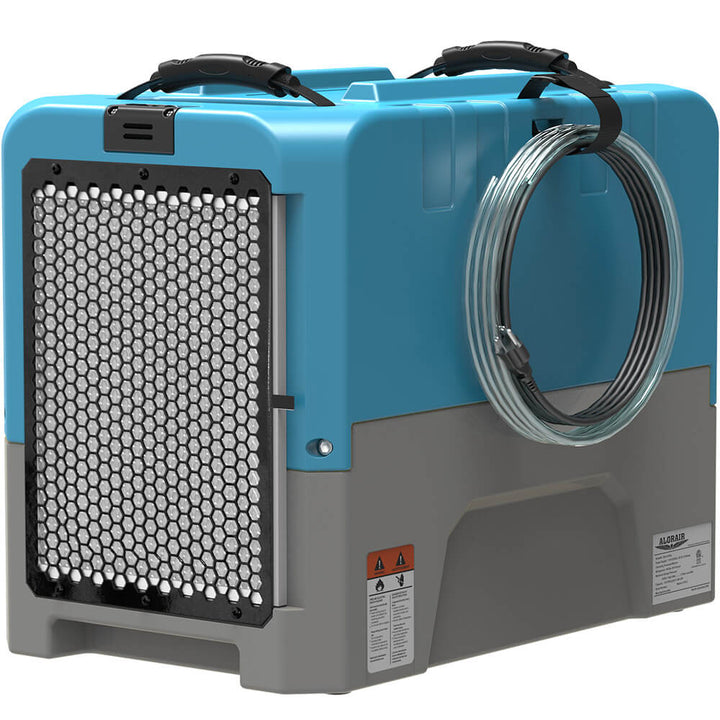
Ebac CD30-S Series Industrial Dehumidifier
From $1,207
A 12 inch tall unit listed for 400 sq ft; CD30-S and CD30-SE are priced apart.
The Ebac CD30-S Series starts at $1,207. Ebac's brochure lists a typical 24 pints a day at 80°F and 60% RH, a 33°F minimum operating temperature and 47 dBA. The same brochure gives 15 pints a day at 65°F and 60% RH, a reminder that any unit removes less water in a cool crawl space than its 80°F rating. It uses hot gas defrost for low ambient temperatures and drains by gravity. Ebac's brochure gives an effective volume of 3,000 cubic feet, about 400 sq ft at a 7.5 ft height (our calculation). The CD30-SE adds an hours run meter and an adjustable alarm humidistat with a remote alarm connector, which suits sites where the space is monitored. Browse the full range of crawl space dehumidifiers and see dehumidifier maintenance for filter and coil care.
Quick comparison of the tools in this guide
| Tool | Job | Price | Listed spec |
|---|---|---|---|
| Extech SD700 | Week-long logging | $340.99 | 5 to 600 second intervals; 32 to 122°F |
| Extech 445580-NIST | Handheld spot checks | $172.49 | 10% to 90% RH; 14 to 122°F |
| FLIR MR277 | Wood and thermal survey | $1,609 | 160 x 120 thermal; pin and pinless |
| AlorAir Sentinel HD55 | Hold the target | from $587.48 | 53 pints/day AHAM; 33.8 to 104°F |
| Ebac CD30-S | Compact unit | from $1,207 | 24 pints/day at 80°F and 60% RH; 33°F minimum |
Getting more from the setup
- Keep the logger running after the dehumidifier goes in, so you see the weekly peaks and know the setpoint is holding.
- Check the drain path and the filter on a schedule; a blocked line stops the unit from removing water.
- Recheck after a heavy rain or a plumbing job, when readings are most likely to move.
- Run costs depend on watts and hours; see how much a dehumidifier costs to run.
Frequently asked questions
Is 60% humidity too high for a crawl space?
It sits at the EPA's upper limit for homes, so there is no margin. Check the weekly log: a brief touch is different from weeks at 60 percent or above. If it stays there, find the source and plan to seal and dehumidify.
Do I really need a dehumidifier in my crawl space?
Not always. If the space is dry, the logger holds at or below your target and no water source is present, you may not. If readings sit above 60 percent in summer after the leaks are fixed, a dehumidifier in a sealed space is the usual next step.
Is 50% humidity too high for a basement?
Fifty percent is inside the EPA's ideal range of 30 to 50 percent. Our basement humidity guide covers the target and how to hold it.
Why is my crawl space humidity so high?
Common sources to check are standing or seeping water, bare soil without ground cover, open vents in humid weather and plumbing leaks. A logger that shows peaks in summer points to humid outside air; one that stays high in winter points to liquid water.
Will a fan in a crawl space help with humidity?
Only when the outdoor air is drier than the crawl space air. In humid summer weather, a vent fan can pull in air whose dew point is above the temperature of the ducts and joists, which adds moisture. Compare logged dew points before you rely on one, and see crawl space ventilation fans and our venting guide.
How do you dry out a wet crawl space?
Stop the water and remove standing water first, then dry it with air movers and a restoration dehumidifier. A crawl space unit holds a sealed space at its setpoint and is not built to dry out a flood. See dehumidifiers for water damage.
Should I turn off my crawl space dehumidifier in winter?
Check the lowest operating temperature on your unit: the AlorAir Sentinel HD55 lists 33.8°F and the Ebac CD30-S lists 33°F. Below that the unit is outside its listed range. If the space is cold and the logger reads low, you can pause it; keep logging so you see when readings climb.
What should a crawl space dehumidifier be set to?
AlorAir's HD55 manual says the setpoint is typically 50 to 55 percent. Your own log should decide the final number.
Hold the crawl space at your target
Related guides
- Venting a Crawl Space: Open, Closed or Sealed? What to Use Instead of Vents
- Best Crawl Space Dehumidifiers: Picks by Size, Height and Drainage
- Crawl Space Dehumidifier Installation: Placement, Drainage and Setup Step by Step
- Ideal Basement Humidity Level: The Target, Where to Measure and How to Hold It