How we made this guide: picks, prices and specs come from our catalog and the makers' published specs, owner quotes come from customer reviews on our product pages and the guide was drafted with AI help, then checked and edited by Trevor Hall.
Yes, a dehumidifier helps with mold, because mold needs moisture and the machine holds the air's relative humidity down. The EPA advises holding indoor relative humidity under 60 percent, and says 30 to 50 percent is ideal. A dehumidifier is not a cleaning tool and it does nothing to growth that is already on a surface: that material has to be cleaned or removed and the water source fixed first.
For a damp basement or crawl space, a machine like the AlorAir Sentinel HD35P at $466.11 does the holding part, and a hygro-thermometer such as the Extech 445703 at $46.99 tells you whether it is working.
Quick answer
A dehumidifier is prevention and drying, not cleanup. Fix the leak and start drying. Clean or remove the growth. Keep the dehumidifier running afterward to hold the humidity down. Browse dehumidifiers for mold jobs or all of our dehumidifiers.
What a dehumidifier can and cannot do about mold
Mold grows where there is moisture, and a dehumidifier removes moisture from the air. That is the whole connection, and it is a strong one for prevention. It stops short of cleanup, because the machine works on the air and not on the stained drywall, wood or carpet that already carries growth.
| Question | Dehumidifier | What does the job |
|---|---|---|
| Lower the humidity that mold needs | Yes | The dehumidifier, held at a target you can measure |
| Dry a damp space after the water source is fixed | Yes | The dehumidifier, with air movement where the job calls for it |
| Remove mold already growing on a surface | No | Cleaning or removal of the material |
| Stop a leak or a wet foundation | No | Repair of the water source |
| Capture particles in the air during cleanup | No | A HEPA air scrubber, at the rating its maker gives |
| Show whether the humidity is where you want it | No | A hygro-thermometer or humidity meter |
The EPA's home mold guide says no home can be made free of every spore, so the practical goal is to keep conditions too dry for growth. Wet materials are the real trigger, which is why drying a space and fixing the source come before any equipment choice.
The humidity target and where to measure it
The EPA's guide to mold and moisture sets the ceiling at 60 percent relative humidity indoors and calls 30 to 50 percent ideal. That is the number to build around. Pick a setpoint in that range and hold it. The Sentinel HD35P lets you set 25 to 80 percent in 5 percent steps on the standard model, and the Galaxy 60 sets 35 to 90 percent in 1 percent steps, both as AlorAir lists.
Do not trust the machine's own readout alone. Put a separate meter where the problem is, such as the far corner of a basement or low in a crawl space. Keep the meter away from the dehumidifier's exhaust, which reads drier than the room.
The Extech 445703 reads 10 to 99 percent RH with a listed humidity accuracy of plus or minus 5 percent RH. That matters: a reading of 52 percent could be 47 or 57. If your goal is under 50 percent, aim for a reading of about 45 percent so the meter's error cannot hide a real 50. The psychrometric chart guide explains how the readings relate.

Humidity meter
Extech 445703 Big Digit Hygro-Thermometer with 1 in. Digits on Super Large LCD, 14 to 140°F
$46.99
A low-cost reading of temperature and humidity; its listed accuracy is plus or minus 5 percent RH, so aim a few points under your target.
Sizing shortcut
Match the pints per day rating to the space, and compare ratings only when they share a condition. An AHAM figure (80°F, 60 percent RH) and a saturation figure (90°F, 90 percent RH) are different tests, so a listing that says 35 pints and one that says 70 pints can describe the same machine: the HD35P carries both figures. The HD35P is rated 35 pints a day at AHAM and 70 at saturation. The Galaxy 60 is rated 60 at AHAM and 145 at saturation. Coverage figures, such as the 1,000 sq ft AlorAir lists for the HD35P and the 1,800 sq ft it lists for the Galaxy 60, are AlorAir's own figures; makers do not measure coverage the same way, so do not compare coverage across brands.
For wet or cold spaces, move up a size. The full method, with a chart, is in What Size Dehumidifier Do I Need. If you are choosing between sizes, our 50 pint dehumidifiers are the next place to look. Check whether each listing's pints per day figure is AHAM or saturation before you compare.
| Machine | Price | AHAM pints per day | Saturation pints per day | Drain | Amps | Coverage | Noise | Operating range | Setpoint range | Efficiency | Weight |
|---|---|---|---|---|---|---|---|---|---|---|---|
| AlorAir Sentinel HD35P | from $466.11 | 35 | 70 | Pump up to 19.6 ft, or gravity | 2.9 A | 1,000 sq ft | Under 50 dBA | 33 to 105°F | 25 to 80% in 5% steps | 2.0 L/kWh | 38.18 lb |
| AlorAir Galaxy 60 | $699.66 | 60 | 145 | Gravity only | 4.5 A | 1,800 sq ft | 49 dBA or less | 37.4 to 100.4°F | 35 to 90% in 1% steps | 2.4 L/kWh | 47.5 lb |
Two machines that fit damp spaces
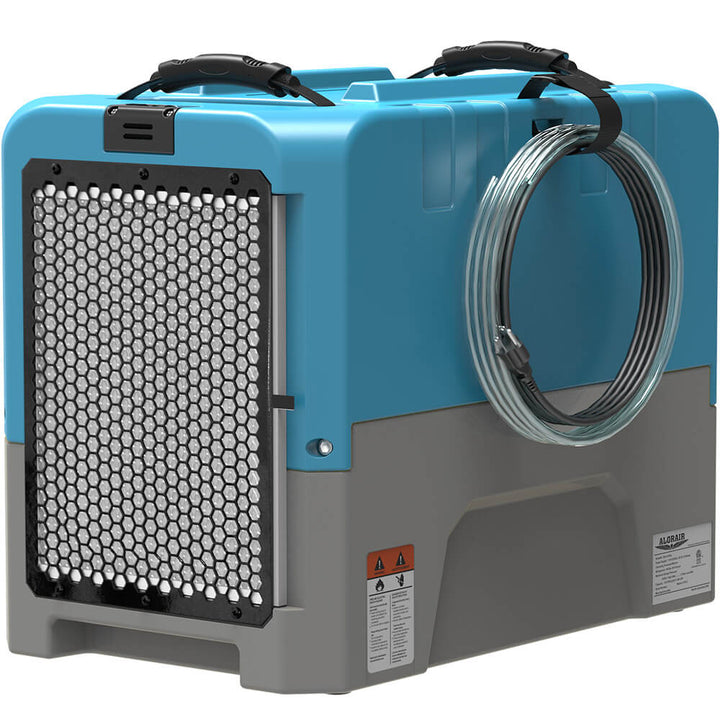
AlorAir Sentinel HD35P: a pump for spaces without a floor drain
The HD35P has a built-in condensate pump with up to 19.6 ft of lift, plus a 6.5 ft gravity hose. It draws 2.9 A on a 115 V circuit, and AlorAir lists a grounded 3-prong GFCI outlet on a 15 A circuit for both the HD35P and the Galaxy 60. AlorAir rates its noise at under 50 dBA. It runs from 33°F to 105°F. It weighs 38.18 lb. Its MERV-1 filter protects the unit and is not a mold filter.

Pump drain
AlorAir Sentinel HD35P 35-Pint Crawl Space Dehumidifier with Pump
From $466.11
35 pints a day at AHAM, with a built-in pump for spaces where gravity drain is not an option.
Skip it if your drain sits below the machine and you want a larger rating: the Galaxy below removes more per day, though it has no pump.
AlorAir Galaxy 60: more capacity, gravity drain only
The Galaxy 60 removes 60 pints a day at AHAM and 145 at saturation. It draws 4.5 A and AlorAir rates it at 49 dBA or less. Its drainage is a 6.5 ft gravity hose with no pump, so it has to sit above a drain or a bucket. It also has a GPP mode, which holds a grains per pound target between 20 and 200 gr/lb instead of a percentage.

More capacity
AlorAir Galaxy 60 60-Pint Crawl Space Dehumidifier
$699.66
60 pints a day at AHAM and a 1% humidity step, but it drains by gravity only.
Skip it if the drain is higher than the machine: the Galaxy 60P at $797.11 is the same machine with a built-in pump.
Where the moisture comes from
Before you buy anything, find out why the space is damp. Common sources are a leak in a pipe or roof, groundwater coming through a foundation wall or floor, bare soil in a crawl space, a clothes dryer vented indoors and warm humid air meeting a cold surface. Each source has its own fix: repair the leak, direct groundwater away, cover bare crawl space soil with a vapor barrier and, as the EPA advises, vent the dryer to the outside. A dehumidifier handles condensation on cold surfaces and the dampness that lingers once those fixes are in. It does not replace them. The EPA's window for drying water-damaged areas and items is 24 to 48 hours. If a space floods or stays wet to the touch, drying equipment and a restoration plan come first, as covered in flooded basement cleanup.
Smell is a clue too. A musty odor with no visible growth usually points to damp materials somewhere close by, such as the back of a wall or the underside of a floor. A humidity reading that stays high day after day, even with a machine running, points the same way: look harder for the source instead of adding capacity.
When to run it
Run it whenever the humidity would otherwise sit above your target. Both machines have a humidistat, so the compressor cycles as the room crosses the setpoint, and a machine that runs a lot on a humid day is doing its job. A machine that never reaches the setpoint is undersized, is drawing in humid outside air through open vents or gaps, is running near the bottom of its temperature range, or the space has an ongoing water source.
Plan the drain before you plan the rest. A pump or a gravity hose avoids emptying a bucket every day. The HD35P ships set to gravity drainage; hold its Drain button for 3 seconds to switch the pump on. In a cool space, check the operating range: the HD35P is listed from 33°F to 105°F and the Galaxy 60 from 37.4°F to 100.4°F. For placement in a crawl space, see crawl space dehumidifier installation and venting a crawl space. Our crawl space dehumidifiers are built for that job.
The real downsides
- Power: the HD35P draws 2.9 A and the Galaxy 60 draws 4.5 A, so run cost adds up over a season. How much it costs to run a dehumidifier works it out.
- Noise: AlorAir lists under 50 dBA for the HD35P and 49 dBA or less for the Galaxy 60, which is quiet for a crawl space but present in a finished room.
- Heat: a refrigerant dehumidifier puts out slightly warmer air than it takes in, because the compressor's energy and the heat released as water condenses stay in the room, so a small closed room warms up while it runs.
- Drainage: the Galaxy 60 needs a drain below it.
- Upkeep: filters and coils need cleaning, covered in dehumidifier maintenance.
- It will not fix the cause: if water keeps coming in, the machine only manages the symptom.
What to do about growth that is already there
Small surface growth on a hard, non-porous material is a cleaning job. Growth on porous material such as drywall, insulation or carpet padding usually means removing the material. For a patch under about 10 square feet (a 3 by 3 foot square), the EPA says a household can usually manage the work. Absorbent items like carpet and ceiling tiles may need to be discarded once moldy. Larger jobs call for containment and trained crews. The steps, from containment to clearance, are laid out in the mold remediation process. Run the dehumidifier throughout so the area stays dry while the work happens and afterward.
What captures airborne particles
A dehumidifier does not filter the air in any way that counts for cleanup. During remediation, a HEPA air scrubber is the machine that moves air through a filter. The AlorAir PureAiro HEPA Pro 870 moves 270 to 550 CFM on variable speed, and its HEPA stage is listed at up to 99.95 percent of particles 0.3 micron and larger. That is below the common 99.97 percent HEPA figure, so treat it as the listing's own rating. It also has a UV-C lamp. Choose it on airflow and filter rating, not on the lamp. Both its 16 in inlet and 8 in outlet can be ducted, so it can also run as a negative air machine; see air scrubber vs negative air machine.

Air scrubber for cleanup
AlorAir PureAiro HEPA Pro 870 Air Scrubber with UV-C Light
$699
270 to 550 CFM; HEPA stage listed at up to 99.95 percent of particles 0.3 micron and larger. It moves air, it does not dry it.
For more on how the two machine types differ, read dehumidifier vs air purifier, what an air scrubber is and what a HEPA filter is. For a full job kit, see mold remediation equipment.
Frequently asked questions
Should I use a dehumidifier if I have mold?
Yes, once the moisture source is found and fixed: run it while the growth is cleaned or removed and keep it running afterward. A dehumidifier then holds the humidity below the level mold needs, which makes regrowth less likely as long as the water source stays fixed. On its own it will not clean mold off a surface. For mold on building materials, read the basement mold remediation steps. For low spaces see crawl space mold remediation.
Does a dehumidifier clear existing mold or airborne spores?
No. A dehumidifier lowers the moisture mold needs to grow, but it leaves growth that is already there in place; that growth has to be cleaned or removed. During cleanup, a HEPA air scrubber captures airborne particles at its filter's rating. The EPA notes that some mold spores are always present indoors, so the lasting fix is removing the growth and the water source behind it.
Is it bad to run a dehumidifier all night?
No. With a humidistat setting, the machine cycles on and off as the humidity crosses your setpoint, which is how it is designed to run. Check the drain and the operating range in the manual, and set a target between 35 and 50 percent (the Galaxy 60's lowest setpoint is 35 percent). In a bedroom, noise is the main issue: AlorAir lists these crawl space units at about 50 dBA.
What are the disadvantages of a dehumidifier?
Expect electricity use, fan noise, a drain to plan and filters and coils to keep clean, all covered above. It also cannot repair a leak. If you have health questions about mold in your home, ask a doctor: this post only covers humidity and equipment.
Control the humidity