How we made this guide: picks, prices and specs come from our catalog and the makers' published specs, owner quotes come from customer reviews on our product pages and every guide is checked and edited by Trevor Hall.
Carpet that got wet in the last 24 to 48 hours and shows no mold can usually be saved: pull the water out, lift it off the pad if needed and dry it fast. Saving wet carpet is a one-person job plus 3 to 5 days of drying and meter checks. Removing moldy carpet and pad is a dusty half-day to day of work before the subfloor dries.
Once growth shows on the carpet or the pad, the answer changes. Both soak up water like a sponge, and the EPA's home cleanup page warns that carpet "may have to be thrown away if they become moldy." Below you will find a table to tell which case you have, then the steps for each one. For the save-it route you need an extractor or pump, a dehumidifier and a moisture meter. For the remove-it route you need containment, a HEPA vacuum and often a negative air machine. A 24-gallon pumper such as the Sandia Sniper 80-6001 runs $2,892, an Ebac Triton dehumidifier $2,200 and a FLIR MR160 moisture meter $679.
Quick answer
Wet under 48 hours and clean: extract, dry, confirm dry with a meter. Visible growth on the carpet or pad: cut it out, bag it and replace it. No spray makes moldy pad safe to keep. For a full containment job, follow our mold remediation process.
What the EPA says, in plain words
Four points matter for carpet.
- Time: the EPA says to "dry water-damaged areas and items within 24-48 hours to prevent mold growth," and that wet materials dried inside that window usually stay free of growth.
- Porous materials: "Mold can grow on or fill in the empty spaces and crevices of porous materials, so the mold may be difficult or impossible to remove completely."
- Size: for a moldy patch smaller than roughly a 3 ft by 3 ft patch, about 10 square feet, the EPA says you can usually do the cleanup yourself.
- Small patches: for growth under about 10 square feet from clean water, the EPA's commercial guide lists wet vacuuming the carpet, drying it completely and then HEPA vacuuming it. It adds discarding only for larger areas, and notes that some spores and fragments stay in porous material and do not grow only if it is completely dried.
The EPA's guide for schools and commercial buildings has a row for carpet and backing: "dry within 24-48 hours," by removing the water with a water extraction vacuum, reducing humidity with a dehumidifier and speeding drying with fans. It adds that the subfloor under the carpet must also be cleaned and dried. After 48 hours, or once growth has appeared, that guide sends you to its remediation table instead.
The professional standard for mold work is ANSI/IICRC S520. Ask a remediator whether they work to it.
Clean it or remove it: the decision table
Check every row. If more than one matches your carpet, follow the most cautious answer.
| What you have | Wet for | Visible growth | Pad | Decision |
|---|---|---|---|---|
| Clean water from a leak or overflow | Under 24 hours | None | Damp | Save it. Extract now, then dehumidify and run air movers. |
| Clean water from a leak or overflow | 24 to 48 hours | None | Soaked | Probably save it. Lift the carpet, extract the pad or replace it, dry the subfloor and check with a meter. |
| Clean water | Over 48 hours | None seen | Soaked | Inspect under the carpet first. The EPA guide treats this as a remediation question, so expect to replace the pad. |
| Any | Any | Spots on the carpet face or backing | Any | Remove it. Porous material with growth is the case the EPA says may have to be thrown away. |
| Any | Any | None on top, spots or a musty smell on the pad | Moldy | Replace the pad. Whether the carpet itself is worth reinstalling depends on whether its backing is clean. |
| Sewage or flood water | Any | Any | Any | Call a restoration company. See Category 3 water damage and sewage backup cleanup. |
| Any | Any | More than about 10 square feet | Any | Hire a remediator, or follow the EPA's guide for schools and commercial buildings, which the EPA points to for jobs this size. |
Two cautions. First, color does not tell you how serious a patch is, so treat every patch the same way. Second, if the room has been wet for days and you cannot see growth, look at the underside of the carpet and the top of the pad before you decide. The EPA lists "the underside of carpets and pads" as a place hidden mold shows up.
Tools you need
Match the tools to the route. Many households only need the save-it list, and a rental extractor will cover it. If you clean carpet for a living, these are the machines in our range that fit each step.
| Step | Tool | Price | Spec that matters |
|---|---|---|---|
| Pump out standing water | Sandia Sniper 24-gallon flood pumper 80-6001 | $2,892 | 24 gal tank, 25 ft hose, 14.3 A on 115 V |
| Dry the room | Ebac Triton 11393GR-US | $2,200 | 52 pints a day, internal pump, 25.5 ft drain hose |
| Find wet pad and subfloor, confirm dry | FLIR MR160 moisture meter | $679 | Pinless sensor plus pin probe, 80 x 60 thermal image |
| Hold the work area under negative air | Abatement Technologies HEPA-AIRE H2KM | $1,070 | 2,000 CFM high, 1,300 CFM low, 15 A circuit |
| Vacuum the subfloor and tack strip | Novatek 3.3 gal HEPA backpack vacuum | from $2,125 | 3 gal bag, 4 stage filtration ending in a HEPA filter |
For a wider kit, see our list of mold remediation equipment by job size.
Save-it route: step by step
Use this when the carpet has been wet for less than about 48 hours, the water was clean and you see no growth. Speed matters more than any product.
Step 1: Stop the water and take photos
Fix the source first. Photograph the wet area and the date, because an insurer may ask for both later. Open the room and move furniture off the carpet. Put foil or blocks under the legs of furniture you cannot move.
Step 2: Extract the water
Remove water from the carpet with a water extraction vacuum. The EPA's carpet row starts with exactly this step. For standing water, a flood pumper clears the surface first. The Sandia Sniper 80-6001 holds 24 gallons, comes with a 25 ft hose and a 25 ft cord and draws 14.3 A on 115 V through a NEMA 5-15P plug. Sandia's owner's manual says to plug it only into a properly grounded outlet using the supplied 25 ft 12/3 cord.

Pump out standing water
Sandia Sniper 24-Gallon 2-Stage Flood Pumper - 80-6001
$2,892
For a flooded room. Once the surface water is gone, finish the carpet itself with an extractor and wand.
Damp carpet without standing water does not need a pumper. A portable extractor and a few slow passes do the job. Our carpet cleaning machine guide covers the passes, and the wet carpet drying guide goes deeper on the whole save-it sequence.
Step 3: Lift the carpet and handle the pad
If the pad is soaked, drying the carpet face alone will not work, because the pad holds the water. Pull the carpet back from a corner, lift it off the tack strip along one wall and check the pad underneath. Many installers replace a soaked pad, since it is inexpensive next to the labor of drying it. Dry the subfloor either way. The EPA is explicit that the subfloor under carpet must also be cleaned and dried.
Step 4: Dehumidify and move air
Close the room and run a dehumidifier with air movers across the damp areas. The EPA's commercial guide warns not to use fans until you know the water was clean. The Ebac Triton is listed at 52 pints a day with no test condition given, so do not set that number beside an AHAM rating from another machine. It has an internal condensate pump with a 25.5 ft drain hose, and Ebac lists coverage of up to 800 square feet. Its warranty is 1 year unconditional and 3 years on the compressor, condenser and evaporator.

Dry the room
Ebac Triton Professional Series Industrial Dehumidifier 11393GR-US
$2,200
A pump-equipped dehumidifier you can leave running overnight without emptying a bucket.
A dehumidifier helps dry a room. It does not remove mold that is already growing. We explain the limits in does a dehumidifier help with mold, and the air side of drying in air mover vs fan. For the specific units for this job, browse our mold remediation dehumidifiers.
Step 5: Confirm it is dry with a meter
Do not trust your hand or your nose. A carpet can feel dry on top and stay wet underneath. A moisture meter reads the pad and subfloor. The FLIR MR160 pairs a pinless sensor with an external pin probe and shows an 80 x 60 pixel thermal image on a 2.3 inch screen, so you can scan a floor for cooler patches, which often mean evaporating moisture, then confirm each one with a reading.

Confirm it is dry
FLIR MR160 Moisture Meter with IGM Technology
$679
Scan the floor on the thermal image, then take readings at the spots it points to.


Compare readings against a known dry spot in the same room and building material, not against a number you read online. Our moisture meter readings chart explains what the scales mean and the pin vs pinless guide explains the two sensor types. If you are shopping, see all moisture meters we carry.
Step 6: Re-check for 3 to 5 days
Take readings again the next day and a few days after. Rising readings or a returning damp smell mean something is still wet, usually the pad edge, the subfloor or a wall base. Our carpet odor guide covers a smell that outlasts the water.
Remove-it route: step by step
Use this when you can see growth on the carpet or backing, or when the pad is moldy. For more than about 10 square feet, or any job in a business, bring in a remediator or follow the EPA's commercial guidance. Our full mold remediation sequence covers containment and clearance in detail, and we keep the carpet specifics here.
Step 1: Contain the area
Seal the room doors with plastic sheeting, shut the HVAC register in that room and keep people and pets out. On a larger job, a negative air machine pulls room air through its HEPA filter and exhausts it. When the work area is sealed and the exhaust goes outside, that holds the room at lower pressure than the rest of the building. Our negative pressure room guide explains the setup and our air scrubber vs negative air machine post covers the difference between the two boxes.
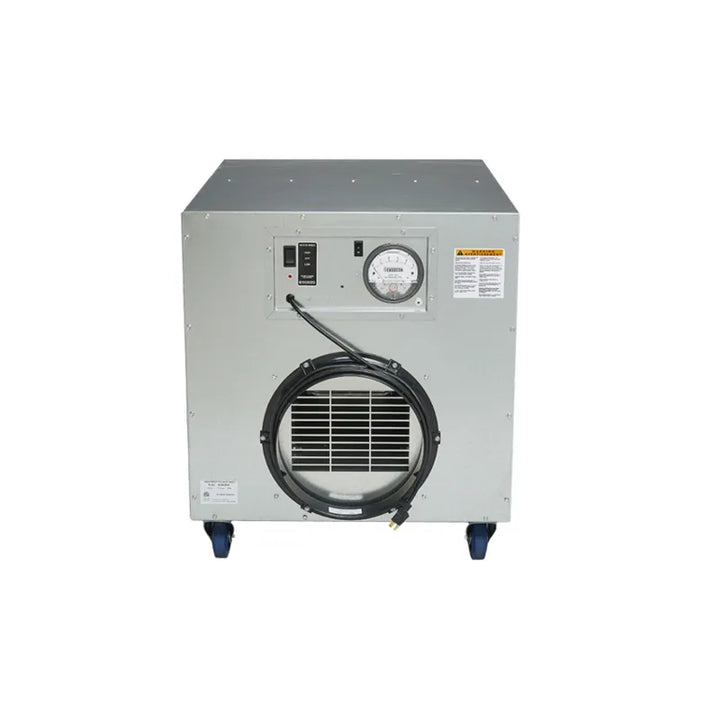
The HEPA-AIRE H2KM runs at two fan speeds. The listing gives 2,000 CFM for high and 1,300 CFM for low. Its standard filter is a 6 inch deep HEPA that the maker rates at 99.97% at 0.3 micron, and a 12 inch filter is an option. It runs on a 115 to 120 volt, 15 amp circuit, weighs 124 lb with the 6 inch filter and measures 35.75 x 26 x 30.25 inches. It is the best-selling negative air machine in our range.

Negative air for a sealed work area
Abatement Technologies HEPA-AIRE Series Negative Air Machine H2KM
$1,070
For larger removals where you seal the room and exhaust the air outside.

The HEPA rating describes how the filter captures particles at that size. It does not make a room safe by itself. Browse more negative air machines if you need a smaller unit.
Step 2: Wear protection
Put on a respirator, gloves, eye protection and disposable coveralls before you disturb the carpet. For a patch under about 10 square feet, the EPA lists gloves, goggles and an N-95 respirator as the minimum. Larger jobs call for more, which a remediator will set. If you have health concerns, consult a health professional before starting cleanup.
Step 3: Mist, cut and roll
Remediators commonly mist the surface lightly with plain water first, so dust stays down when the material moves. Cut the carpet into strips you can roll, and work toward the door so you do not walk back across cut material. Roll each piece with the moldy side inward, which is usually the backing, and wrap it in plastic before it leaves the room. Cut the pad the same way. Never drag unwrapped pieces through the rest of the house.
Step 4: Wrap, seal and bag
Wrap each roll in 6 mil plastic, tape the seam, then bag or wrap it a second time before it leaves the room. The EPA's commercial guide says to seal removed material in plastic bags while still inside containment and dispose of it as normal waste. Check your local hauler's rules too.
Step 5: HEPA vacuum the subfloor and tack strip
Vacuum the bare subfloor, tack strip and baseboard edges with a HEPA vacuum. A regular shop vac exhausts fine particles back into the room, which is the reason pros use a HEPA unit for this step. The Novatek 3.3 gallon HEPA backpack vacuum has a 3 gallon collection bag and a four stage filter system that ends in what Novatek states is a tested and certified HEPA filter. It comes in an electric version (110 CFM, 110 inches of water lift, 11 A on 120 V) and an air version that draws 50 cfm at 90 psi and moves 170 CFM at 160 inches of lift. The electric model is the lower-priced of the two.

HEPA vacuum for the subfloor
Novatek 3.3 Gal HEPA Backpack Vacuum, Air or Electric
From $2,125
Carried on your back, so you can work on stairs and in tight rooms. Choose electric or air.
See the full range of HEPA vacuums and read what a HEPA vacuum is to understand sealed systems. For the rules on lead, asbestos and mold vacuuming, see HEPA vacuums for asbestos, lead and mold.
Step 6: Dry the subfloor and check for the source
The subfloor must be dry before you lay new pad. Run the dehumidifier and meter the subfloor, then fix whatever caused the water. Mold that returns after a dry spell usually means the cause is still there. Wipe hard surfaces such as the baseboard with detergent and water and dry them completely. The EPA's cleanup page says to scrub mold off hard surfaces that way.
Step 7: Re-check, then re-lay
Meter the subfloor again after several days. Install new pad and carpet only after readings match a known dry spot and the smell is gone. For the clearance step on a larger job, our remediation process guide explains what a remediator checks before you rebuild.
When to call a remediator
Hire a professional when any of these is true:
- The moldy area is more than about 10 square feet, the line the EPA draws for a do-it-yourself job.
- The water was sewage or flood water. See our Category 3 guide.
- Mold has spread into walls, the HVAC system or the subfloor.
- You or someone in the home has a health condition that mold could aggravate. Ask a doctor, not a product page.
- An insurer or a landlord needs a written report.
The EPA's commercial guide also says that professional help may be needed to dry an area quickly and thoroughly, depending on its size and your resources. If you run a restoration business, the basement mold remediation guide and the water damage restoration process show the full workflow.
Common mistakes
| Mistake | Why it fails | Do this instead |
|---|---|---|
| Spraying a cleaner on moldy pad and putting the carpet back | The EPA says mold in porous material may be impossible to remove completely | Replace the pad and check the carpet backing |
| Shampooing a carpet that is already wet or musty | It adds more water to something that needs to get dry | Extract, dry, then clean once the carpet is dry. See shampoo vs steam cleaning |
| Covering a damp carpet with a rug or furniture | It slows drying | Move everything off and keep air moving |
| Skipping the meter | A carpet can feel dry on top while the pad or subfloor stays damp | Read the pad and subfloor against a known dry spot |
| Using bleach as a routine fix | The EPA says bleach "is not recommended as a routine practice during mold cleanup" | Remove porous material and clean hard surfaces with detergent and water |
| Mixing cleaning products | The EPA warns never to mix bleach solution with other cleaning solutions | Use one product at a time and ventilate |
| Running a dehumidifier in an open room | It pulls in humid air from the rest of the building | Close the doors and size the unit to the space |
Prevent mold in carpet that gets wet
The prevention plan is the same as the save-it route, and the clock is the EPA's 24 to 48 hours. Keep a simple kit ready if you manage a building where leaks happen: a way to extract water, a dehumidifier with a drain hose and a moisture meter. Our carpet drying time guide explains why carpet stays damp after cleaning and how to speed it up, and the dehumidifiers for water damage post shows how many units a room needs.
For cars and boats, the steps change because the carpet is glued or hard to lift. We cover that in how to get mold out of car carpet.
Area rugs
Rug mold removal starts the same way: lift the rug, dry both sides and dry the floor under it. A valuable or wool rug with growth goes to a rug cleaning specialist, and our wool rug cleaning guide explains what they do. A low-value rug with growth is usually replaced. A mildew smell that stays after the rug and floor are fully dry means it was wet long enough for growth, so treat it as a moldy rug, not a smell problem.
Frequently asked questions
Can carpet with mold be saved?
Sometimes. For a patch under about 10 square feet caused by clean water, the EPA's guide for schools and commercial buildings lists wet vacuuming, then HEPA vacuuming once the carpet is thoroughly dry. Its home page still warns that moldy carpet may need to go, because growth works into the fibers and backing where no tool reaches it all. Carpet that got wet but shows no growth and is dried within 24 to 48 hours has a good chance.
Does vinegar work on mold in carpet?
We do not recommend vinegar or any spray as a fix, and the EPA pages we checked give no recipe for carpet. Even if a spray reached the surface, the pad underneath would still hold the problem. If you can see growth, plan to remove the carpet and pad and clean hard surfaces with detergent and water.
How do you clean black mold out of carpet?
For a small patch from clean water, the EPA's commercial guide lists wet vacuuming, full drying, then HEPA vacuuming once dry. Many pros still replace the pad and any carpet whose backing shows growth, because they cannot confirm what stays in the fibers. Color does not tell you how risky a patch is, so treat every patch by where it is and how large it is. Above about 10 square feet, hire a remediator.
Why does my carpet smell musty after I shampoo it?
Usually because the carpet or the pad is still damp. Shampooing leaves the carpet wet, and slow drying keeps the smell. Extract thoroughly, run air movers plus a dehumidifier and meter the pad. If the smell stays after the carpet is fully dry, the pad or subfloor may be the source. See how to get rid of carpet odor.
Can I remove moldy carpet myself?
In most cases, yes, if the area is under about 10 square feet and the water was clean. The EPA says that in most cases you can handle a job that size yourself. Above that, or with sewage, hire a pro. Wear protection, contain the room, bag the carpet and pad and vacuum the subfloor with a HEPA vacuum.
How fast can mold grow under carpet?
Fast enough that the EPA's drying window is 24 to 48 hours: its guidance says that if wet materials are dried within that time, in most cases mold will not grow. After 48 hours, inspect the underside of the carpet and the pad.
What causes mold on carpet?
Water left in the pad. Common sources are leaks, floods, slow drying after cleaning, damp slabs and high indoor humidity. The carpet face may look fine while the pad and backing stay wet.
What is the best mold carpet cleaner?
No cleaner makes moldy pad safe to keep. For wet carpet, extraction and fast drying matter more than any chemical, so start with a water extraction vacuum, a dehumidifier and a meter.
Dry it fast or remove it safely